- Animals
- ›Chordates
- ›Vertebrates
- ›Ray-finned Fishes
- ›Spiny-rayed fishes
- ›Perches, Scorpionfishes, Sticklebacks, and Allies
- ›Sticklebacks and Allies
- ›Sticklebacks
- ›Pungitius
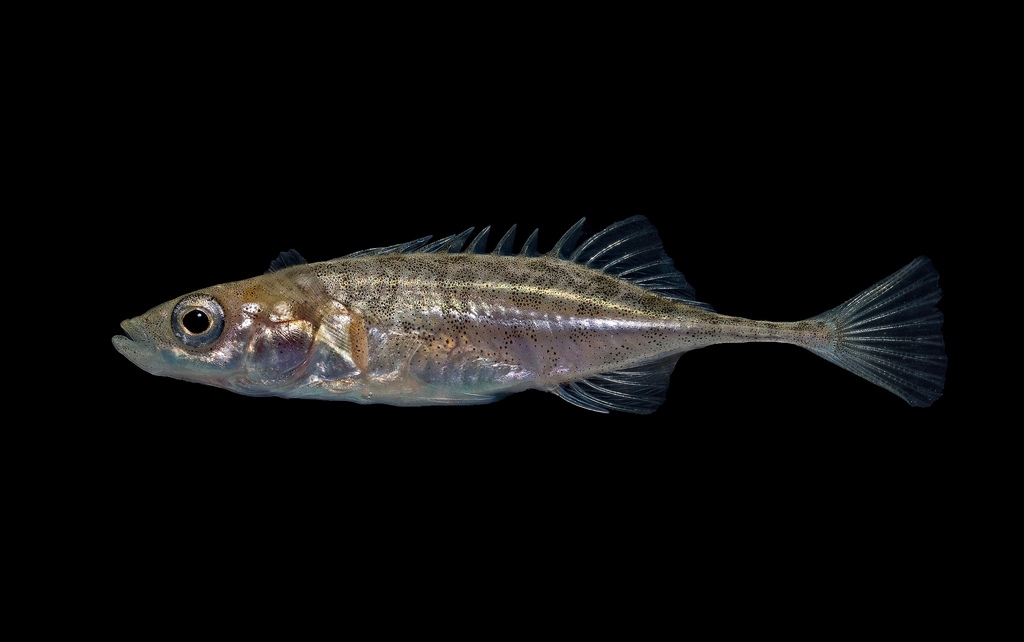
Ninespine Stickleback
Pungitius pungitius
The ninespine stickleback (Pungitius pungitius), also called the ten-spined stickleback, is a freshwater species of fish in the Gasterosteidae family that inhabits temperate waters. It is widely but locally distributed throughout Eurasia and North America. Despite its name, the number of spines can vary from 8 to 12.
From the article Ninespine stickleback on Wikipedia (CC BY-SA), quoted section by section
Description
The ninespine stickleback is a small fish, reaching a maximum size of around 12.5 cm. It reaches an age of about 3 years. The body of the ninespine stickleback tapers to a very narrow caudal peduncle and the caudal fin is fan-shaped. The body is less deep and more elongated than that of the three-spined stickleback with a thinner and longer caudal peduncle, but the best way of distinguishing these two species is the number of spines in front of the dorsal fin which, for this species, varies from seven to twelve although nine is the commonest number. This species does not have scales but there is a group of small bony plates on the narrowest part of the caudal peduncle at the lateral line. The mouth points upwards in this species. It is generally greyish or olive-brown with silvery flanks irregularly barred or blotched with darker colour. During the breeding season, the males develop a black area around the pelvis and the pelvic spines become white. The eyes are dark with a gold ring around the pupils. The ninespine stickleback lives in streams, lakes, ponds and rivers and favors thick submerged vegetation, as its small spines do not offer much protection. …
Range & habitat
The species occurs in freshwater systems draining into the Arctic Ocean and the Atlantic across Canada, Alaska, and south to New Jersey. It is present on the North American Pacific coast of Alaska and in the Great Lakes basin. It can also be found throughout most of Eurasia, including the United Kingdom, Greenland, Turkey and the Far East.
Wikipedia: “Distribution”
What it does
During the breeding season (April to July), the male builds a nest suspended on a piece of waterweed, about an inch or so above the substrate at the bottom. The female is attracted by the male and she lays eggs inside the nest, but then departs, leaving parental care to the male. The male guards these eggs and the young fry when they hatch. Then, when they have their spines, he drives them away to look after themselves.
Wikipedia: “Behaviour”
In human culture
The celebrated British zoologist Desmond Morris (born 1928) published a paper in 1952 — "Homosexuality in the ten-spined stickleback (Pygosteus pungitius L.)." — which became the basis of his 1954 doctoral thesis at Oxford University. (This work was undertaken under the tutelage of the famous ethologist Niko Tinbergen.) Morris described and illustrated the normal reproductive behavior of the stickleback as well as certain "pseudofemale" variants which he thought might be fairly frequent in occurrence. ("These observations reveal that the nervous mechanisms of the sexual behavior pattern of the other sex are present, although they are not normally functional.") Although these findings were considered fairly conventional at the time within his specialty, the topic represented a harbinger of the later controversy that Morris's popular publications would arouse when he extended the findings of the biological sciences to the interpretation of aspects of human behavior. He describes some of his adventures with the fish, and his roomful of aquaria, in his book Animal Days (1979).
Wikipedia: “In culture”
Where it lives
Recorded sightings
—
geo-referenced records in GBIF, from museums, herbaria and field observers.
Drag the globe to turn it. Dots are where records exist, not a range map; darker means more records.
In the stacks
Searching the stacks…
Every page naming Pungitius pungitius in the Biodiversity Heritage Library →
This page is assembled live from iNaturalist, GBIF, Wikipedia, the Source Library and the Internet Archive. It is not yet part of the hand-edited codex. iNaturalist taxon 48399.