- Animals
- ›Chordates
- ›Vertebrates
- ›Mammals
- ›Therians
- ›Placental Mammals
- ›Primates, Rodents, and Allies
- ›Primates
- ›Lemurs, Lorises, and Allies
- ›Lemurs
- ›Lemurs
- ›Sloth Lemurs
- ›Palaeopropithecus
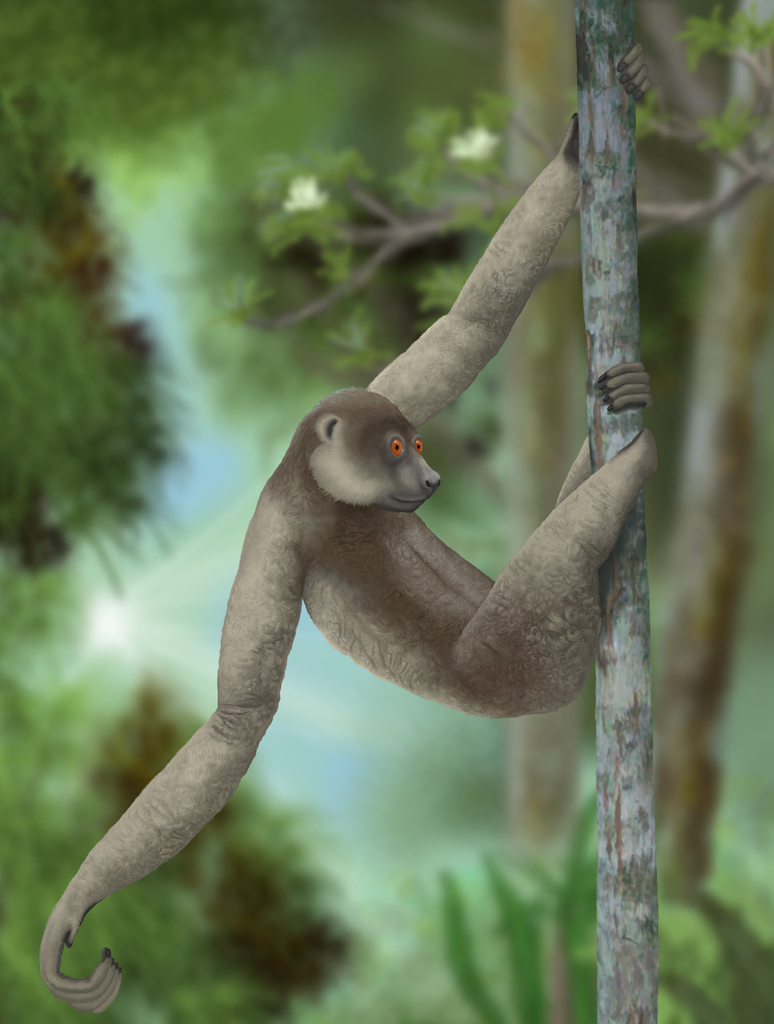
Large Sloth Lemur
Palaeopropithecus ingens
Palaeopropithecus is a recently extinct genus of large sloth lemurs from Madagascar related to living lemur species found there today. Three species are known, Palaeopropithecus ingens, P. maximus, and P. kelyus. Radiocarbon dates indicate that they may have survived until around 1300–1620 CE. Malagasy legends of the tretretretre or tratratratra are thought to refer to P. ingens.
Evidence suggests a solely arboreal lifestyle with frequent upside down suspension, hence the name sloth lemur.
From the article Palaeopropithecus on Wikipedia (CC BY-SA), quoted section by section
Description
Palaeopropithecus primarily lived in the trees to stay away from predators as well as to gain valuable resources. To survive properly in the trees, Palaeopropithecus had long and powerful arms and legs, each with significantly long fingers and toes to allow them to hang upside down on branches. These were used to swing from branch to branch to travel across the jungle of Madagascar. These long arms made it much easier to grab hold of various trees and branches, making travel at the arboreal level easier. Laurie Godrey states in "The Extinct Sloth Lemurs of Madagascar", "Thus, these animals exhibit the odd behavioral combination of being both specialized leapers and adept climbers and hangers." The long arms of Palaeopropithecus had hook like extremities on their hands and feet. This benefited Palaeopropithecus by enabling them to hook their bodies onto the foliage to stabilize themselves as they traversed through the trees. Palaeopropithecus on average weighed between 100 pounds (45 kg)-120 pounds (54 kg). This weight is heavier than most modern lemurs and could potentially have caused the species to fall while hanging on branches, forcing the species to make sufficient use of their long arms and legs to survive. Palaeopropithecus eating habits were different from those of modern lemurs. …
Wikipedia: “Anatomy”
What it does
The Palaeopropithecus species were probably folivorous based on dental morphology, consuming a mixed diet of foliage and fruit to varying degrees. They supplemented their leaf-eating with substantial amounts of seed-predation, much like modern indrids. There is also no molar use wear evidence that Palaeopropithecus relied on terrestrial foods (C4 grasses, tubers, rhizomes). P. ingens faced weaning early on and lost their deciduous teeth early. After a little over a month they learned and were able to forage for solid food much earlier than other lemur species. More than likely P. ingens had to find food for themselves at an early age. The degree to how much of their diet consisted of seeds is somewhat uncertain but because of the pitting of the teeth it is clear they ate seeds. Palaeopropithecus ingens and P. maximus have similar use-wear scars. These were apparently mixed fruit and foliage consumers; neither species appears to have been a hard-object specialist. P. kelyus had smaller teeth than the other two species. Its dental characteristics could be described from the P. kelyus subfossil maxilla fragmentshowing a parastyle and a highly developed mesostyle. …
Wikipedia: “Diet”
Listen
Looking for field recordings…
Where it lives
Recorded sightings
—
geo-referenced records in GBIF, from museums, herbaria and field observers.
Drag the globe to turn it. Dots are where records exist, not a range map; darker means more records.
In the stacks
Searching the stacks…
Every page naming Palaeopropithecus ingens in the Biodiversity Heritage Library →
This page is assembled live from iNaturalist, GBIF, Wikipedia, the Source Library and the Internet Archive. It is not yet part of the hand-edited codex. iNaturalist taxon 74830.