- Animals
- ›Chordates
- ›Vertebrates
- ›Mammals
- ›Therians
- ›Placental Mammals
- ›Ungulates, Carnivorans, and Allies
- ›Carnivorans
- ›Euplerids
- ›Civet-like Euplerids
- ›Cryptoprocta
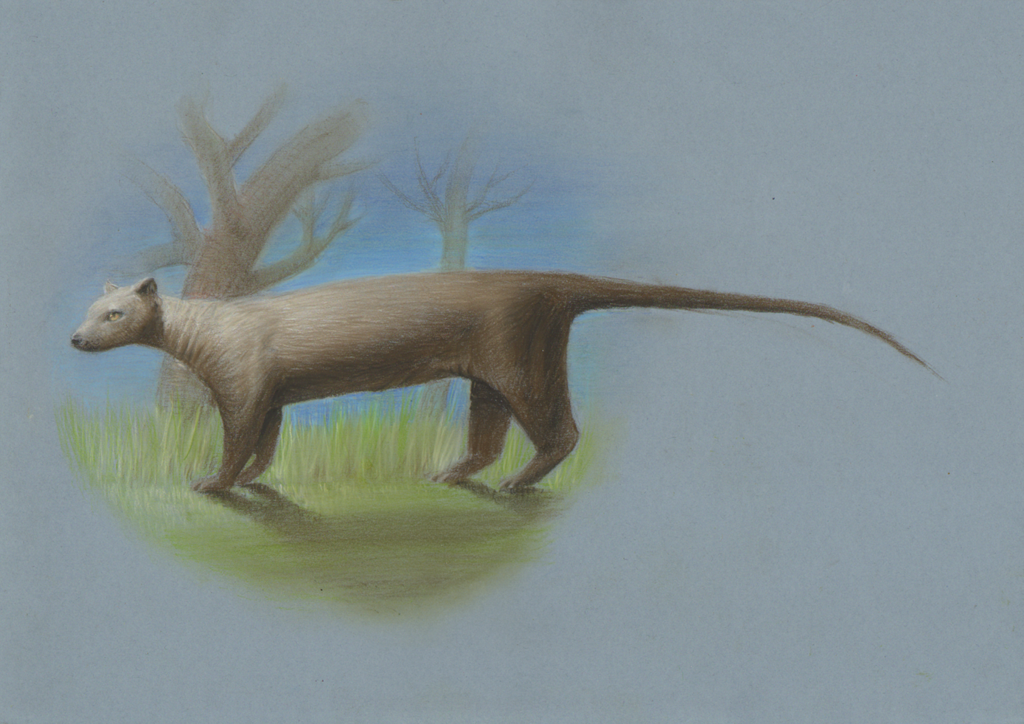
Giant Fosa
Cryptoprocta spelea
Cryptoprocta spelea, also known as the giant fossa or the cave fossa, is an extinct species of carnivore from Madagascar in the family Eupleridae which is most closely related to the mongooses and includes all Malagasy carnivorans.
It was first named in 1902, and was subsequently recognized as a separate species in 1935 from its closest relative, the living fossa (Cryptoprocta ferox). C. spelea was larger than its extant relative but otherwise similar. The two have not always been recognized as distinct species. When and how C. spelea became extinct remains unknown; however, some researchers suggest that the species may have gone extinct much more recently or possibly survived to this day based on anecdotal evidence including reports of unusually large fossas.
From the article Cryptoprocta spelea on Wikipedia (CC BY-SA), quoted section by section
Description
Although some morphological differences between the two fossa species have been described, these may be allometric (growth-related), and in their 1986 Mammalian Species account of the fossa, Michael Köhncke and Klaus Leonhardt wrote that the two were morphologically identical. However, remains of C. spelea are larger than any living C. ferox. Goodman and colleagues found that spelea were 1.07 to 1.32 times as large as in adult C. ferox, and postcranial measurements were 1.19 to 1.37 times as large. The only specimen of C. spelea in which condylobasal length (a measure of total skull length) could be ascertained measured 153.4 mm (6.04 in), compared to a range of 114.5 to 133.3 mm (4.51 to 5.25 in) in adult C. ferox. Humerus (upper arm bone) length in twelve C. spelea is 122.7 to 146.8 mm (4.83 to 5.78 in), averaging 137.9 mm (5.43 in), compared to 108.5 to 127.5 mm (4.27 to 5.02 in), averaging 116.1 mm (4.57 in), in the extant fossa. Body mass estimates for C. spelea varied based on methods of body mass used. Fossil evidence suggests C. spelea had a geographic variation in size as Mitoho specimens were larger than specimens from other localities. Burnes et al. (2001) estimated C. spelea weighed range 17 kg (37 lb) based on an unknown method. Wroe et al. (2004) suggested the species weighed 20 kg (44 lb) based on skull regressions. Meador et al. (2019) estimated C. …
Range & habitat
Subfossil remains of the giant fossa have been found in Holocene cave sites from the northern end of Madagascar along the west coast to the far south, and in the central highlands. The known radiocarbon dated subfossil specimens of C. spelea and modern C. ferox suggest that the two species overlapped in age. The size ratio between the two species is within the range of ratios seen between similar-sized living cats and mongooses found in the same areas, suggesting that the two species may have been able to occur together. With its large size and massive jaws and teeth, C. spelea was a formidable, "puma-like" predator, and in addition to smaller prey it may have eaten some of the big, now extinct subfossil lemurs that would have been too large for C. ferox. This is further supported by bone collagen isotopic values which found evidence niche partitioning between C. spelea and C. ferox. No subfossil evidence has been found to definitively show that lemurs were its prey; this assumption is based on the diet of the smaller, extant species of fossa. Isotopic analysis by Lewis et al. (2026) confirms C. spelea was targeting large-bodied extinct lemurs. Other possible prey include tenrecs, smaller euplerids, and even young Malagasy hippopotamuses. Much like C. ferox, it has been hypothesized that C. spelea may have hunted cooperatively to hunt larger prey. …
Wikipedia: “Distribution and ecology”
Listen
Looking for field recordings…
Where it lives
Recorded sightings
—
geo-referenced records in GBIF, from museums, herbaria and field observers.
Drag the globe to turn it. Dots are where records exist, not a range map; darker means more records.
In the stacks
Searching the stacks…
Every page naming Cryptoprocta spelea in the Biodiversity Heritage Library →
This page is assembled live from iNaturalist, GBIF, Wikipedia, the Source Library and the Internet Archive. It is not yet part of the hand-edited codex. iNaturalist taxon 74231.