- Animals
- ›Chordates
- ›Vertebrates
- ›Birds
- ›Swifts and Hummingbirds
- ›Hummingbirds
- ›Bee Hummingbirds, Emeralds, Mountain-gems, and Allies
- ›Emerald Hummingbirds and Allies
- ›Chlorostilbon
On eBird ↗
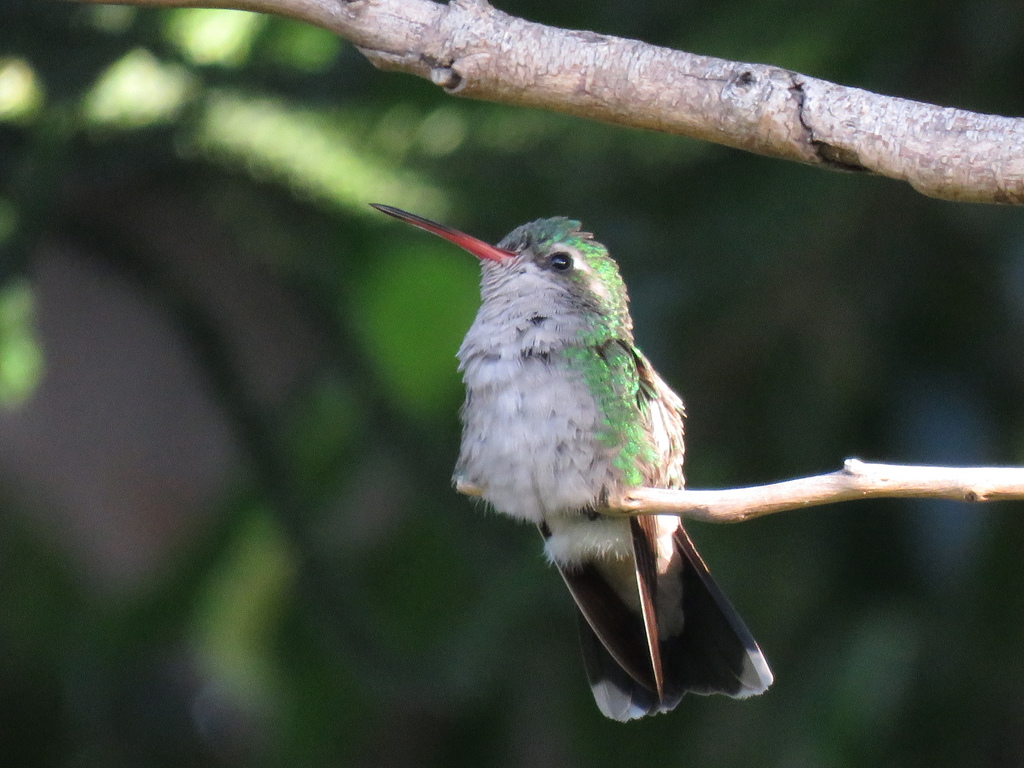
Glittering-bellied Emerald
Live sightings near you, the range map, bar charts of when it is seen, and Macaulay Library photos and recordings.
Glittering-bellied Emerald
Chlorostilbon lucidus
The glittering-bellied emerald (Chlorostilbon lucidus) is a species of hummingbird in the family Trochilidae. It has widely been listed by the scientific name Chlorostilbon aureoventris, but this was shown to be mistaken by J. F. Pacheco and B. M. Whitney in 2006.
From the article Glittering-bellied emerald on Wikipedia (CC BY-SA), quoted section by section
Description
The male glittering-bellied emerald is 9.5 to 10.5 cm (3.7 to 4.1 in) long and weighs 3 to 3.8 g (0.11 to 0.13 oz). Females are 7.5 to 8.5 cm (3.0 to 3.3 in) long and weigh 3 to 4.5 g (0.11 to 0.16 oz). Both sexes have a short straight bill. The male's is red with a black tip; the female's is black on its outer half and red on the inner. Males of the nominate subspecies have a dull bronzy green forehead and crown, slightly golden green upperparts, grass green uppertail coverts, and a slightly forked dark steely blue tail. It has a blue-green throat and upper breast and a bronze to bronzy green belly that is more iridescent than the upperparts. The nominate female's forehead, crown, and upperparts are slightly golden green and its uppertail coverts grass green. The innermost pair of tail feathers have green inner and blue outer halves. The other four pairs are steel blue with gray tips in a V shape. It has a grayish white streak behind the eye and a whitish throat that darkens to pale brownish gray on the breast and belly. Subspecies C. l. beflepschi has pure green rather than golden green upperparts. C. l. pucherani has the same plumage as the nominate but is slightly smaller. When considered separately, C. l. …
Range & habitat
Subspecies C. l. pucherani of glittering-bellied emerald is found in eastern Brazil from Maranhão and Ceará all the way south to Paraná. The nominate C. l. lucidus is found in eastern Bolivia, Paraguay, and southwestern Brazil including Mato Grosso. C. l. igneous, when treated separately from the nominate, is found in western and northern Argentina. C. l. beflepschi is found from Rio Grande do Sul in southeastern Brazil through Uruguay into northeastern Argentina to Buenos Aires Province. The species has also been recorded as a vagrant in Chile and Peru. The glittering-bellied emerald inhabits a variety of semi-arid to somewhat humid, open to semi-open landscapes. It occurs in scrublands, savanna, grasslands, the edges of forest, and in parks and gardens. In elevation it ranges from sea level to 3,500 m (11,500 ft) but is most common between 500 and 3,500 m (1,600 and 11,500 ft). It is sedentary, but vagrancy has been documented.
Wikipedia: “Distribution and habitat”
What it does
The glittering-bellied emerald forages for nectar by trap-lining, visiting a circuit of a wide variety of flowering plants. In addition to taking nectar from the flower opening, it pierces the bases of some kinds to obtain it. It generally forages between 4 and 12 m (13 and 39 ft) above the ground. It captures small insects by hawking from a perch and has been observed taking insect honeydew.
Wikipedia: “Feeding”
Listen
Looking for field recordings…
Where it lives
Recorded sightings
—
geo-referenced records in GBIF, from museums, herbaria and field observers.
Drag the globe to turn it. Dots are where records exist, not a range map; darker means more records.
In the stacks
Searching the stacks…
Every page naming Chlorostilbon lucidus in the Biodiversity Heritage Library →
This page is assembled live from iNaturalist, GBIF, Wikipedia, the Source Library and the Internet Archive. It is not yet part of the hand-edited codex. iNaturalist taxon 6085.