On eBird ↗
Barred Antshrike
Live sightings near you, the range map, bar charts of when it is seen, and Macaulay Library photos and recordings.
Barred Antshrike
Thamnophilus doliatus
The barred antshrike (Thamnophilus doliatus) is a passerine bird in the antbird family. It is found in the Neotropics from Tamaulipas, Mexico, through Central America, Trinidad and Tobago, and a large part of South America east of the Andes as far south as northern Argentina, Bolivia and Paraguay. There is one accepted record from southern Texas. It is found in a wide range of wooded habitats (even gardens and parks) in both humid and arid regions....
From the article Barred antshrike on Wikipedia (CC BY-SA), quoted section by section
Description
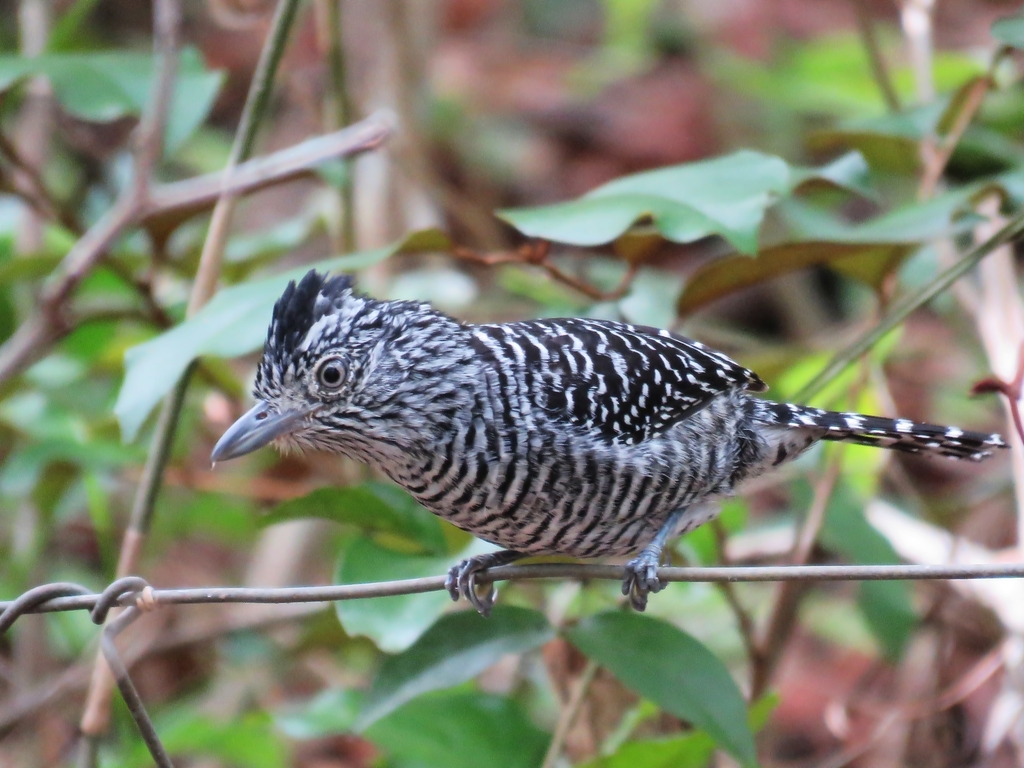
The barred antshrike is 15 to 18.5 cm (5.9 to 7.3 in) long and weighs 24 to 32 g (0.85 to 1.1 oz). Members of genus Thamnophilus are largish members of the antbird family; all have stout bills with a hook like those of true shrikes. This species exhibits marked sexual dimorphism though both sexes have a bushy crest. Adult males of the nominate subspecies T. d. doliatus are almost entirely plumaged with alternating black and white bars. The black bars on their upperparts are thicker than the white bars; on their underparts the black bars are thinner than the white ones. Their face, throat, and chin have thin black and white streaks. Their crest is black with white bases on the middle feathers. Adult females have a cinnamon-rufous crest and upperparts. The sides of their head and neck are streaked black and white or buff. Their chin is buff and their underparts ochraceous-buff. Adults of both sexes have a pale yellow iris, a black maxilla, a bluish gray mandible, and lead-gray legs and feet. Juvenile males are barred with black and light yellowish brown. The other subspecies of the barred antshrike differ from the nominate and each other thus:
T. d. intermedius: males are darker and have wider black bars than the nominate T. d. nigricristatus: males' bellies have faint or no bars; females have unstreaked throats T. d. nesiotes: similar to nigricristatus but more deeply colored T. …
Range & habitat
The subspecies of the barred antshrike are found thus:
T. d. intermedius: from San Luis Potosí and Tamaulipas in east-central Mexico south on both sides of Central America through Costa Rica and possibly into Panama T. d. nesiotes: Pearl Islands in the Gulf of Panama T. d. eremnus: Coiba Island off the Pacific coast of western Panama T. d. nigricristatus: Panama between eastern Chiriquí Province and western Guna Yala (San Blas) T. d. albicans: Caribbean slope of northern and western Colombia and south in the Magdalena Valley T. d. nigrescens: north-central Colombia east of the Andes and northwestern Venezuela north of the Andes T. d. tobagensis: Tobago T. d. doliatus: northeastern Colombia, Venezuela except its northwest but including Margarita Island, Trinidad, the Guianas, and northern Amazonian Brazil T. d. difficilis: east-central Brazil roughly bounded by eastern Maranhão, eastern Mato Grosso, Goiás, and western Bahia T. d. capistratus: eastern Brazil between Ceará, Bahia, and the Atlantic T. d. radiatus: Amazonas Department in southeastern Colombia, northeastern Ecuador, eastern Peru, northern and eastern Bolivia, most of Paraguay, northern and northeastern Argentina, and western and south-central Brazil T. d. cadwaladeri: Tarija Department in southern Bolivia The barred antshrike inhabits a variety of landscapes with some geographical differences. …
Wikipedia: “Distribution and habitat”
What it does
The barred antshrike has a cosmopolitan diet. It primarily feeds on a wide variety of mature and larval insects but also includes significant amounts of other arthropods, small lizards, fruit, and seeds. It typically forages in pairs that remain close together in dense foliage from the ground to about 3 m (10 ft) above it, but will go as high as 10 m (35 ft). It almost never joins mixed-species feeding flocks. It hops and makes wing-assisted jumps up from the ground and between branches, and also climbs branches and vines. It usually gleans prey from leaves, stems, branches, and trunks using a rapid stabbing motion. It also feeds on prey that flees army ant swarms.
Wikipedia: “Feeding”
Listen
Looking for field recordings…
Where it lives
Recorded sightings
—
geo-referenced records in GBIF, from museums, herbaria and field observers.
Drag the globe to turn it. Dots are where records exist, not a range map; darker means more records.
In the stacks
Searching the stacks…
Every page naming Thamnophilus doliatus in the Biodiversity Heritage Library →
This page is assembled live from iNaturalist, GBIF, Wikipedia, the Source Library and the Internet Archive. It is not yet part of the hand-edited codex. iNaturalist taxon 15764.