On eBird ↗
Southern Screamer
Live sightings near you, the range map, bar charts of when it is seen, and Macaulay Library photos and recordings.
Southern Screamer
Chauna torquata
The southern screamer (Chauna torquata), also known as the crested screamer, belongs to the order Anseriformes. It is found in southeastern Peru, northern Bolivia, Paraguay, southern Brazil, Uruguay and northern Argentina. Its diet consists of plants stems, seeds, leaves, and, rarely, small animals.
From the article Southern screamer on Wikipedia (CC BY-SA), quoted section by section
Description
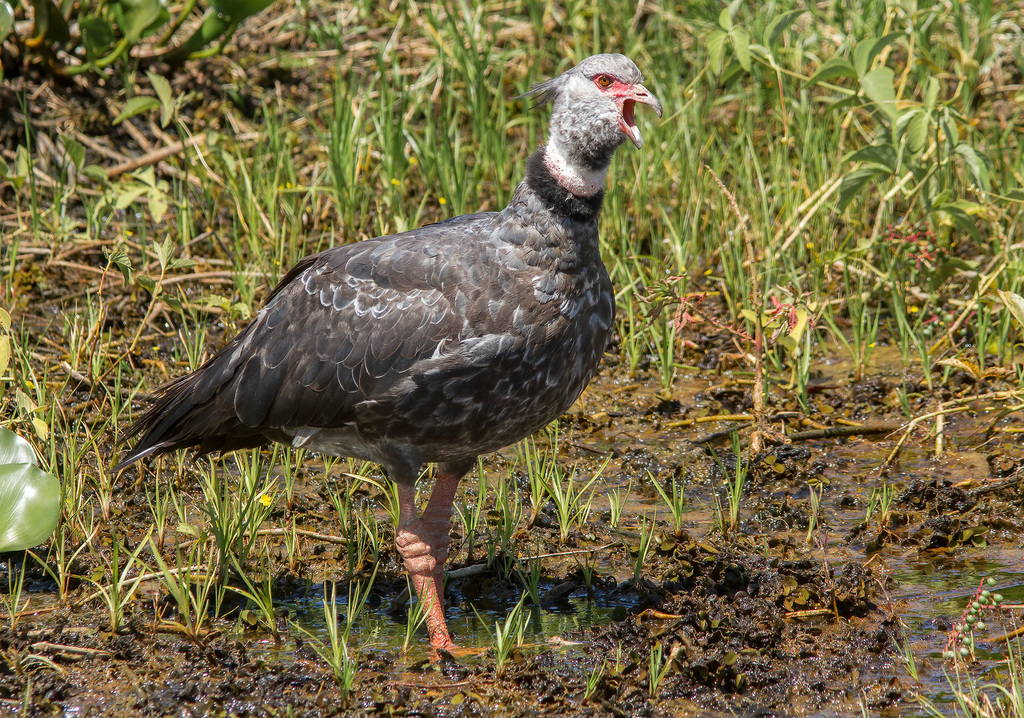
The southern screamer is one of the largest birds of southern South America at 83 to 90 cm (33 to 35 in) long and weighing about 4.4 kg (9.7 lb). Their flat wing measures 50 to 57 cm (20 to 22 in), their tail 22 to 26 cm (8.7 to 10.2 in), and their culmen 4.0 to 5.4 cm (1.6 to 2.1 in). Weight is known from one female, which was 4.4 kg (9.7 lb). They are stout bodied with a disproportionately small head and a "chicken-like" grayish brown bill. The sexes have the same plumage. Their head and upperparts are gray with a velvety black "collar" around the base of the neck. Their wings and tail are dusky and the wing has two sharp spurs at its manus. The front of their neck, their breast, and their sides are pale gray faintly mottled and streaked with white. Their belly is unmarked pale gray or white. Their legs and feet are rosy.
Range & habitat
The southern screamer is found from the eastern half of Bolivia south into Argentina as far as Buenos Aires Province and east through Paraguay into southwestern Brazil and Uruguay. It has also been documented as a vagrant in southeastern Peru. It inhabits tropical and subtropical wetlands, including lakes, marshes, and flooded meadows with scattered trees.
Wikipedia: “Distribution and habitat”
What it does
The southern screamer feeds on the leaves, stems, and seeds of aquatic plants and also on some crops. They usually graze like geese but have been seen digging for food. Flocks of up to about 100 forage together in the non-breeding season.
Wikipedia: “Feeding”
Listen
Looking for field recordings…
Where it lives
Recorded sightings
—
geo-referenced records in GBIF, from museums, herbaria and field observers.
Drag the globe to turn it. Dots are where records exist, not a range map; darker means more records.
In the stacks
Searching the stacks…
Every page naming Chauna torquata in the Biodiversity Heritage Library →
This page is assembled live from iNaturalist, GBIF, Wikipedia, the Source Library and the Internet Archive. It is not yet part of the hand-edited codex. iNaturalist taxon 6910.