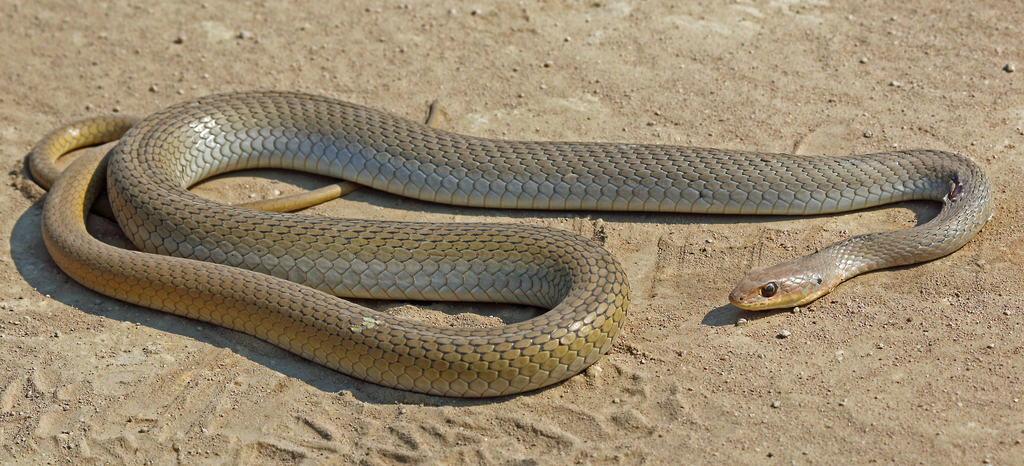
Olive Whip Snake
Psammophis mossambicus
Psammophis mossambicus, the olive grass snake, is a snake species in the family Psammophiidae, the sand and whip snakes (not to be confused with the Australian olive whipsnake, Demansia olivacea). P. mossambicus is native to Southern Africa (Angola, Botswana, Eswatini, Malawi, Mozambique, Namibia, eastern South Africa, Zambia, Zimbabwe), but may also be found in Central African Republic, Democratic Republic of the Congo, Gabon, Kenya, South Sudan, Tanzania, and Uganda, and as far north as southern Chad....
From the article Psammophis mossambicus on Wikipedia (CC BY-SA), quoted section by section
Description
This snake grows to 100 to 180 cm (roughly 3–5 feet) in length, and lives in somewhat moist places near a source of water. It is olive-brown in color, with dark-edged scales and a lighter-hued underside. It is often confused with the black mamba, as it can raise its head in a similar fashion to the mambas, cobras and other elapid snakes; however, unlike the aforementioned species, the olive grass snake is opisthoglyphous (rear-fanged), with small teeth located at the back of the mouth that deliver mild venom (and/or toxic salival compounds), primarily used for subduing small, slippery or "squirmy" prey such as frogs, lizards and some rodents. It is considered mildly venomous to humans. No deaths have been recorded, though possible side effects of envenomation may include localised pain and swelling, nausea and fatigue. In Afrikaans, it is known as olyfkleurige grasslang.
== References ==
Range & habitat
P. mossambicus is native to Southern Africa (Angola, Botswana, Eswatini, Malawi, Mozambique, Namibia, eastern South Africa, Zambia, Zimbabwe), but may also be found in Central African Republic, Democratic Republic of the Congo, Gabon, Kenya, South Sudan, Tanzania, and Uganda, and as far north as southern Chad.
Wikipedia: “Distribution”
Where it lives
Recorded sightings
—
geo-referenced records in GBIF, from museums, herbaria and field observers.
Drag the globe to turn it. Dots are where records exist, not a range map; darker means more records.
In the stacks
Searching the stacks…
Every page naming Psammophis mossambicus in the Biodiversity Heritage Library →
This page is assembled live from iNaturalist, GBIF, Wikipedia, the Source Library and the Internet Archive. It is not yet part of the hand-edited codex. iNaturalist taxon 56629.