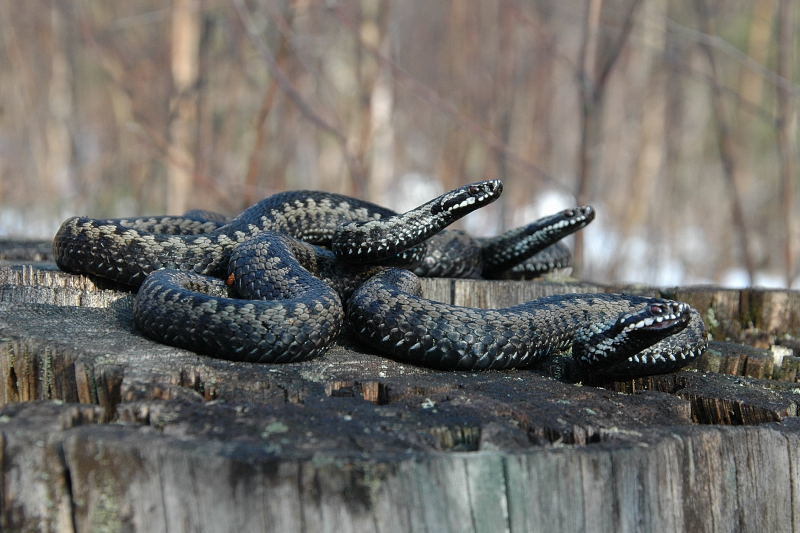
Adder
Vipera berus
Vipera berus, commonly known as the common European adder and the common European viper, is a species of venomous snake in the family Viperidae. The species is extremely widespread, and thus can be found throughout much of Europe, and as far as East Asia. There are three recognised subspecies.
Known by a host of common names including common adder and common viper, the adder has been the subject of much folklore in Britain and other European countries. It is not regarded as especially dangerous; the snake is not aggressive and usually bites only when really provoked, stepped on, or picked up. Bites can be very painful, but are rarely fatal. The specific name, berus, is Neo-Latin and was at one time used to refer to a snake, possibly the grass snake, Natrix natrix.
From the article Adder on Wikipedia (CC BY-SA), quoted section by section
Description
Relatively thick-bodied, adults usually grow to 60 cm (24 in) in total length (including tail), with an average of 55 cm (22 in). Maximum size varies by region. The largest, at over 90 cm (35 in), are found in Scandinavia; specimens of 104 cm (41 in) have been observed there on two occasions. In France and Great Britain, the maximum size is 80–87 cm (31–34 in). Mass ranges from 50 g (1.8 oz) to about 180 grams (6.3 oz).
The head is fairly large and distinct and its sides are almost flat and vertical. The edge of the snout is usually raised into a low ridge. Seen from above, the rostral scale is not visible, or only just. Immediately behind the rostral, there are two (rarely one) small scales. Dorsally, there are usually five large plates: a squarish frontal (longer than wide, sometimes rectangular), two parietals (sometimes with a tiny scale between the frontal and the parietals), and two long and narrow supraoculars. The latter are large and distinct, each separated from the frontal by one to four small scales. The nostril is situated in a shallow depression within a large nasal scale. The eye is relatively large, equal in size to or slightly larger than the nasal scale, but often smaller in females. Below the supraoculars, there are six to 13 small circumorbital scales, usually eight to 10. The temporal scales are smooth (rarely weakly keeled). …
Range & habitat
Vipera berus has a wide range. It can be found across the Eurasian land-mass; from northwestern Europe (Great Britain, Belgium, Netherlands, Scandinavia, Germany, France) across southern Europe (Italy, Serbia, Albania, Croatia, Montenegro, Bosnia and Herzegovina, North Macedonia, Bulgaria, and northern Greece) and eastern Europe to north of the Arctic Circle, and Russia to the Pacific Ocean, Sakhalin Island, North Korea, northern Mongolia and northern China. It is found farther north than any other snake species. The type locality was originally listed as 'Europa'. Mertens and Müller (1940) proposed restricting the type locality to Uppsala, Sweden and it was eventually restricted to Berthåga, Uppsala by designation of a neotype by Krecsák & Wahlgren (2008). In several European countries, it is notable for being the only native venomous snake. It is also one of only three native British snake species. The other two, the barred grass snake and the smooth snake, are non-venomous. Sufficient habitat complexity is crucial for this species to be present, in order to support its various behaviours—basking, foraging, and hibernation—as well as to offer some protection from predators and human disturbance. …
Wikipedia: “Distribution and habitat”
What it does
This species is mainly diurnal, especially in the north of its range. Further south, it is said to be active in the evening, and it may even be active at night during the summer months. It is predominantly a terrestrial species, though it is known to climb up banks and into low bushes in order to bask or search for prey. Adders are not usually aggressive and tend to be rather timid, biting only when they are cornered, alarmed, stepped on, or picked up. They will usually disappear in the undergrowth at the slightest hint of danger, but will return once all is quiet, often to the same spot. Occasionally, individual snakes will reveal their presence with a loud, sustained hiss, presumably to warn off potential aggressors. These are often pregnant females. When threatened, the front part the adder's body is drawn into an S-shape in preparation for a strike. This cold-adapted species hibernates in winter. In Great Britain, males hibernate for around 150 days and females for around 180 days. In northern Sweden, hibernation lasts 8–9 months. On mild winter days, they may emerge to bask in areas where the snow has melted, often travelling across snow in the process. Approximately 15% of adults and 30–40% of juveniles die during hibernation.
Wikipedia: “Behaviour”
Toxicity
Adder venom is primarily proteolytic, haemotoxic, and cytotoxic, although some populations may also have neurotoxic and neuromuscular effects. The venom is considered simpler than the related Vipera ammodytes, which could explain its comparatively mild effects and greater LD50. There is probably regional and individual variation in the venom composition of adders. Due to the rapid rate of human expansion throughout the range of this species, bites are relatively common. Domestic animals and livestock are frequent victims. In Great Britain, most cases occur between March and October. In Sweden, there are around 1,300 bites per year, with an estimated 12% of cases requiring hospitalisation. At least eight different antivenoms are available against bites from this species. Mallow et al. (2003) describe the toxicity of the venom as being relatively low compared to that of other viper species. They cite Minton (1974) who reported the LD50 values for mice to be 0.55 mg/kg IV, 0.80 mg/kg IP and 6.45 mg/kg SC. For comparison, one test found that the minimum lethal dose of venom for a guinea pig was 40–67 mg, whereas only 1.7 mg was necessary when Daboia russelii venom was used. Brown (1973) gives a higher subcutaneous LD50 range of 1.0–4.0 mg/kg. All agree that the venom yield is low. …
Wikipedia: “Venom”
In human culture
It was once thought that adders were deaf, as referenced in Psalm 58 (v. 4), yet snake oil derived from adders was used as a cure for deafness and earaches. Females were also thought to swallow their young when threatened and regurgitate them unharmed later. It was further believed that they did not perish until sunset. Remedies for adder "stings" included killing the snake responsible and rubbing the corpse or its fat on the wound, also holding a pigeon or chicken on the bite, or jumping over water. Adders were thought to be attracted to hazel trees and repelled by ash trees. The Druids believed that large, frenzied gatherings of adders took place in spring, at the centre of which was a polished rock called an adder stone or Glain Neidr in the Welsh language. These stones were said to have held supernatural powers.
Wikipedia: “In culture and beliefs”
Where it lives
Recorded sightings
—
geo-referenced records in GBIF, from museums, herbaria and field observers.
Drag the globe to turn it. Dots are where records exist, not a range map; darker means more records.
In the old herbals & bestiaries

Introductio Generalis in Rem Herbariam
Augustus Quirinus Rivinus · 1690 · p.164

Latin Herbal
1484 · p.253

Commentaries on the Six Books of Dioscorides
Pietro Andrea Mattioli · 1560 · p.442

Hortus Eystettensis
Basilius Besler · 1640 · p.119

Museum of the Royal Society
Nehemiah Grew · 1681 · p.462

Latin Herbal with German Synonyms
1484 · p.281

Herbarius
1485 · p.254

Herbarius latinus (with French synonyms)
1486 · p.29

Herbarius latinus (with Dutch synonyms)
1486 · p.251

Latin Herbal with German Synonyms
1486 · p.254

Garden of Health
Jacob Meydenbach · 1491 · p.376

Ortus sanitatis
1491 · p.376
In the stacks
Searching the stacks…
Every page naming Vipera berus in the Biodiversity Heritage Library →
This page is assembled live from iNaturalist, GBIF, Wikipedia, the Source Library and the Internet Archive. It is not yet part of the hand-edited codex. iNaturalist taxon 966698.