- Animals
- ›Chordates
- ›Vertebrates
- ›Ray-finned Fishes
- ›Spiny-rayed fishes
- ›Perches, Scorpionfishes, Sticklebacks, and Allies
- ›Sculpins and Allies
- ›Lumpfishes
- ›Typical Lumpsuckers
- ›Cyclopterus
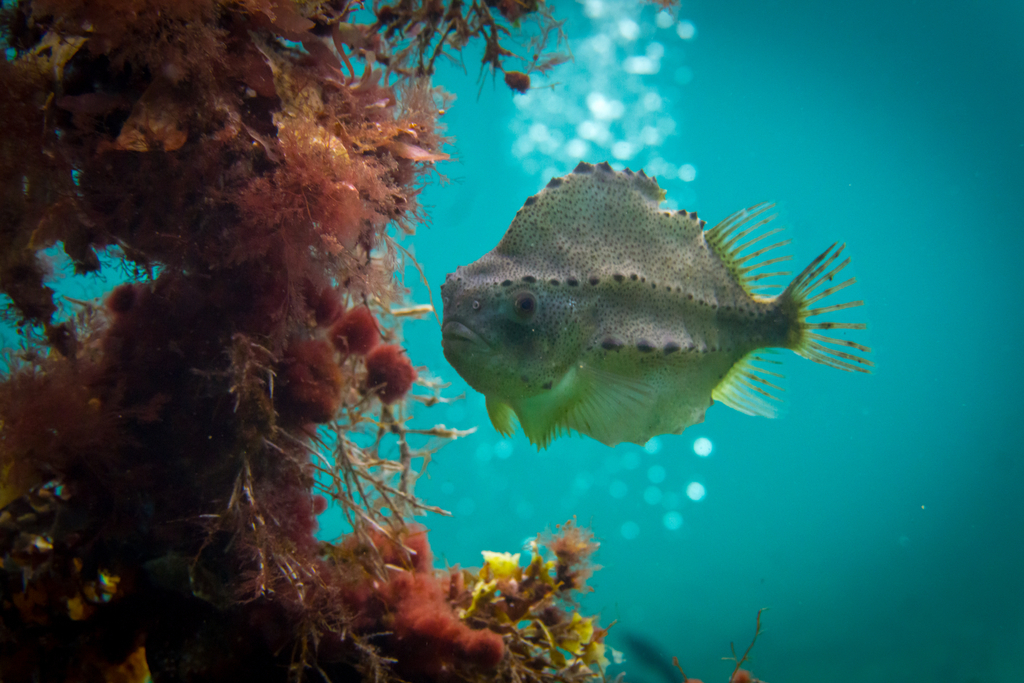
Lumpfish
Cyclopterus lumpus
Cyclopterus is a genus of marine ray-finned fish belonging to the family Cyclopteridae, the lumpsuckers or lumpfish. Its only species is Cyclopterus lumpus, the lumpsucker or lumpfish. It is found in the North Atlantic and adjacent parts of the Arctic Ocean, ranging as far south as the Chesapeake Bay (rare south of New Jersey) on the North American coast and Spain (rare south of the English Channel) on the European coast. The species has been reported twice in the Mediterranean Sea, off Croatia in 2004 and Cyprus in 2017.
From the article Cyclopterus on Wikipedia (CC BY-SA), quoted section by section
Description
Cyclopterus is sexually dimorphic with females reaching larger sizes than the males. Males typically reach 30–40 cm (12–16 in) in length while females can typically grow up to 50 cm (20 in) in length and 5 kg (11 lb 0 oz) in weight. The largest specimen recorded measured 61 cm (24 in) in length, and 9.6 kg (21 lb 3 oz) in weight. In the brackish water of the Baltic Sea, it usually does not surpass 20 cm (8 in). The body is ball-like. It has a knobbly, ridged back and three large bony tubercles on each flank. Its pelvic fins form suction discs which it uses to attach strongly to rocks or other surfaces. The head and the pectoral fins of males are larger than those of females. It has a jelly-like layer of fat under the skin. Its colour is highly variable; bluish, greyish, olive, yellowish or brownish. Mature males turn orange-reddish during the breeding season.
What it does
Cyclopterus spend the first few months following hatching in tidal pools, or in association with floating seaweed clumps. As they grow they migrate out into open water far from land where they live in the pelagic zone feeding upon gelatinous zooplankton, fish eggs and small crustaceans. When they reach maturity they will migrate to coastal areas in spring to breed. During the breeding season, males change colour, taking on a reddish/orange colouration. The population spawns over many months with spawning fish being caught in Iceland from March until August. Females which have spawned during the previous year tend to return to the same area when spawning again. They will also return at a similar time of year i.e. individuals which spawned early and late in the season will return to spawn early and late in the season the following year. A single female will lay 50,000–220,000 eggs which are laid in two batches of roughly equal size 1–2 weeks apart. The eggs are between 2.2 and 2.5 millimetres (11⁄128 and 13⁄128 in) in diameter and the ovary can account for up to one third of the weight of the female fish before spawning. The female will lay the eggs in a nest area pre-selected by the male, which will usually consist of a rocky outcrop or boulders on the seabed. The nest is in relatively shallow water (<10 metres (33 ft)) and may even be in the intertidal zone. …
Wikipedia: “Reproduction and lifecycle”
At the table
Cyclopterus roe, a good source of omega-3 fatty acids, is used to produce relatively inexpensive caviar substitutes. The roe is removed from the fish and processed to remove connective tissue. The roe is stored in large barrels where it is salted. The roe is dyed either red or black and packed with a mould inhibitor such as sodium benzoate (E211). In Scandinavia the flesh of the fish is eaten. In Iceland, the males are often salted and smoked, or simply boiled. The female lumpfish is rarely eaten fresh but when it is caught during the spawning season, the guts and head removed, scored deeply with a knife and hung in a cool place until the flesh turns yellow. The fish is then poached before serving, as a dish called sigin grásleppa in Icelandic. They are used as "cleaner fish" to reduce the parasite burden on salmon farms in Scotland, Iceland and Norway, and Canada.
Wikipedia: “Uses”
In human culture
Cyclopterus is a compound of cyclos, meaning 'ring', with pteros, which means 'fin'. This is a reference to the pelvic fins being modified into a suction disc. The specific name lumpus is derived from the Anglo-Saxon lump and the fish was called Lumpus anglorum by Gessner in 1558. This seems to refer to the dorsal fin being embedded in the thick and tubercular skin on the back, creating the impression of a hump.
Wikipedia: “Etymology”
Where it lives
Recorded sightings
—
geo-referenced records in GBIF, from museums, herbaria and field observers.
Drag the globe to turn it. Dots are where records exist, not a range map; darker means more records.
In the old herbals & bestiaries

In the stacks
Searching the stacks…
Every page naming Cyclopterus lumpus in the Biodiversity Heritage Library →
This page is assembled live from iNaturalist, GBIF, Wikipedia, the Source Library and the Internet Archive. It is not yet part of the hand-edited codex. iNaturalist taxon 60603.