- Animals
- ›Chordates
- ›Vertebrates
- ›Cartilaginous Fishes
- ›Sharks and Rays
- ›Rays
- ›Stingrays
- ›Whiptail Stingrays
- ›Maskrays
- ›Neotrygon
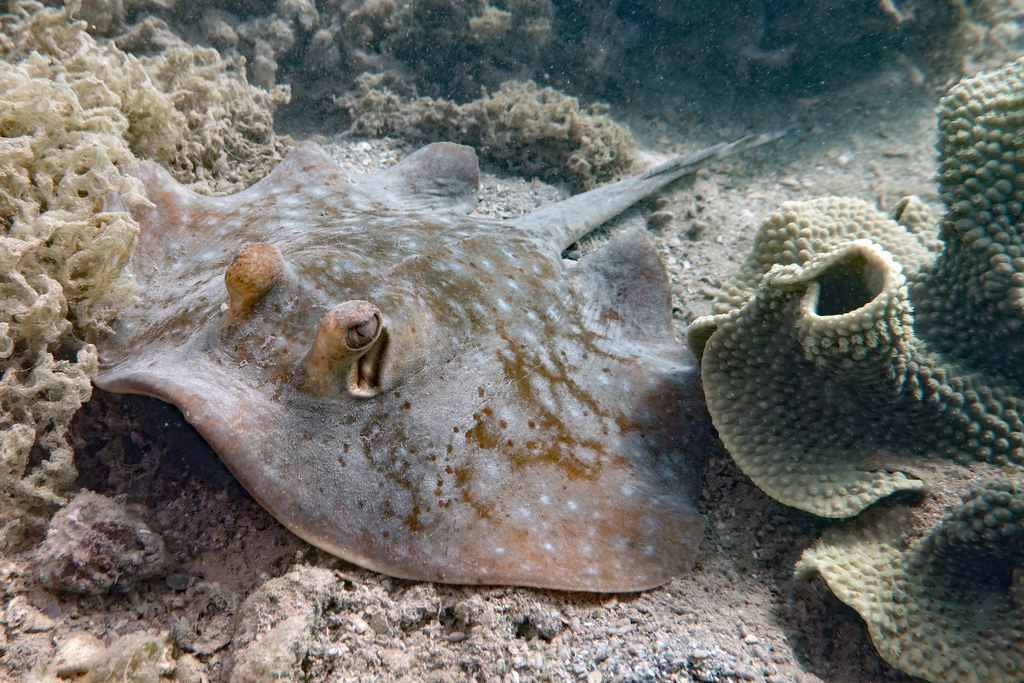
Ningaloo Maskray
Neotrygon ningalooensis
The Ningaloo maskray (Neotrygon ningalooensis) is a species of stingray in the family Dasyatidae, found along the northwestern coast of Australia. Measuring up to 30 cm (12 in) across, it has a diamond-shaped pectoral fin disc with a blunt snout and rounded outer corners. Its tail is whip-like with both upper and lower fin folds. This species has a distinctive dorsal color pattern consisting of numerous small, sharp-edged deep orange spots and slightly larger, fuzzy-edged pale blue spots on a yellowish brown background.
Inhabiting inshore waters less than 5 m (16 ft) deep, the bottom-dwelling Ningaloo maskray has highly specific habitat preferences. It is found on reddish sand near reefs, upon which its coloration grants it excellent camouflage. It is able to bury itself deeper than other maskrays thanks to its protruding eyes. The International Union for Conservation of Nature (IUCN) has listed this species as Data Deficient due to lack of information. It is not vulnerable to fisheries but may be impacted by habitat degradation.
From the article Ningaloo maskray on Wikipedia (CC BY-SA), quoted section by section
Description
The Ningaloo maskray has a diamond-shaped pectoral fin disc about 1.1 times wider than long, with straight to slightly convex leading margins and rounded outer corners. The snout is short and rounded. The eyes are large and protruding, with large crescent-shaped spiracles behind. Between the slender nostrils is a curtain-shaped flap of skin with a deeply fringed rear margin that is divided into two lobes. The small mouth has shallow grooves at the corners and is surrounded by papillae; there are also two long papillae on the floor of the mouth. The teeth range from long and pointed to short and blunt. There are five pairs of S-shaped gill slits. The pelvic fins are narrow and triangular. The whip-like tail bears two very slender stinging spines on the upper surface; it is fairly broad and flattened at the base and tapers evenly past the stings. Behind the stings are well-developed dorsal and ventral fin folds; the dorsal fold is smaller than the ventral fold, which is deep and short relative to the tail's total length. The only dermal denticles are four or five small, closely spaced thorns in a midline row behind the spiracles. …
Range & habitat
Endemic to northwestern Australia, the Ningaloo maskray has been found from Shark Bay in Western Australia to the Gove Peninsula in Northern Territory. This bottom-dwelling species appears to have very restricted habitat preferences: it inhabits areas of fine reddish sand close to reefs, in inshore waters less than 5 m (16 ft) deep.
Wikipedia: “Distribution and habitat”
What it does
Compared to other maskrays, the Ningaloo maskray has more protruding eyes that allow it to bury itself deeper in the substrate and still remain aware of its surroundings. Within its favored habitat, its coloration makes it well camouflaged against predators.
Wikipedia: “Biology and ecology”
Where it lives
Recorded sightings
—
geo-referenced records in GBIF, from museums, herbaria and field observers.
Drag the globe to turn it. Dots are where records exist, not a range map; darker means more records.
In the stacks
Searching the stacks…
Every page naming Neotrygon ningalooensis in the Biodiversity Heritage Library →
This page is assembled live from iNaturalist, GBIF, Wikipedia, the Source Library and the Internet Archive. It is not yet part of the hand-edited codex. iNaturalist taxon 188820.