On eBird ↗
Bahama Oriole
Live sightings near you, the range map, bar charts of when it is seen, and Macaulay Library photos and recordings.
Bahama Oriole
Icterus northropi
The Bahama Oriole (Icterus northropi) is a species of songbird in the New World blackbird family - Icteridae. It is endemic to the Bahamas. It is listed as critically endangered by IUCN (CR). The taxon was originally classified as its own distinct species in 1890 by Joel Asaph Allen before it was lumped with the Cuban Oriole (Icterus melanopsis), Hispaniolan Oriole (Icterus dominicensis), and Puerto Rican oriole (Icterus portoricensis) into a single species by the ornithologist...
From the article Bahama oriole on Wikipedia (CC BY-SA), quoted section by section
Description
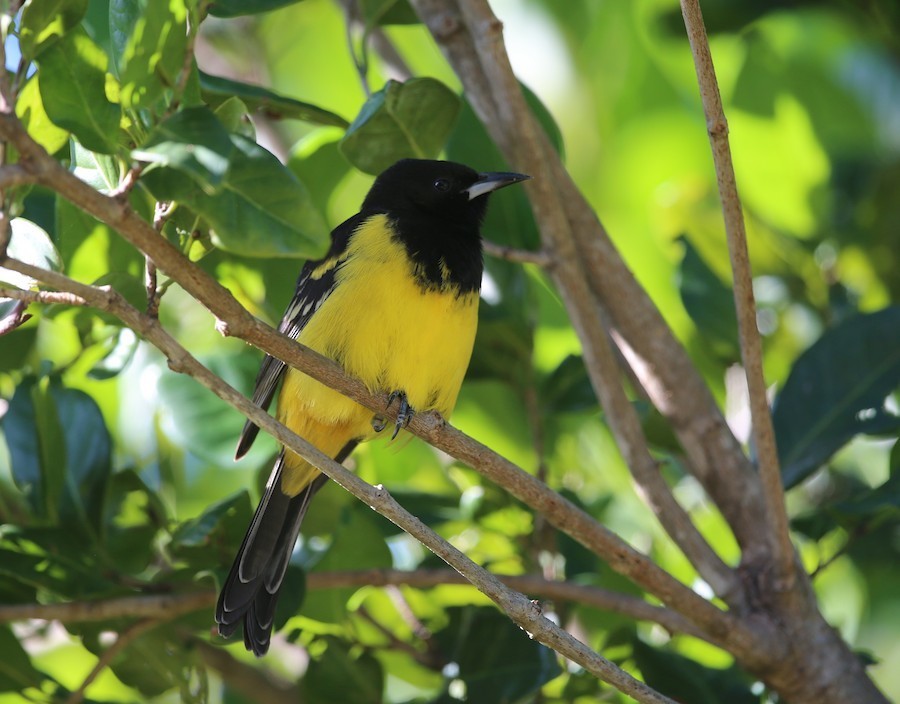
The Bahama oriole is a black and yellow oriole that has small white markings on the wings and tail. It shows the most yellow out of all the Caribbean orioles. The adult male and females are mostly black with yellow underparts, ranging from the mid-breast to the vent, thighs, rump, and lower back. The greater coverts and primaries are thinly fringed with white. The wing linings are yellow and the outer tail feathers have small white tips. The bill and eyes are dark black, and the legs are blue-grey. Like most tropical oriole species, the females are similar or identical to the males in coloring. The immature Bahama oriole is more of an olive-grey with the head a yellowish color.
Range & habitat
Historically, the Bahama oriole has been known to inhabit only two major islands in the Bahamas: Abaco and Andros. It became extirpated from Abaco in the 1990s, and today remains only on Andros. The exact reasons for their extirpation from Abaco remain unknown, but it was likely a consequence of Hurricane Andrew. The oriole is now found on the three major islands of Andros: North Andros, Mangrove Cay, and South Andros. It is likely the oriole also occurs on some of the smaller cays, but current documentation is lacking. The species was recognized as endangered by Birdlife International in 2011 with population estimates of 300 or fewer individuals remaining. However, this population estimate conducted by Price et al. (2011) was exclusive to populations in developed habitats near the coast; new findings suggest that the population size could be much larger than previously estimated now that researchers have documented extensive populations in the pine forest. In the past, it was assumed the Bahama oriole preferred to live around settlements and nest in coconut palmss (Cocos nucifera), but now research has shown that they likely prefer to nest in the vast pine forest of Andros. Developed habitats are important for nesting since the species often uses introduced Coconut Palm. …
Wikipedia: “Habitat”
Listen
Looking for field recordings…
Where it lives
Recorded sightings
—
geo-referenced records in GBIF, from museums, herbaria and field observers.
Drag the globe to turn it. Dots are where records exist, not a range map; darker means more records.
In the stacks
Searching the stacks…
Every page naming Icterus northropi in the Biodiversity Heritage Library →
This page is assembled live from iNaturalist, GBIF, Wikipedia, the Source Library and the Internet Archive. It is not yet part of the hand-edited codex. iNaturalist taxon 72951.