- Animals
- ›Chordates
- ›Vertebrates
- ›Birds
- ›Perching Birds
- ›Old World Flycatchers, Robins, and Chats
- ›Oenanthe
On eBird ↗
Brown Rock Chat
Live sightings near you, the range map, bar charts of when it is seen, and Macaulay Library photos and recordings.
Brown Rock Chat
Oenanthe fusca
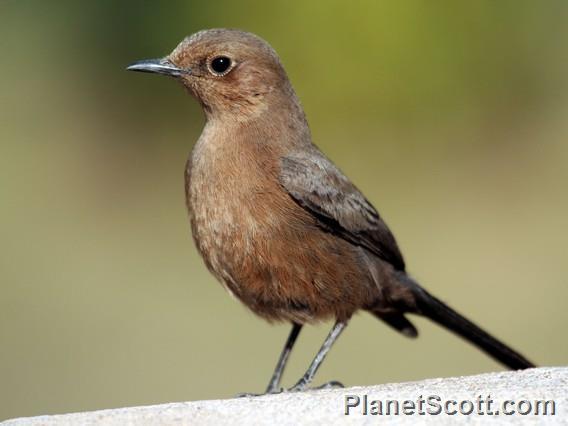
The brown rock chat (Oenanthe fusca) or Indian chat is a bird species of the family Muscicapidae. It is found mainly in northern and central India. It is often found in old buildings and rocky areas. It resembles a female Indian robin but lacks the reddish vent and differs in posture and behaviour apart from being larger. In flight it bears some resemblance to thrushes and redstarts. It feeds on insects, captured mainly on the ground. It was formerly placed as the sole species in the genus Cercomela but is now included with the wheatears in the genus Oenanthe.
In central India, the local name of Shama has been noted.
From the article Brown rock chat on Wikipedia (CC BY-SA), quoted section by section
Description
The brown rock chat is about 17 cm long, larger than the somewhat similar-looking Indian robin. It is uniformly rufous brown with the wings and tail of a slightly darker shade. The brown on the undersides grades into a dark grey-brown vent. The beak is slender and is slightly curved at the tip. The second primary is the longest and the tail is rounded. In flight it resembles a female blue rock thrush. The sexes are indistinguishable in the field.
Range & habitat
The species is nearly endemic to India, distributed north of the Narmada, west to Gujarat (mainly Kutch but extending south) and east to Bengal bordered on the north by the Himalayas where it is found up to about 1300 m in the foothills. Its distribution extends into northern Pakistan west to the Chenab River. Although largely resident, some populations make movements in response to weather. In the foothills of the Himalayas it moves higher up in summer, appearing in Dehra Dun in spring and leaving before the onset of winter. The species has been seen in Nepal. It is a common species although very patchily distributed. It is usually found singly or in pairs on old buildings or rocky areas.
Wikipedia: “Distribution and habitat”
What it does
The brown rock chat feeds mainly on insects, picked off the ground. They have been known to feed late and forage on insects attracted to artificial lighting. When feeding on the ground it sometimes flicks open its wings and tail. It also has a habit of slowly raising its tail slightly, fanning it and bobbing its head.
Wikipedia: “Diet and feeding”
Listen
Looking for field recordings…
Where it lives
Recorded sightings
—
geo-referenced records in GBIF, from museums, herbaria and field observers.
Drag the globe to turn it. Dots are where records exist, not a range map; darker means more records.
In the stacks
Searching the stacks…
Every page naming Oenanthe fusca in the Biodiversity Heritage Library →
This page is assembled live from iNaturalist, GBIF, Wikipedia, the Source Library and the Internet Archive. It is not yet part of the hand-edited codex. iNaturalist taxon 980211.