- Animals
- ›Chordates
- ›Vertebrates
- ›Birds
- ›Perching Birds
- ›Old World Flycatchers, Robins, and Chats
- ›Saxicola
On eBird ↗
Amur Stonechat
Live sightings near you, the range map, bar charts of when it is seen, and Macaulay Library photos and recordings.
Amur Stonechat
Saxicola stejnegeri
The Siberian stonechat or Asian stonechat (Saxicola maurus) is a recently validated species of the Old World flycatcher family (Muscicapidae). Like the other thrush-like flycatchers, it was often placed in the Turdidae in the past. It breeds in the East Palearctic including in easternmost Europe and winters in the Old World tropics.
From the article Siberian stonechat on Wikipedia (CC BY-SA), quoted section by section
Description
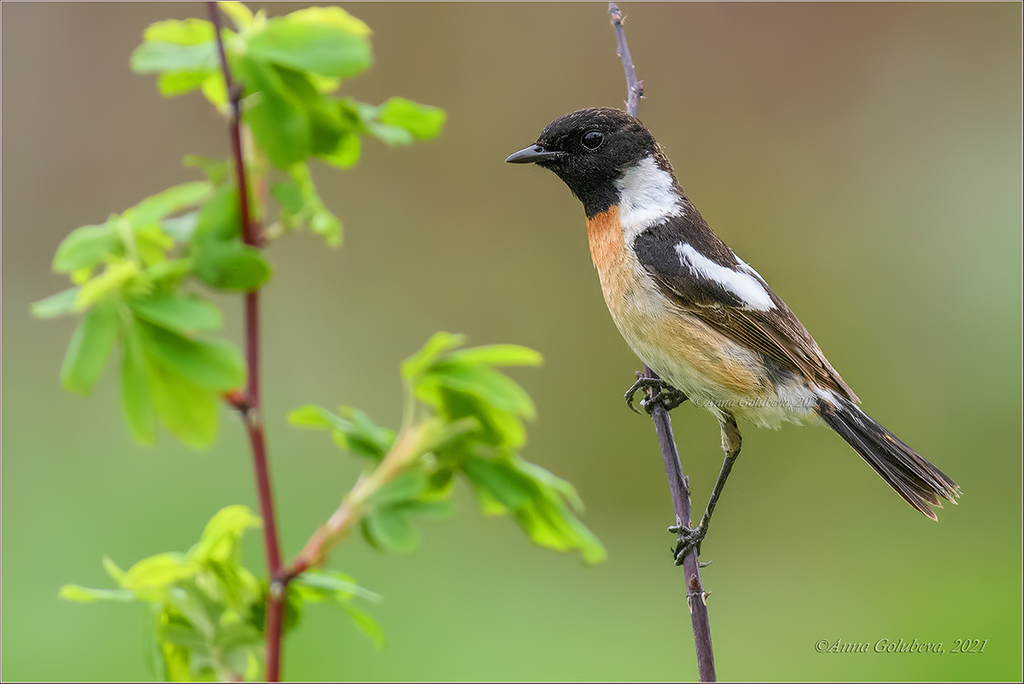
Siberian stonechat resembles its close relative relative the European stonechat (S. rubicola), but is typically darker above and paler below, with a white rump and whiter underparts with less orange on the breast. The male in breeding plumage has black upperparts and head (lacking the brownish tones of the European stonechat), a conspicuous white collar, scapular patch and rump, and a restricted area of orange on the throat. The female has pale brown upperparts and head, white neck patches (not a full collar), and a pale, unstreaked pinkish-yellow rump. Males in winter plumage are intermediate between summer males and females, with a supercilium resembling the whinchat (S. rubetra); from this species and the female it can be distinguished by the full white collar. If seen at close distance, it can be recognized that its primary remiges are distinctly longer than in S. rubicola. In this, it closely resembles the whinchat, which like S. maurus is adapted to long-distance migrations. The male has a clicking call, like two pebbles knocked together. The song is high and twittering like the dunnock (Prunella modularis), an unrelated passeridan songbird belonging to the Passeroidea. There are five or six subspecies, with S. m. maurus (described above) and the distinct but similar S. m. stejnegeri found across northern and central Asia. The southern S. m. …
Range & habitat
The breeding range covers most of temperate Asia, from about latitude 71°N in Siberia south to the Himalaya and southwest China, and west to eastern Turkey and the Caspian Sea area. It also breeds in the far northeast of Europe, mainly in Russia but occasionally as far west as Finland. The wintering range of the migratory bird is from southern Japan south to Thailand and India, and west to northeast Africa. On migration, small numbers reach as far west as western Europe, and exceptionally as far east as Alaska in North America.
Wikipedia: “Distribution and habitat”
What it does
The Siberian stonechat is insectivorous. It breeds in open rough scrubland or rough grassland with scattered shrubs, from sea level to about 4,000 m ASL or more. The birds seem to avoid even cool temperate conditions and stay up north only during the hot continental summer. In the montane regions of the Himalaya foothills of Bhutan, migrants can on occasion be seen foraging in fields and pastures more than 2,000 m ASL, but most move further down and south to winter in tropical regions. Though it is not considered a distinct species by the IUCN, it is widespread and common and would not be considered a threatened species.
Wikipedia: “Behaviour”
Listen
Looking for field recordings…
Where it lives
Recorded sightings
—
geo-referenced records in GBIF, from museums, herbaria and field observers.
Drag the globe to turn it. Dots are where records exist, not a range map; darker means more records.
In the stacks
Searching the stacks…
Every page naming Saxicola stejnegeri in the Biodiversity Heritage Library →
This page is assembled live from iNaturalist, GBIF, Wikipedia, the Source Library and the Internet Archive. It is not yet part of the hand-edited codex. iNaturalist taxon 1286913.