On eBird ↗
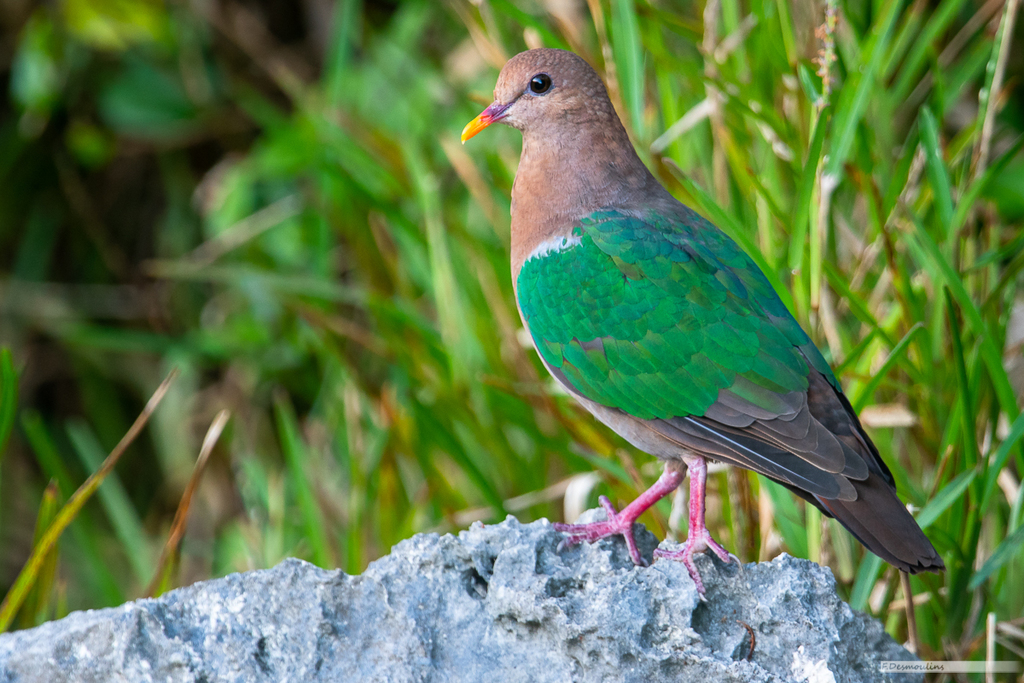
Pacific Emerald Dove
Live sightings near you, the range map, bar charts of when it is seen, and Macaulay Library photos and recordings.
Pacific Emerald Dove
Chalcophaps longirostris
The Pacific emerald dove or brown-capped emerald dove (Chalcophaps longirostris) is a pigeon which is a widespread resident breeding bird in the tropical and sub-tropical parts of Indonesia, northern and eastern Australia, Timor-Leste, and Papua New Guinea. It was formerly conspecific with the common emerald dove.
From the article Pacific emerald dove on Wikipedia (CC BY-SA), quoted section by section
Description
This is a common species in rainforest and similar dense wet woodlands, farms, gardens, mangroves, and coastal heaths. It builds a scant stick nest in a tree up to five metres and lays two cream-coloured eggs. Breeding tends to occur in Australia in spring or early summer in southeastern Australia and late in the dry season in northern Australia. Its flight is fast and direct, with the regular beats and an occasional sharp flick of the wings which are characteristic of pigeons in general. It often flies low between the patches of dense forest it prefers, but when disturbed will frequently walk away rather than fly. They are particularly good weavers when flying through forests. When flying they expose a buff underwing and a chestnut colour of their flight feathers. The Pacific emerald dove is a stocky, medium-sized pigeon, typically 23 to 28 centimetres (9.1 to 11.0 inches) in length. The back and wings are bright emerald green. The flight feathers and tail are blackish, and broad black and white bars show on the lower back in flight. The head and underpants are dark vinous pink fading to greyish on the lower belly. The eyes are dark brown, the bill bright red, and the legs and feet rufous. The male has a white patch on the edge of the shoulders and a grey crown, which the female lacks. Females will tend to have a browner complexion with a grey mark on the shoulder. …
Listen
Looking for field recordings…
Where it lives
Recorded sightings
—
geo-referenced records in GBIF, from museums, herbaria and field observers.
Drag the globe to turn it. Dots are where records exist, not a range map; darker means more records.
In the stacks
Searching the stacks…
Every page naming Chalcophaps longirostris in the Biodiversity Heritage Library →
This page is assembled live from iNaturalist, GBIF, Wikipedia, the Source Library and the Internet Archive. It is not yet part of the hand-edited codex. iNaturalist taxon 508098.