- Animals
- ›Chordates
- ›Vertebrates
- ›Ray-finned Fishes
- ›Carps, Characins, Catfishes and Allies
- ›Characins
- ›Characoidei
- ›American tetras
- ›Discus tetras
- ›Ectrepopterus
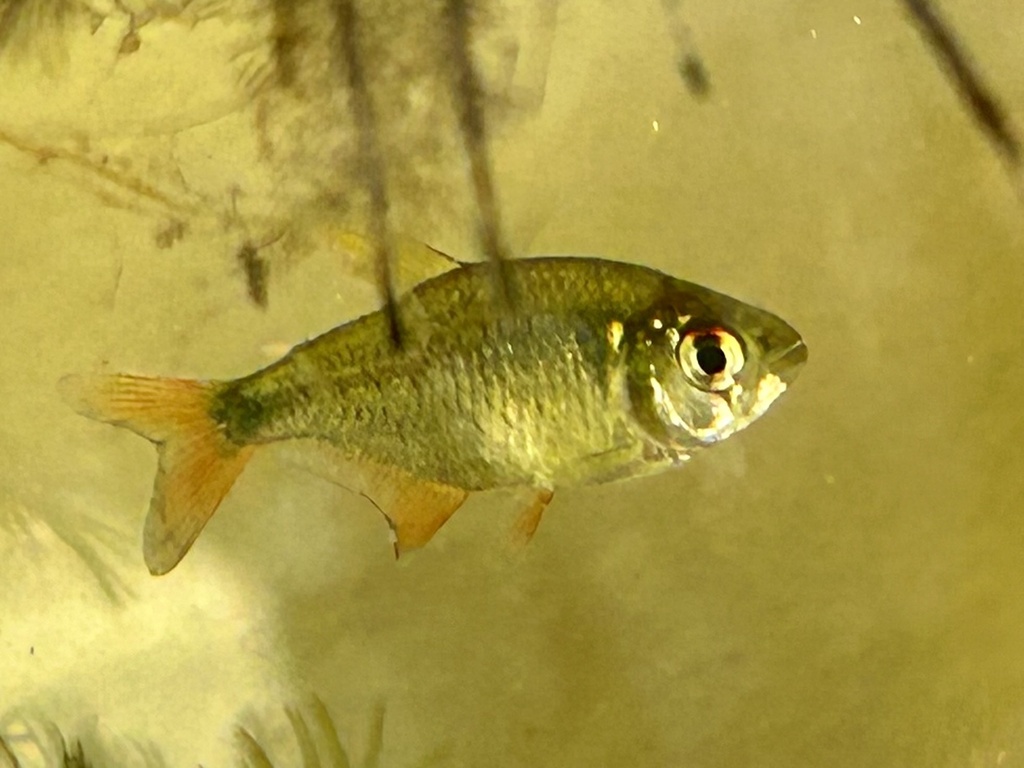
Ectrepopterus uruguayensis
Ectrepopterus is a monospecific genus of freshwater ray-finned fish belonging to the family Acestrorhamphidae, the American characins. The only species in the genus is Ectrepopterus uruguayensis. Given its restricted range, it is considered a rare fish, and is of note for conservation researchers interested in preserving the biodiversity of the region.
A small fish with silvery-gold scales and yellow fins, E. uruguayensis is characterized by a variety of features, including an incomplete lateral line and eyes wider than the snout is long. Something of particular note is the presence of bony hooks on the fin-rays of the pectoral fin, which is unusual for a characin; other members of Characidae may display these hooks on the pelvic or anal fins, but the pectoral fin is an uncommon location. E. uruguayensis can be found living in syntopy with other characids in the wild, such as the genera Bryconamericus and Astyanax, and has a preference for shallow, flowing waters with ample vegetation.
From the article Ectrepopterus on Wikipedia (CC BY-SA), quoted section by section
Description
Ectrepopterus uruguayensis reaches a maximum of 5.1 cm (2.0 in) SL (standard length, without the tail fin included). The body is elongated and horizontally compressed, and is deepest within the range of the dorsal-fin origin. The caudal peduncle is relatively long and usually straight, occasionally with slight concavity above and below. The eye is wider than the snout is long, and the lower jaw protrudes slightly past the upper. The lateral line is incomplete, with 5–9 pored scales (most often 6). There are 10–12 dorsal-fin rays (ii, 8–10 - meaning two unbranched rays and 8 to 10 branched rays), 11–13 pectoral-fin rays (i, 10–12), 7 or 8 pelvic-fin rays (i, 6 or 7), and 22–31 anal-fin rays (iii–v, 19–26). There are hooks on the pectoral-fin rays; while hooks on various fin-rays are common in various characid species, their presence on the pectoral fin in particular is unusual, and can be used as diagnostic criteria for E. uruguayensis when compared to similar species. The lower lobe of the caudal fin is sometimes longer than the upper, which Fowler cited amongst further diagnostic criteria; however, this is not uncommon in small characins, and is not present in all specimens of E. uruguayensis. As such, it should not be regarded as a distinguishing feature, though it is of occasional note during research. The base scale color for E. …
Range & habitat
Ectrepopterus uruguayensis was originally described from Uruguay, though Fowler failed to provide specific details. For a period of roughly 20 years from 1990 to 2010, there were no records of the species anywhere else; before then, there were instances of occasional specimens from the portion of the Río Uruguay in Brazil. A 2013 report of specimens found in Argentina broadened this range somewhat, and specimens were rediscovered in the Pampas region of Brazil in May 2023, again expanding the known range. Still, the area of occurrence remains relatively restricted. Generally, E. uruguayensis displays a preference for streams, and occurs in shallow areas (less than 1 m depth) with a notable current, though it has been cited from semi-still waters and areas of up to 2 m depth. It is found in regions with aquatic and riparian vegetation both. While it has its preferences, it also demonstrates some adaptability to weather conditions that influence its habitat; for instance, heavy rainfall may result in turbid water with a muddy substrate, while a drought might result in transparent water and a depth as little as 30 cm (12 in). Ectrepopterus uruguayensis is a generally amicable fish that occurs in low-density populations, with an extensive list of syntopic species from various fish families. Syntopic species also in the family Characidae, to which E. …
Wikipedia: “Distribution and ecology”
In human culture
The genus name originates in Greek. "Ectrepos" means "reversed", and "pterus" means "fin" or "wing", in reference to the caudal fin; the upper lobe is shorter than the lower. The suffix "-ensis" denotes a location, and E. uruguayensis was originally described from Uruguay. Ectrepopterus uruguayensis lacks a common name, but is referred to under the general "tetra" label in English and the "mojarra" label in Spanish.
Wikipedia: “Etymology”
Where it lives
Recorded sightings
—
geo-referenced records in GBIF, from museums, herbaria and field observers.
Drag the globe to turn it. Dots are where records exist, not a range map; darker means more records.
In the stacks
Searching the stacks…
Every page naming Ectrepopterus uruguayensis in the Biodiversity Heritage Library →
This page is assembled live from iNaturalist, GBIF, Wikipedia, the Source Library and the Internet Archive. It is not yet part of the hand-edited codex. iNaturalist taxon 610498.