- Animals
- ›Chordates
- ›Vertebrates
- ›Mammals
- ›Therians
- ›Placental Mammals
- ›Primates, Rodents, and Allies
- ›Primates
- ›Monkeys, Apes, and Tarsiers
- ›Monkeys and Apes
- ›Apes and Old World Monkeys
- ›Old World Monkeys
- ›Cercopithecines
- ›Baboons, Macaques, and Mangabeys
- ›Papio
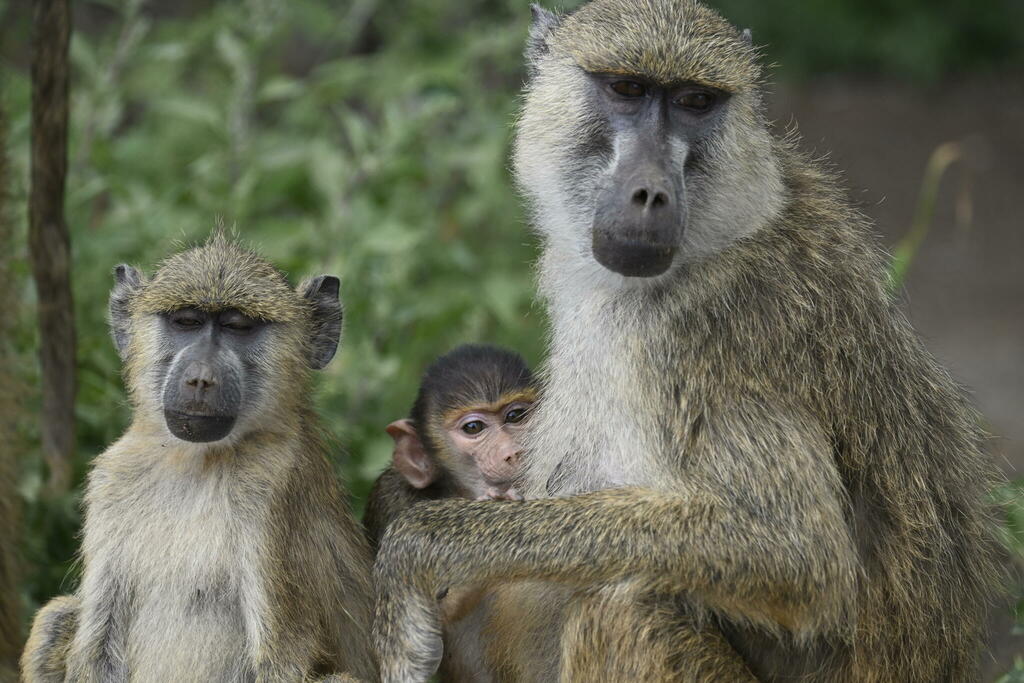
Yellow Baboon
Papio cynocephalus
The yellow baboon (Papio cynocephalus) is a baboon in the family of Old World monkeys. The species epithet means "dog-head" in Greek, due to the dog-like shape of the muzzle and head. Yellow baboons have slim bodies with long arms and legs along with yellowish-brown hair. They resemble the chacma baboon, but are somewhat smaller and with a less elongated muzzle. Their hairless faces are black, framed with white sideburns. Males can grow to about 84 cm (33 in), females to about 60 cm (24 in). They have long tails which grow to be nearly as long as their bodies. The average life span of the yellow baboon in the wild is roughly 15–20 years; some may live up to 30 years.
Yellow baboons inhabit savannas and light forests in eastern Africa, from Kenya and Tanzania to Zimbabwe and Botswana. They are diurnal, terrestrial, and live in complex, mixed-gender social groups of 8 to 200 individuals per troop. Like all other baboon species, they are omnivorous, with a preference for fruits; they also eat plants, leaves, seeds, grasses, bulbs, bark, blossoms and fungi, as well as worms, grubs, insects, spiders, scorpions, birds, rodents and small mammals. All species of baboons are highly opportunistic feeders and will eat virtually any food they can find.
From the article Yellow baboon on Wikipedia (CC BY-SA), quoted section by section
What it does
Yellow baboons use at least ten different vocalizations to communicate. When traveling as a group, males will lead, females and young stay safely in the middle, and less-dominant males bring up the rear. A baboon group's hierarchy is a serious matter, and some subspecies have developed behaviors intended to avoid confrontation and retaliation. For example, males may use infants as a kind of "passport" or shield for safe approach toward another male. One male will pick up the infant and hold it up as it nears the other male. This action often calms the other male and allows the first male to approach safely. An area of active research on yellow baboons is the role of their social habits in the composition of their gut microbiome. One group of researchers found that social group membership and interaction rates affected baboon microbiome composition, which they suggested could be due to accidental fecal-oral transmission during grooming periods, even though yellow baboons are not coprophagic. Accidental fecal-oral transmission during close contact may be especially important for the transmission of gut microbes that cannot survive long in the environment, such as those that are non-spore forming. Another group found evidence that male dispersal affected the gut microbiome of the immigrant individual. …
Wikipedia: “Behavior”
Listen
Looking for field recordings…
Where it lives
Recorded sightings
—
geo-referenced records in GBIF, from museums, herbaria and field observers.
Drag the globe to turn it. Dots are where records exist, not a range map; darker means more records.
In the stacks
Searching the stacks…
Every page naming Papio cynocephalus in the Biodiversity Heritage Library →
This page is assembled live from iNaturalist, GBIF, Wikipedia, the Source Library and the Internet Archive. It is not yet part of the hand-edited codex. iNaturalist taxon 67683.