On eBird ↗
Rattling Cisticola
Live sightings near you, the range map, bar charts of when it is seen, and Macaulay Library photos and recordings.
Rattling Cisticola
Cisticola chiniana
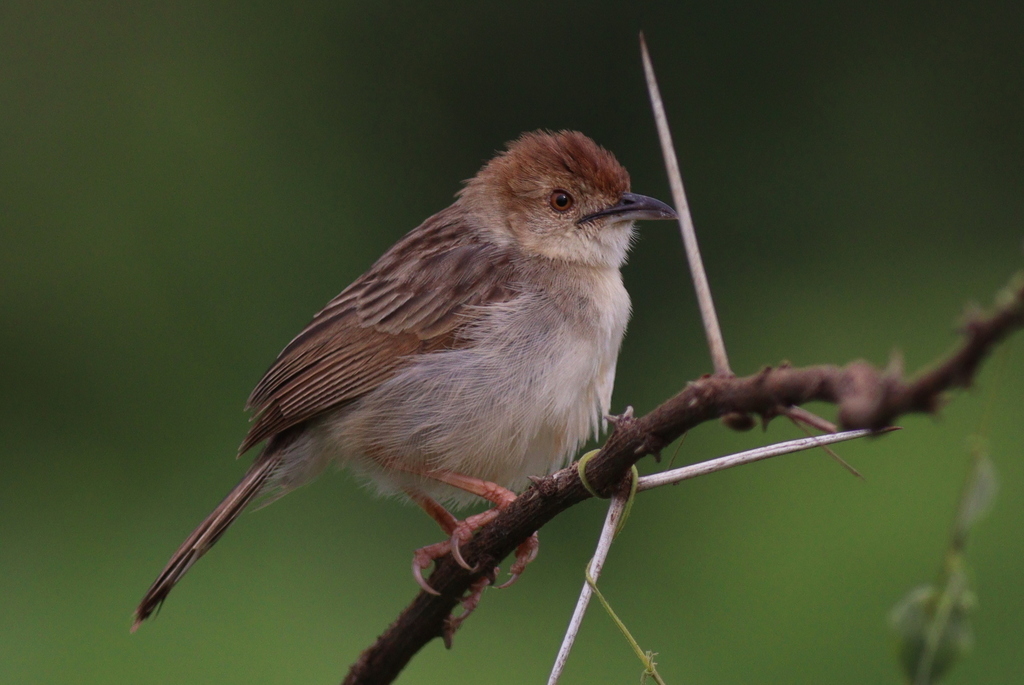
The rattling cisticola (Cisticola chiniana) is a species of bird in the family Cisticolidae which is native to Africa south of the equator, and parts of East Africa. It is a common to abundant species in open savanna and scrubland habitats, whether in arid, moist or upland regions. Especially during summer, it is highly conspicuous due to its strident and repetitive call-notes from prominent perches.
From the article Rattling cisticola on Wikipedia (CC BY-SA), quoted section by section
Range & habitat
It is found in Angola, Botswana, Burundi, Republic of the Congo, DRC, Eswatini, Ethiopia, Kenya, Malawi, Mozambique, Namibia, Somalia, South Africa, South Sudan, Tanzania, Uganda, Zambia, and Zimbabwe. Its natural habitat is arid, mesic or moist savannas and woodland, often dominated by thorn trees or thorn shrub (Dichrostachys, etc.). It is, however, also commonly found in miombo and mopane woodland, and is one of the commonest bird species on the Mozambican coastal plain. It is also present in the Eastern Highlands and the East African uplands below 2,000 m. In addition it utilizes some ecotones including edges of cultivation, fringes of dense woodland and woodland fringing the Okavango delta. The tinkling cisticola replaces it in stunted broad-leaved woodland and dry deciduous woodland on sandy substrates, while various Cisticola species replace it in marshy situations. It co-occurs with various Prinia species.
Wikipedia: “Distribution and habitat”
What it does
Especially in summer, much time is spent calling prominently from the top of a tree or bush. The strident call can be rendered as "chee-chee chichi-chirrrrr", but varies somewhat from individual to individual.
Breeding. Breeding occurs during the wet season in spring and summer. They build a ball-shaped nest of very coarse grass blades, which is lined on the inside with fine plant material.
Wikipedia: “Behaviour”
Listen
Looking for field recordings…
Where it lives
Recorded sightings
—
geo-referenced records in GBIF, from museums, herbaria and field observers.
Drag the globe to turn it. Dots are where records exist, not a range map; darker means more records.
In the stacks
Searching the stacks…
Every page naming Cisticola chiniana in the Biodiversity Heritage Library →
This page is assembled live from iNaturalist, GBIF, Wikipedia, the Source Library and the Internet Archive. It is not yet part of the hand-edited codex. iNaturalist taxon 72729.