


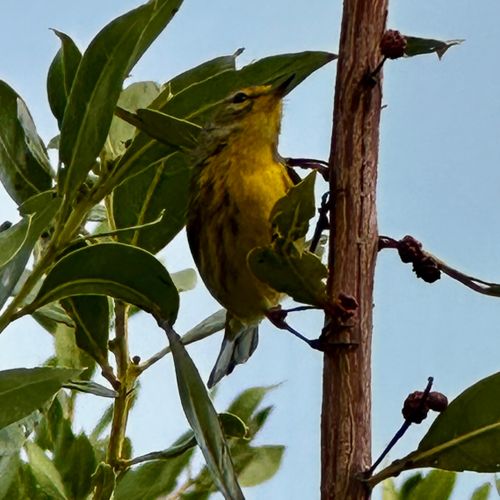

Images attached to GBIF records (field photographs), from . Open licences; click for the record.
Prairie Warbler
Setophaga discolor (Vieillot, 1809)
Also calledChipe de pradera (spa) · Cigüita de los Prados (spa) · Dendroica della prateria (ita) · Halgaiidę́ę́ʼ tsídiiłtsooí (nav) · Paruline des prés (fra) · Prairiezanger (nld) · Preri Ötleğeni (tur) · Prerijska cvrkutarka (srp) · Prärieskogssångare (swe) · Reinita galana (spa) · Rostscheitel-Waldsänger (deu) · Rostscheitelwaldsänger (deu) · Rotmantel-Waldsänger (deu) · Sylvette à moustache, Paruline des prés (fra)
The prairie warbler (Setophaga discolor) is a small songbird of the New World warbler family.
Descriptions from checklists and floras indexed by GBIF
Distribution
Breeding regions are NA. Breeding subregions are e, se USA. Non breeding regions are West Indies.
IOC World Bird List, v
From Wikipedia (CC BY-SA), quoted section by section
Description
These birds have yellow underparts with dark streaks on the flanks. In males, the back is olive green with chestnut or rufuos streaks. A black stripe runs through the eye, and another black stripe runs from the beak down the throat. This semicircular stripe gives them a distinctive "tired" look. They have two faint wing bars. Their tails have large white areas, and they have dark legs. Coloring is duller in females and immature birds, and streaks are fainter or absent. The subspecies S. d. paludicola is also duller overall.
Measurements. The prairie warbler typically measures from 11 to 13 cm (4.3 to 5.1 in) in length. The typical adult wingspan measures from 5.4 to 5.8 cm (2.1 to 2.3 in) for males or 5.1 to 5.7 cm (2.0 to 2.2 in) for females. The bird weighs about 7.7 g (0.27 oz). The tail of an adult male measures from 4.7 to 5.1 cm (1.9 to 2.0 in), the exposed culmen measures from 9 to 10 mm (0.35 to 0.39 in), and the tarsus measures from 17 to 19 mm (0.67 to 0.75 in).
Vocalizations. Prairie warblers have two categories of songs, referred to as Type A and Type B. Type A songs are typically a series of ascending buzzy notes. The B songs are an ascending series of whistled notes that often contain some buzzy notes. Compared to A songs, the B songs are lower in pitch and have fewer, longer notes. The total song length is longer as well in Type B songs. …
Range & habitat
The full breeding range of the subspecies S. d. discolor includes much of the eastern United States, with the highest population density in the southeast. Isolated populations have been observed as far west as Kansas, Iowa, and Michigan. Their reach extends as far north as Ontario and New Brunswick in Canada. The winter range of S. d. discolor includes the southern portion of Florida, the Bahamas, the Greater Antilles, and the eastern coast of Mexico and further along the coast of Central America as far south as Honduras. The subspecies S. d. paludicola inhabits the coasts of Florida year-round.
What it does
Prairie warblers forage for insects. The majority of their foraging behavior comprises gleaning from twigs, leaves, and infrequently trunks and branches. Less common tactics include fly-catching, hovering, and chasing. Rarely, they have been observed pecking the ground, feeding on nectar, and web-picking.
Where it has been recorded
Recorded sightings
—
geo-referenced records in GBIF, from museums, herbaria and field observers.
Drag the globe to turn it. Dots are where records exist, not a range map; darker means more records.
In the stacks
Searching the stacks…
Every page naming Setophaga discolor in the Biodiversity Heritage Library →
From the GBIF Backbone Taxonomy and occurrence records (GBIF.org), with Wikipedia and the Source Library. GBIF species 7341789.