On eBird ↗
Pine Warbler
Live sightings near you, the range map, bar charts of when it is seen, and Macaulay Library photos and recordings.
Pine Warbler
Setophaga pinus
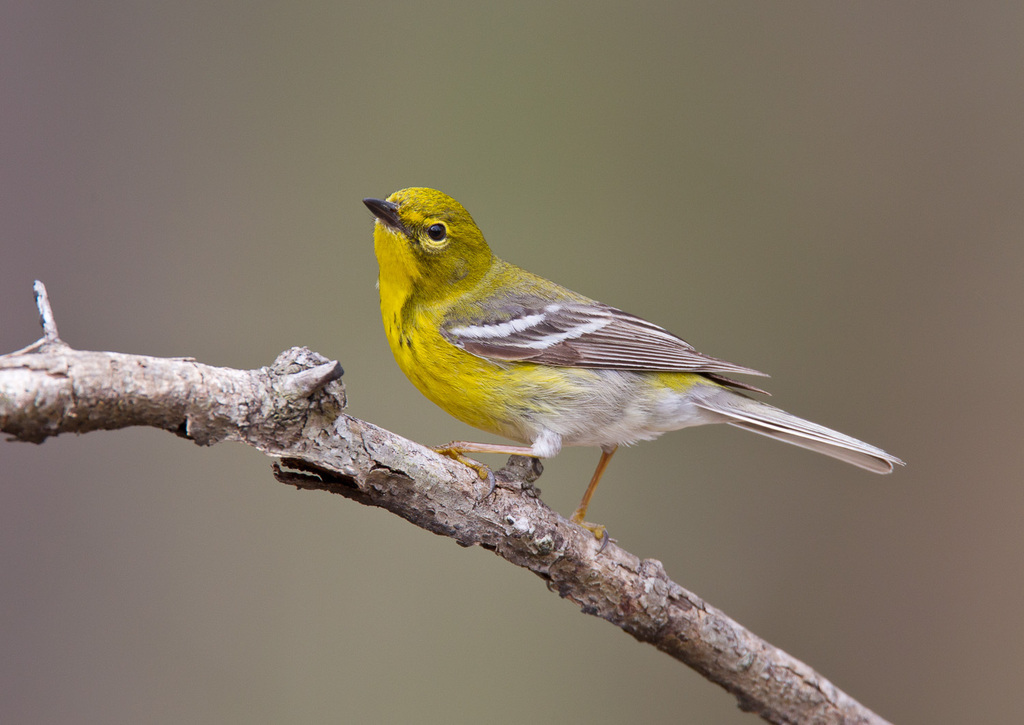
The pine warbler (Setophaga pinus) is a small songbird of the New World warbler family Parulidae. It is a permanent resident in the southeastern United States and also breeds in southeastern Canada and the northeastern United States, where it is migratory. Unlike other wood-warblers, in addition to insects the pine warbler also sometimes consumes seeds.
From the article Pine warbler on Wikipedia (CC BY-SA), quoted section by section
Description
These birds have white bellies, two white wing bars, dark legs and thin, relatively long pointed bills; they have yellowish 'spectacles' around their eyes. Adult males have olive upperparts and bright yellow throats and breasts; females and immatures display upperparts which are olive-brown. Their throats and breasts are paler. The adult male pine warbler looks somewhat similar to the yellow-throated vireo which may cause some identification problems.
The song of this bird is a musical trill. Their calls are slurred chips.
Range & habitat
Their breeding habitats are open pine woods in eastern North America. These birds are permanent residents in southern Florida. Some of them, however, migrate to northeastern Mexico and islands in Bermuda and the Caribbean. The first record for South America was a vagrant wintering female seen at Vista Nieve, Colombia, on 20 November 2002; this bird was foraging as part of a mixed-species feeding flock that also included wintering Blackburnian and Tennessee warblers.
Wikipedia: “Distribution and habitat”
What it does
They forage slowly on tree trunks and branches by poking their bill into pine cones. These birds also find food by searching for it on the ground. These birds mainly eat insects, seeds and berries. Their nests are deep, open cups, which are placed near the end of a tree branch. Pine warblers prefer to nest in pine trees, hence their names. Three to five blotched white eggs are laid.
Wikipedia: “Behavior”
Listen
Looking for field recordings…
Where it lives
Recorded sightings
—
geo-referenced records in GBIF, from museums, herbaria and field observers.
Drag the globe to turn it. Dots are where records exist, not a range map; darker means more records.
In the stacks
Searching the stacks…
Every page naming Setophaga pinus in the Biodiversity Heritage Library →
This page is assembled live from iNaturalist, GBIF, Wikipedia, the Source Library and the Internet Archive. It is not yet part of the hand-edited codex. iNaturalist taxon 145244.