On eBird ↗
Brown-eared Bulbul
Live sightings near you, the range map, bar charts of when it is seen, and Macaulay Library photos and recordings.
Brown-eared Bulbul
Hypsipetes amaurotis
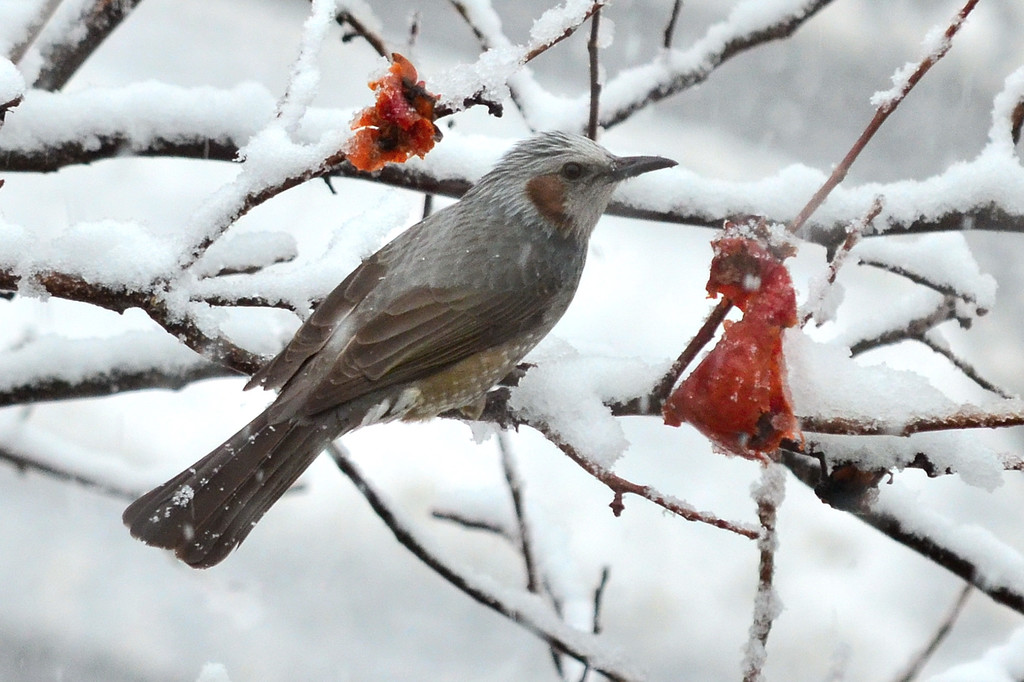
The brown-eared bulbul (Hypsipetes amaurotis) is a medium-sized bulbul native to eastern Asia. It is extremely common within the northern parts of its range and is a familiar bird throughout Japan and Korea, but in Taiwan is rare and limited to Orchid Island.
From the article Brown-eared bulbul on Wikipedia (CC BY-SA), quoted section by section
Description
Reaching a length of about 28 cm (11 in), brown-eared bulbuls are grayish-brown, with brown cheeks (the "brown ears" of the common name) and a long tail. While they prefer forested areas, they readily adapt to urban and rural environments, and their noisy squeaking calls are a familiar sound in most areas of Japan. Flocks of brown-eared bulbuls produce loud "shreep" and "weesp" calls throughout the year. One author described the song of the brown-eared bulbul as "one of the most unattractive noises made by any bird".
Range & habitat
The brown-eared bulbul is common in a very large range that includes the Russian Far East (including Sakhalin), northeastern China, the Korean Peninsula, and Japan, south to Taiwan and the Babuyan and Batanes island chains in the north of the Philippines. Historically, brown-eared bulbuls were migratory birds moving to the southern parts of their range in winter, but they have taken advantage of changes in crops and farming practices in recent decades to overwinter in areas farther north than previously possible. Most brown-eared bulbuls still move south in winter, often forming huge flocks during migration. They are considered agricultural pests in some areas of Japan where they may invade orchards and damage crops such as cabbages, cauliflowers and spinach.
Wikipedia: “Distribution and habitat”
What it does
In summer, brown-eared bulbuls primarily feed on insects, while they mostly take fruits (like berries and citrus) and seeds in the fall and winter. At this time, they also feed on the nectar from Camellia flowers, becoming dusted with yellow pollen in the process. In this way they help to pollinate the flowers at a time of year when there are few insect pollinators around.
Wikipedia: “Feeding”
Listen
Looking for field recordings…
Where it lives
Recorded sightings
—
geo-referenced records in GBIF, from museums, herbaria and field observers.
Drag the globe to turn it. Dots are where records exist, not a range map; darker means more records.
In the stacks
Searching the stacks…
Every page naming Hypsipetes amaurotis in the Biodiversity Heritage Library →
This page is assembled live from iNaturalist, GBIF, Wikipedia, the Source Library and the Internet Archive. It is not yet part of the hand-edited codex. iNaturalist taxon 144910.