- Animals
- ›Chordates
- ›Vertebrates
- ›Mammals
- ›Therians
- ›Placental Mammals
- ›Primates, Rodents, and Allies
- ›Primates
- ›Monkeys, Apes, and Tarsiers
- ›Monkeys and Apes
- ›Apes and Old World Monkeys
- ›Old World Monkeys
- ›Cercopithecines
- ›Guenons, Vervet Monkeys, and Talapoins
- ›Allochrocebus
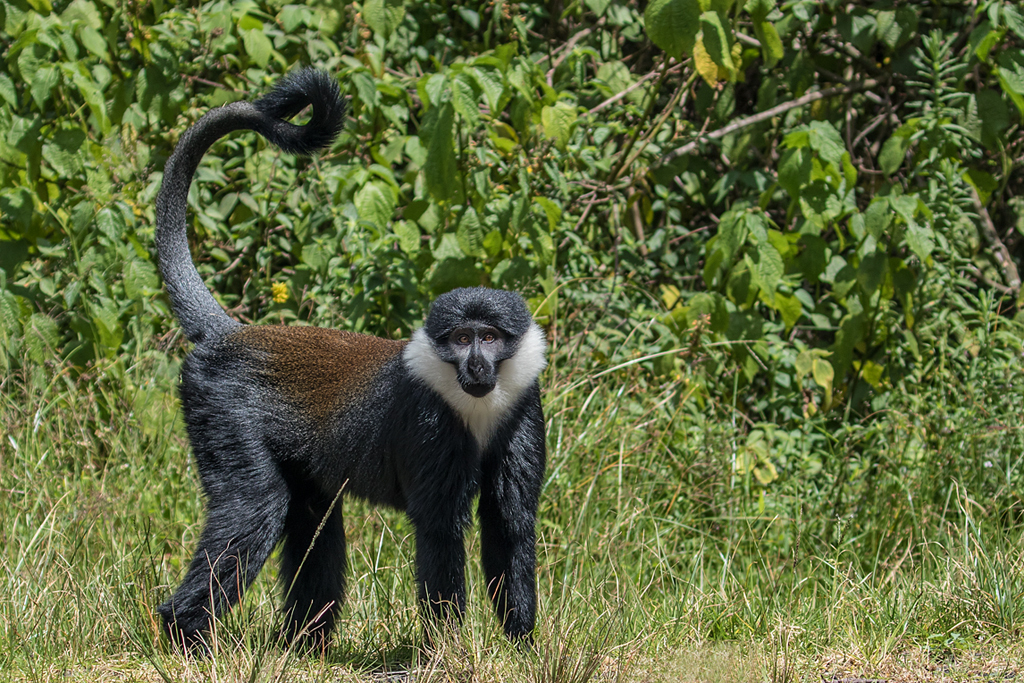
L'Hoest's Monkey
Allochrocebus lhoesti
L'Hoest's monkey (Allochrocebus lhoesti), also known as the mountain monkey, is a guenon found in the upper eastern Congo Basin. They mostly live in mountainous forest areas in small, female-dominated groups. They have a dark coat and can be distinguished by a characteristic white beard.
From the article L'Hoest's monkey on Wikipedia (CC BY-SA), quoted section by section
Range & habitat
L'Hoest's monkey occurs in northeastern Democratic Republic of the Congo, Rwanda, Burundi, and western Uganda. It is a forest monkey, which is typical of the moist and high primary forests. It will occupy a range of different kinds of forested areas, including gallery forest, mature lowland rain forests, wooded savanna at mountain slopes, and forest borders. However, it also will live on cultivated lands. In lowland forests it shows a preference toward areas where the forest is regenerating, while in mountain areas it will frequent the mature, tangled, undergrowth below the broken canopy. One study found this population only above 900 metres (3,000 ft) but another found it as low as 610 metres (2,000 ft). Another mostly observed it from 1,500 to 2,500 metres (4,900 to 8,200 ft).
Wikipedia: “Habitat and distribution”
What it does
C. lhoesti lives in fairly small groups dominated by females and have only a single male. The females are usually related, while the male stays only a couple of weeks or at most a couple of years. The adult male will make very loud and distinct calls. They are active during the day, mostly during early morning and late afternoon. They sleep in trees in a sitting position, usually either holding branches or each other. When they are alarmed or see they are being observed, they will flee and take shelter in trees, and after become very still. They are mostly terrestrial.
Reproduction. L'Hoest's monkey breeds seasonally, with the timing depending on the area. After about a five-month gestation period, a single young will be born. The mother gives birth typically at night and where ever she happens to be at the time. Birth usually occurs at the end of the dry season, which allows lactation when rainfall is highest. She will eat the placenta and lick the baby clean while it hangs on to her belly. The other females in the group will show much interest in the newborn and will try to hold it. After a few months, nursing becomes less frequent, but will continue for about two years when there is another birth. When male offspring reach sexual maturity, they will leave the group. In captivity, they have been known to live for more than 30 years.
Diet. …
Wikipedia: “Behavior”
Listen
Looking for field recordings…
Where it lives
Recorded sightings
—
geo-referenced records in GBIF, from museums, herbaria and field observers.
Drag the globe to turn it. Dots are where records exist, not a range map; darker means more records.
In the stacks
Searching the stacks…
Every page naming Allochrocebus lhoesti in the Biodiversity Heritage Library →
This page is assembled live from iNaturalist, GBIF, Wikipedia, the Source Library and the Internet Archive. It is not yet part of the hand-edited codex. iNaturalist taxon 566540.