- Animals
- ›Chordates
- ›Vertebrates
- ›Reptiles
- ›Snakes and Lizards
- ›Lizards
- ›Glass, alligator, monitor lizards and allies
- ›Glass and Alligator Lizards
- ›Glass Lizards
- ›Anguis
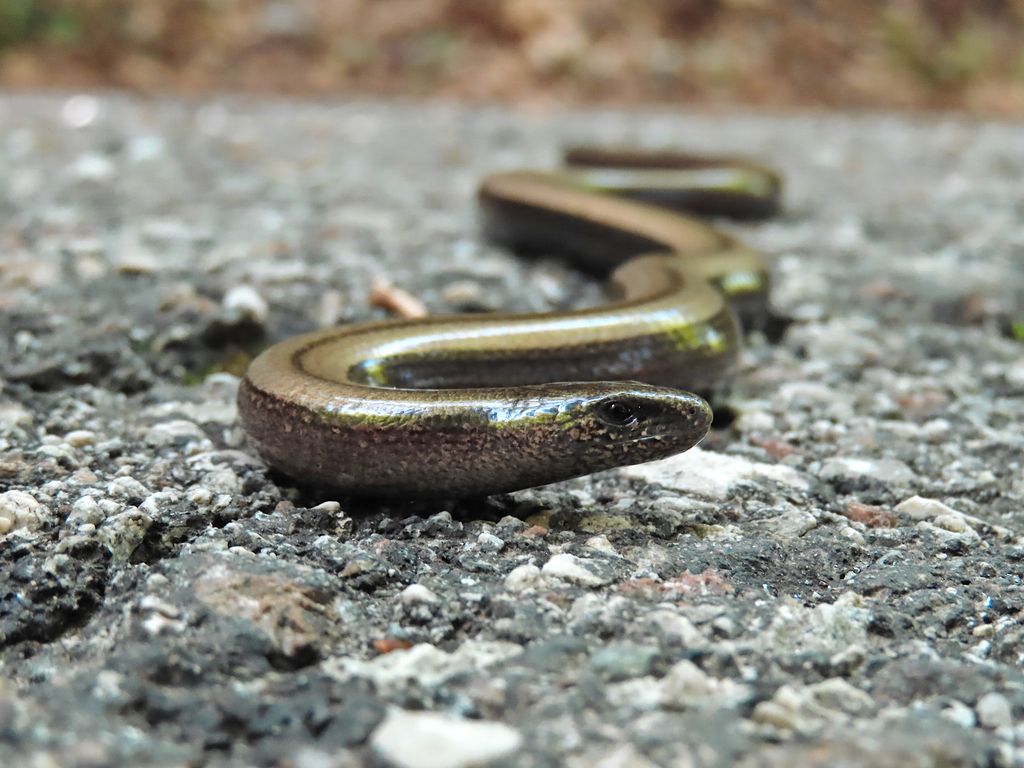
Italian Slowworm
Anguis veronensis
Anguis veronensis, commonly known as the Italian slow worm, is a European lizard species in the family Anguidae. The slow worm is distributed throughout Italy and in southeastern part of France.
A. veronensis got its first scientific description in 1818, when it was described by Italian naturalist Ciro Polinni, and named after the Italian city Verona, where specimens were found. The synonymous species name Anguis cinerea (cinereus) is derived from the Latin word cinereus meaning ash-grey, even though typical gray colour is a common feature of the whole genus Anguis, especially the similar common slow worm, Anguis fragilis.
From the article Anguis veronensis on Wikipedia (CC BY-SA), quoted section by section
Range & habitat
For now, this anguid species has been observed only in Italy and some parts of France. Some experts hypothesize the slow worm's remotest area of distribution also includes southern parts of Switzerland. The species' main territories are located on the Italian Peninsula, with animals populating the whole peninsula but its southeastern parts. The Italian slow worm is more common in northern Italy, while populations in southern parts of the country are smaller. In north and northeastern Italy, as well as in Slovenia (only hybrids found), the Italian slow worm sometimes comes in contact with the common slow worm, resulting in occasional hybridization. Anguis veronensis inhabits exclusively the far southeastern mainland France, region Provence-Alpes-Côte d'Azur. The species' presence has also been confirmed on the Mediterranean island Ile Sainte-Marguerite, with animals being genetically related to mainland slow worms of Provence-Alpes-Côte d'Azur. The northern populations' common habitats include various forest-steppe, steppe and ruderal areas, with some animals inhabiting urban surfaces. Slow worms of central and southern regions of Italy usually inhabit less diverse collection of habitats; borders of oak and beech forests are the most common, followed by sand dunes of Mediterranean characteristic maquis shrubland. …
Wikipedia: “Distribution and ecology”
Where it lives
Recorded sightings
—
geo-referenced records in GBIF, from museums, herbaria and field observers.
Drag the globe to turn it. Dots are where records exist, not a range map; darker means more records.
In the stacks
Searching the stacks…
Every page naming Anguis veronensis in the Biodiversity Heritage Library →
This page is assembled live from iNaturalist, GBIF, Wikipedia, the Source Library and the Internet Archive. It is not yet part of the hand-edited codex. iNaturalist taxon 343020.