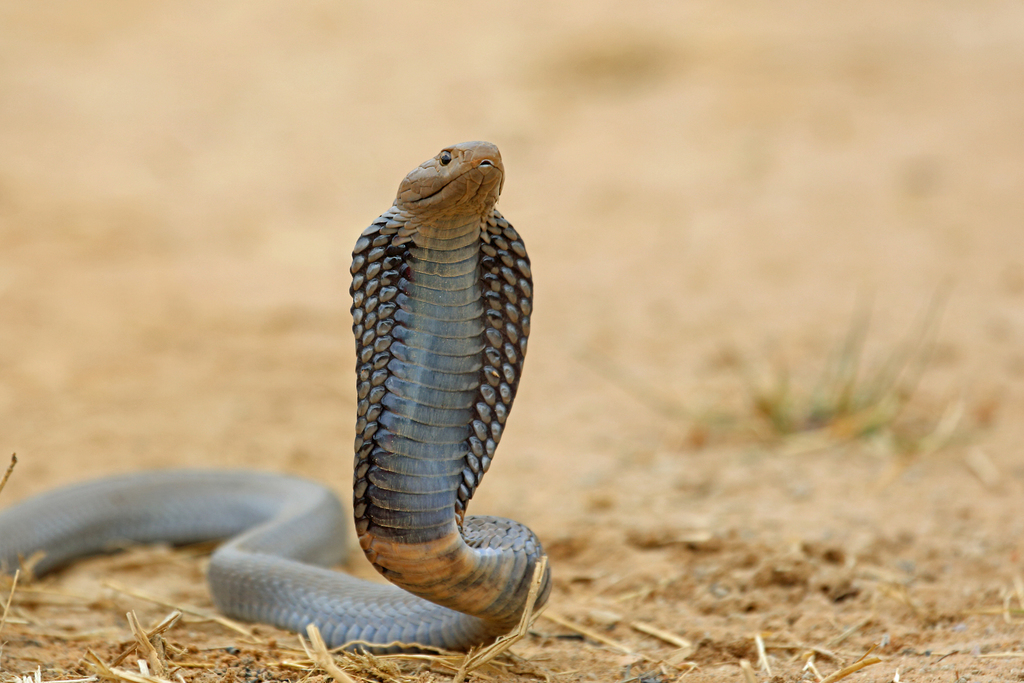
Black-necked Spitting Cobra
Naja nigricollis
The black-necked spitting cobra (Naja nigricollis) is a species of spitting cobra found mostly in sub-Saharan Africa. They are moderately sized snakes that can grow to a length of 1.2 to 2.2 m (3.9 to 7.2 ft) in length. Their coloration and markings can vary considerably. They prey primarily on small rodents. They possess medically significant venom, although the mortality rate for untreated bites on humans is relatively low (~ 5–10%, in endemic regions under 1%). Like other spitting cobras, they can eject venom from their fangs when threatened (one drop over 7 metres (23 ft) and more in perfect accuracy). The cytotoxic venom irritates the skin, causing blisters and inflammation, and can cause permanent blindness if the venom makes contact with the eyes and is not washed off.
Naja nigricollis belongs to the cobra genus Naja under the family Elapidae. It previously included two subspecies that have been moved to the species Naja nigricincta – the zebra spitting cobra (Naja nigricincta nigricincta) and the black spitting cobra (Naja nigricincta woodi).
From the article Black-necked spitting cobra on Wikipedia (CC BY-SA), quoted section by section
Description
N. nigricollis is a moderately sized, venomous snake with a moderately distinct head; the shape of the head is due primarily to two large venom glands found on each side of the head. Its colour can vary depending on region of origin. Some specimens are black or pale grey with a yellow or reddish ventral side with a broad, black neck band, often with an orange or pinkish bar on the neck. Other specimens can be yellowish-brown or have a yellow copper colour and are missing the bandings around the neck and the reddish colour on the belly. Some other specimens are deep reddish-brown, and yet others are an olive brown. Some can even be striped black and white or totally white (with dark eyes). There are 21–23 dorsal scales at the mid-body, 182–196 ventral scales, and 54–66 subcaudal scales. This species generally grows to a length of 1.2 metres (3.9 ft) to 2.2 metres (7.2 ft). These sizes are subject to trends based on geographic location and subspecies.
Range & habitat
The species is very common and is widespread through much of sub-Saharan Africa and is found in western, eastern, central, and parts of southern Africa. It is absent from the rainforests of the Congo Basin. It has been recorded from Angola, Benin, Burkina Faso, Cameroon, Central African Republic, Chad, Democratic Republic of the Congo (except in the center), Congo, Ethiopia, Gabon, Ghana, Guinea Bissau, Guinea, Ivory Coast, Kenya, Liberia, Mali, Niger, Nigeria, Senegal, Sierra Leone, Gambia, Mauritania, Sudan, Tanzania, Somalia, Togo, Uganda, Zambia. Older records from South Africa, Botswana, Zimbabwe, Eswatini, Mozambique, or most of Namibia refer to Naja mossambica or Naja nigricincta, which were formerly regarded as subspecies of N. nigricollis. N. nigricollis usually inhabits savanna and semi-desert regions of Africa. However, they can be found at altitudes up to 1,800 metres (5,900 ft), as well as in tropical and subtropical regions of central Africa in moist savanna and cleared former forest regions, particularly near rivers and streams. Adaptable snakes, Naja n. nigricollis occurs in southeastern Nigeria where their habitat has been transformed from rainforest to man-made farmlands, plantations, suburban areas, and a few fragmented forests. This species of cobra has found advantages in the drastic changes which have taken place in Nigeria's rainforests. …
Wikipedia: “Distribution and habitat”
What it does
Unlike other snakes, Naja nigricollis can be either nocturnal or diurnal depending on the time of year, geographic location, and average daytime temperature. This adaptability allows the snake to better regulate its body temperature and to gain access to the most abundant food sources of a particular area. It feeds primarily on small rodents, such as small rats and mice, birds, and fishes, but will also eat lizards, eggs, and other snakes. Like other snakes, it may fall prey to raptors, especially different species of snake eagles that migrate to Africa when it is winter in the Northern Hemisphere. The short-toed snake eagle (Circaetus gallicus) may be a particular threat, as it is almost strictly an ophiophagus raptor. Other snakes also prey on this species. Like other spitting cobras, this species is known for its ability to project venom at a potential threat. The venom is an irritant to the skin and eyes. If it enters the eyes, symptoms include extreme burning pain, loss of coordination, partial loss of vision, and permanent blindness. N. nigricollis is known for its tendency to liberally spit venom and bite with only the slightest provocation. This species is sometimes found in captivity, and wild-caught individuals are generally nervous and prone to spitting. Captive-bred animals tend to be much more docile and calm when compared to their wild-caught counterparts.
Wikipedia: “Behavior”
Toxicity
The venom of Naja nigricollis is somewhat unusual among elapids in that it consists primarily of cytotoxins, but with other components also. It retains the typical elapid neurotoxic properties while combining these with highly potent cytotoxins (necrotic agents) and cardiotoxins. Bite symptoms include severe external hemorrhaging and tissue necrosis around the bite area and difficulty breathing. Although the mortality rate in untreated cases is low (~ 5–10%), when death occurs, it is usually due to asphyxiation by paralysis of the diaphragm. The LD50 of Naja nigricollis is 2 mg/kg SC and 1.15 mg/kg IV. The average venom yield per bite of this species is 200 to 350 mg (dry weight) according to Minton (1974).
Wikipedia: “Venom”
Where it lives
Recorded sightings
—
geo-referenced records in GBIF, from museums, herbaria and field observers.
Drag the globe to turn it. Dots are where records exist, not a range map; darker means more records.
In the stacks
Searching the stacks…
Every page naming Naja nigricollis in the Biodiversity Heritage Library →
This page is assembled live from iNaturalist, GBIF, Wikipedia, the Source Library and the Internet Archive. It is not yet part of the hand-edited codex. iNaturalist taxon 30476.