- Animals
- ›Chordates
- ›Vertebrates
- ›Ray-finned Fishes
- ›Spiny-rayed fishes
- ›Mackerels, Tunas, Butterfishes, and Allies
- ›Scombroidei
- ›Mackerels, Tunas, and Bonitos
- ›Scombrinae
- ›Scomber
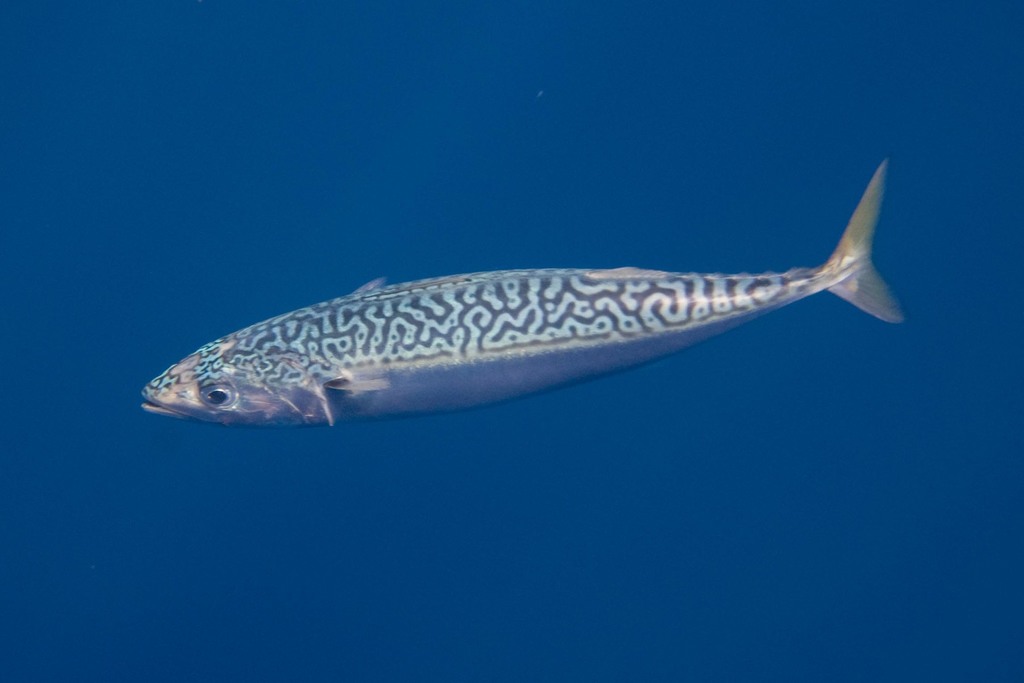
Pacific Chub Mackerel
Scomber japonicus
The chub mackerel, Pacific mackerel, or Pacific chub mackerel (Scomber japonicus) is a species of fish in the tuna and mackerel family, Scombridae. This species of mackerel closely resembles the Atlantic chub mackerel.
From the article Chub mackerel on Wikipedia (CC BY-SA), quoted section by section
Description
The chub mackerel has a well-developed swim bladder attached with the esophagus, which the "true mackerels" in the genus Scomber lack, and a characteristic color difference is seen between the chub and the Atlantic chub, the latter being silvery-sided below the midline, whereas the lower part of the sides of the chub (otherwise colored somewhat like the Atlantic) are mottled with small dusky blotches, and the chub has a larger eye than the Atlantic. Less obvious differences are that the dorsal fins are closer together in the chub and only 9 or 10 spines are in its first dorsal fin instead of 11 or more, which is the usual count in the Atlantic mackerel. In most species, the mackerel is known to travel in large schools. It is a smaller fish than its better-known relatives, growing to a length around 8 to 14 inches (20 to 36 cm).
Wikipedia: “Characteristics”
Range & habitat
Chub mackerel are widespread in the Indo-Pacific. They are absent from the Indian Ocean except for a small range in South Africa from KwaZulu-Natal to Western Cape. In the Atlantic, they are replaced by the closely related Atlantic chub mackerel. The chub mackerel is widely distributed, usually found in the northwestern, southeastern, and northeastern Pacific. In the eastern Pacific, it can be found from Southeast Alaska to central Mexico. Chub mackerel are generally found within 20 miles (32 km) off the coast in waters between 50 and 72 °F (10 and 22 °C). Young mackerel live around sandy beaches or kelp beds, while adults are found in deeper waters in shallow banks to 1,000 feet (300 m) deep. Chub mackerel school with other pelagic species, such as other types of mackerels and sardines. In 2015, a new species of mackerels were found in the Indian Ocean classified as Scomber indicus.
Wikipedia: “Distribution”
What it does
As larvae, chub mackerel feed mainly on copepods and rotifers and sometimes even smaller larvae of their own kind. Chub mackerel larvae can consume up to 87% of their dry body weight a day. As juveniles, chub mackerel feed mainly on zooplankton. As adults, they feed on mysids and euphausids.
Wikipedia: “Diet”
At the table
According to nutrition specialists, the chub mackerel is a healthy meal, high in protein and rich in omega-3 and unsaturated fatty acids. Due to its high energy and protein intake, and low carbohydrate value, it is recommended in the diets of growing children and pregnant women, although it may contain high levels of heavy metals. The chub mackerel is a popular dish in Sicilian cuisine, in which it is served in a variety of ways. In the Sicilian culture, the chub mackerel is called a variety of names, strummu ucchiutu, varatulu scrummu, or occhiutu. In the kitchen and market, the fish is in the best condition if the meat is firm and the eyes are clear with the colors bright. For the most part, it is eaten fresh, but can be seen pickled or frozen. In Sicilian cuisine, it is also served filleted and raw, marinated in oil, lemon, salt, and pepper. Jorim is a Korean dish made with tofu, vegetables, meat and seafood. Mackerel is also one of the most popular foods for Koreans as jorim.
Wikipedia: “As food”
Where it lives
Recorded sightings
—
geo-referenced records in GBIF, from museums, herbaria and field observers.
Drag the globe to turn it. Dots are where records exist, not a range map; darker means more records.
In the stacks
Searching the stacks…
Every page naming Scomber japonicus in the Biodiversity Heritage Library →
This page is assembled live from iNaturalist, GBIF, Wikipedia, the Source Library and the Internet Archive. It is not yet part of the hand-edited codex. iNaturalist taxon 69840.