- Animals
- ›Chordates
- ›Vertebrates
- ›Mammals
- ›Therians
- ›Placental Mammals
- ›Ungulates, Carnivorans, and Allies
- ›Even-toed Ungulates and Cetaceans
- ›Suids and Peccaries
- ›Suids
- ›Suines
- ›Typical Pigs
- ›Sus
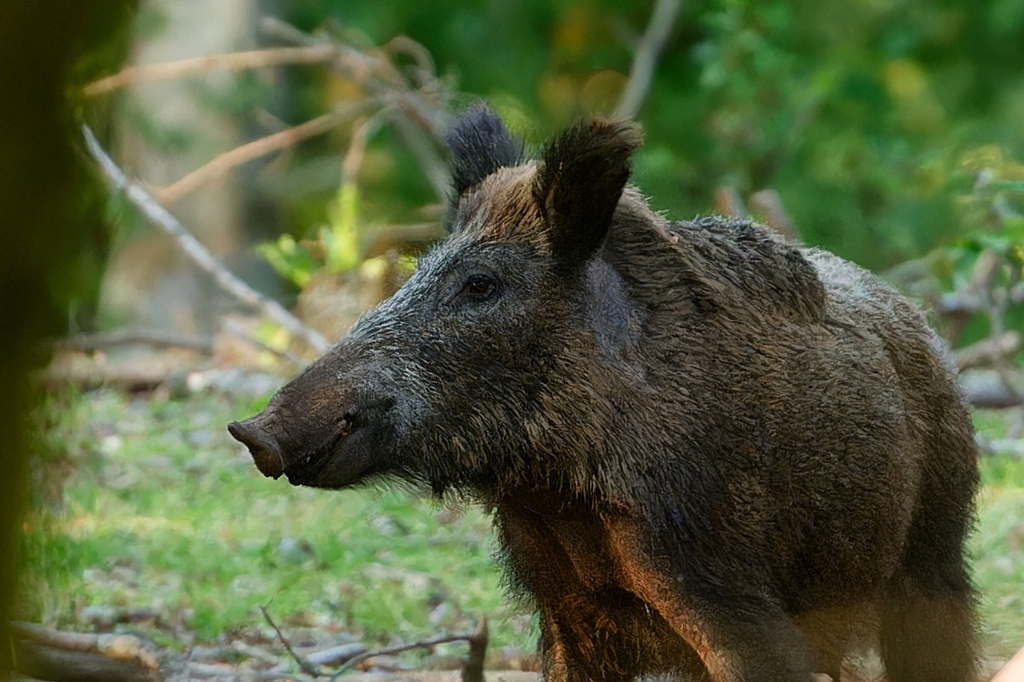
Wild Boar
Sus scrofa
The wild boar (Sus scrofa), also known as the wild swine, common wild pig, Eurasian wild pig, or simply wild pig, is a suid native to much of Eurasia and North Africa and has been introduced to the Americas and Oceania. The species is now one of the widest-ranging mammals in the world as well as the most widespread suiform. It has been assessed as least concern on the IUCN Red List due to its wide range, high numbers, and adaptability to a diversity of habitats. It has become an invasive species in part of its introduced range. Wild boars probably originated in Southeast Asia during the Early Pleistocene and outcompeted other suid species as they spread throughout the Old World. However, extensive interspecific introgression among suids has complicated the reconstruction of wild boar origins. A 2026 genomic study instead placed their origin in tropical continental Asia, with wild boars expanding from South Asia during the Middle Pleistocene and later spreading into Southeast Asian islands and across Eurasia.
As of 2005, up to 16 subspecies are recognized, which are divided into four regional groupings based on skull height and lacrimal bone length. The species lives in matriarchal societies consisting of interrelated females and their young (both male and female). Fully grown males are usually solitary outside the breeding season. The wolf is the wild boar's main predator in most of its natural range except in the Far East and the Lesser Sunda Islands, where it is replaced by the tiger and Komodo dragon respectively.
From the article Wild boar on Wikipedia (CC BY-SA), quoted section by section
Description
The wild boar is a bulky, massively built suid with short and relatively thin legs. The trunk is short and robust, while the hindquarters are comparatively underdeveloped. The region behind the shoulder blades rises into a hump and the neck is short and thick to the point of being nearly immobile. The animal's head is very large, taking up to one-third of the body's entire length. The structure of the head is well suited for digging. The head acts as a plough, while the powerful neck muscles allow the animal to upturn considerable amounts of soil: it is capable of digging 8–10 cm (3–4 in) into frozen ground and can upturn rocks weighing 40–50 kg (88–110 lb). The eyes are small and deep-set and the ears long and broad. The species has well developed canine teeth, which protrude from the mouths of adult males. The medial hooves are larger and more elongated than the lateral ones and are capable of quick movements. The animal can run at a maximum speed of 40 km/h (25 mph) and jump at a height of 140–150 cm (55–59 in). Sexual dimorphism is very pronounced in the species, with males being typically 5–10% larger and 20–30% heavier than females. Males also sport a mane running down the back, which is particularly apparent during autumn and winter. The canine teeth are also much more prominent in males and grow throughout life. …
Range & habitat
The wild boar inhabits a diverse array of habitats from boreal taigas to deserts. In mountainous regions, it can even occupy alpine zones, occurring up to 1,900 m (6,200 ft) in the Carpathians, 2,600 m (8,500 ft) in the Caucasus and up to 3,600–4,000 m (11,800–13,100 ft) in the mountains in Central Asia and Kazakhstan. In order to survive in a given area, wild boars require a habitat fulfilling three conditions: heavily brushed areas providing shelter from predators, water for drinking and bathing purposes and an absence of regular snowfall. The main habitats favored by boars in Europe are deciduous and mixed forests, with the most favorable areas consisting of forest composed of oak and beech enclosing marshes and meadows. In the Białowieża Forest, the animal's primary habitat consists of well-developed broad-leaved and mixed forests, along with marshy mixed forests, with coniferous forests and undergrowths being of secondary importance. Forests made up entirely of oak groves and beeches are used only during the fruit-bearing season. This is in contrast to the Caucasian and Transcaucasian mountain areas, where boars will occupy such fruit-bearing forests year-round. In the mountainous areas of the Russian Far East, the species inhabits nutpine groves, hilly mixed forests where Mongolian oak and Korean pine are present, swampy mixed taiga and coastal oak forests. …
Wikipedia: “Habitat and sheltering”
What it does
Boars are typically social animals, living in female-dominated sounders consisting of barren sows and mothers with young led by an old matriarch. Male boars leave their sounder at the age of 8–15 months, while females either remain with their mothers or establish new territories nearby. Subadult males may live in loosely knit groups, while adult and elderly males tend to be solitary outside the breeding season.
The breeding period in most areas lasts from November to January, though most mating only lasts a month and a half. Prior to mating, the males develop their subcutaneous armour in preparation for confronting rivals. The testicles double in size and the glands secrete a foamy yellowish liquid. Once ready to reproduce, males travel long distances in search of a sounder of sows, eating little on the way. Once a sounder has been located, the male drives off all young animals and persistently chases the sows. At this point, the male fiercely fights potential rivals. A single male can mate with 5–10 sows. By the end of the rut, males are often badly mauled and have lost 20% of their body weight, with bite-induced injuries to the penis being common. The gestation period varies according to the age of the expecting mother. For first-time breeders, it lasts 114–130 days, while it lasts 133–140 days in older sows. …
Wikipedia: “Social behaviour and life cycle”
At the table
Humans have been hunting boar for millennia, the earliest artistic depictions of such activities dating back to the Upper Paleolithic. At some archaeological sites in China dating back to the Holocene Climatic Optimum (HCO), boar composed up to 73% of all medium and large mammal remains, indicating heavy reliance on these suids as a food source. The animal was seen as a source of food among the Ancient Greeks, as well as a sporting challenge and source of epic narratives. The Romans inherited this tradition, with one of its first practitioners being Scipio Aemilianus. Boar hunting became particularly popular among the young nobility during the 3rd century BC as preparation for manhood and battle. A typical Roman boar hunting tactic involved surrounding a given area with large nets, then flushing the boar with dogs and immobilizing it with smaller nets. The animal would then be dispatched with a venabulum, a short spear with a crossguard at the base of the blade. More than their Greek predecessors, the Romans extensively took inspiration from boar hunting in their art and sculpture. …
Wikipedia: “As a game animal and food source”
In human culture
While domestic pigs, both captive and feral (popularly termed "razorbacks"), have been in North America since the earliest days of European colonization, pure wild boars were not introduced into the New World until the 19th century. The suids were released into the wild by wealthy landowners as big game animals. The initial introductions took place in fenced enclosures, though several escapes occurred, with the escapees sometimes intermixing with already established feral pig populations. The first of these introductions occurred in New Hampshire in 1890. Thirteen wild boars from Germany were purchased by Austin Corbin from Carl Hagenbeck and released into a 9,500-hectare (23,000-acre) game preserve in Sullivan County. Several of these boars escaped, though they were quickly hunted down by locals. Two further introductions were made from the original stocking, with several escapes taking place due to breaches in the game preserve's fencing. These escapees have ranged widely, with some specimens having been observed crossing into Vermont. In 1902, 15–20 wild boar from Germany were released into a 3,200-hectare (7,900-acre) estate in Hamilton County, New York. Several specimens escaped six years later, dispersing into the William C. …
Wikipedia: “History”
Listen
Looking for field recordings…
Where it lives
Recorded sightings
—
geo-referenced records in GBIF, from museums, herbaria and field observers.
Drag the globe to turn it. Dots are where records exist, not a range map; darker means more records.
In the old herbals & bestiaries

History of All Cloven-Hoofed Quadrupeds
Ulisse Aldrovandi · 1621 · p.1080

Introductory Book
Michael Scot · 1350 · p.107

Ortus sanitatis
1491 · p.510

History of the Northern Peoples
Olaus Magnus · 1555 · p.680

Theater of Earthly Creatures
Anonymous · 1672 · p.158

Cosmographey: das ist Beschreibung aller Laender
Münster, Sebastian · 1598 · p.1051

Introductory Book
Michael Scot · 1350 · p.108

Introductory Book
Michael Scot · 1350 · p.133

本草綱目圖3卷. [3]
Li Shizhen · 1596 · p.52

Compendium of Materia Medica
李時珍 · 1596 · p.78

Sancai Tuhui (Vol. 101)
王圻, 王思義 · 1609 · p.46

Illustrated Herbal Primer
Chen Jiamo (陳嘉謨) · 1628 · p.294
In the stacks
Searching the stacks…
Every page naming Sus scrofa in the Biodiversity Heritage Library →
This page is assembled live from iNaturalist, GBIF, Wikipedia, the Source Library and the Internet Archive. It is not yet part of the hand-edited codex. iNaturalist taxon 42134.