John Dory
Zeus faber
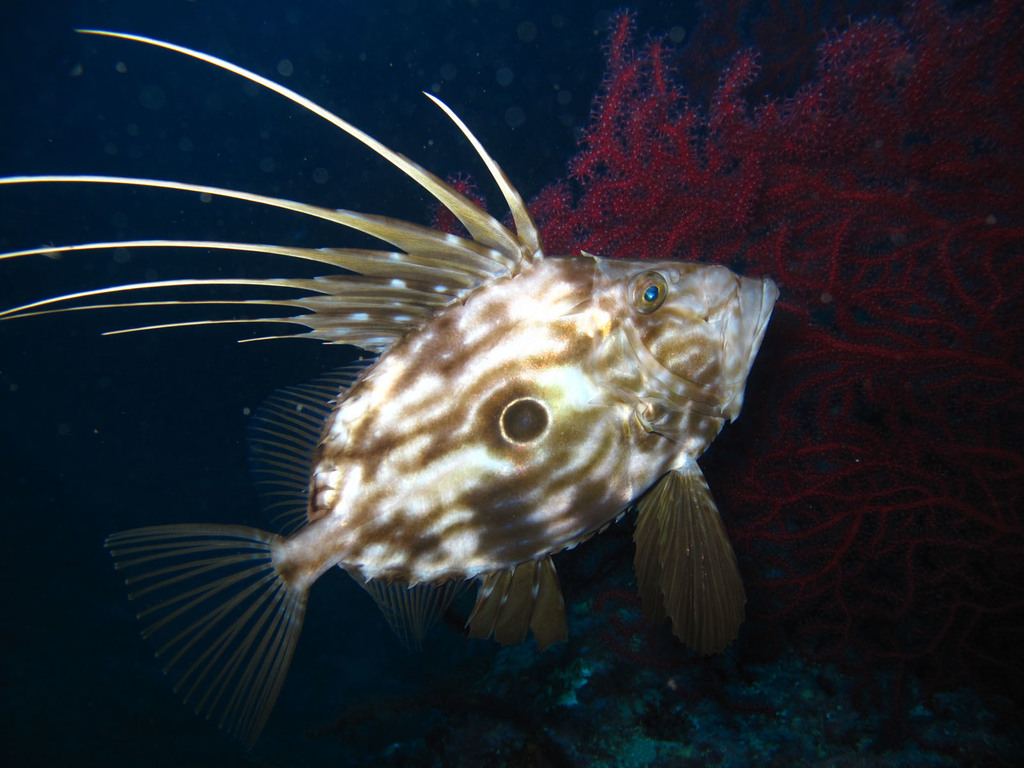
John Dory, St Pierre, or Peter's fish are names which refers to fish of the genus Zeus, especially Zeus faber, which is a demersal coastal marine fish. This widespread species has a laterally compressed olive-yellow body which has a large dark spot, and long spines on the dorsal fin. Its large eyes at the front of the head provide it with binocular vision and depth perception, which are important for predators. The John Dory's eye spot on the side of its body also confuses prey, which are scooped up in its large mouth.
From the article John Dory on Wikipedia (CC BY-SA), quoted section by section
Description
The John Dory grows to a maximum size of 90 cm (35 in) and a maximum weight of 8 kg (18 lb), though more typically 65 cm (26 in) for females, and 45 cm (18 in) for males. It has 9 to 11 long spines on its dorsal fin and 4 spines on its anal fin. It has microscopic, sharp scales that run around the body. The fish is yellowish-brown to olive green with a paler greyish belly, and has a dark spot on its side. Its eyes are near the top of its head. It has a flat, round body shape and is a poor swimmer.
Wikipedia: “Morphology”
Range & habitat
John Dory are benthopelagic coastal fish, found in the Mediterranean Sea and the northeast Atlantic Ocean off the coasts of northern Africa and southern and western Europe north to Norway, though scarce north of Ireland and southern England. It also occurs in the seas off Southeast Asia, New Zealand, Australia, and the coasts of Japan. They live near the seabed, living in depths from 5 to 360 metres (20 to 1,180 ft). They are normally solitary. John Dory are more commonly found in the waters of the North Island of New Zealand than the colder waters surrounding the South Island.
Wikipedia: “Habitat”
At the table
In New Zealand, Māori know it as kuparu, and on the East Coast of the North Island, they gave some to Captain James Cook on his first voyage to New Zealand in 1769. Several casks of them were pickled. Cookery writer Eliza Acton in her 1845 book Modern Cookery for Private Families observed that John Dory "though of uninviting appearance, is considered by some persons as the most delicious fish that appears at table". She recommends simply baking it "very gently", to avoid drying it out in the oven. John Dory is a popular choice among professional chefs due to the versatility of the fish, though access to home cooks is limited; the bycatch fish is not typically sold at supermarkets. The "dory" or "dori" sold in certain fish markets, such as those of Indonesia, are more likely to be fillets of various shark catfish species (such as Pangasius) and not of the John Dory.
Wikipedia: “As food”
In human culture
When John Dories are three or four years of age, they are ready to reproduce. They lay pelagic eggs, which become part of the plankton. Typical lifespan is about 12 years in the wild.
Wikipedia: “Life history”
Where it lives
Recorded sightings
—
geo-referenced records in GBIF, from museums, herbaria and field observers.
Drag the globe to turn it. Dots are where records exist, not a range map; darker means more records.
In the old herbals & bestiaries


In the stacks
Searching the stacks…
Every page naming Zeus faber in the Biodiversity Heritage Library →
This page is assembled live from iNaturalist, GBIF, Wikipedia, the Source Library and the Internet Archive. It is not yet part of the hand-edited codex. iNaturalist taxon 118622.