- Animals
- ›Chordates
- ›Vertebrates
- ›Reptiles
- ›Snakes and Lizards
- ›Lizards
- ›Wall lizards, amphisbaenians, and allies
- ›Wall Lizards
- ›Lacertinae
- ›Podarcis
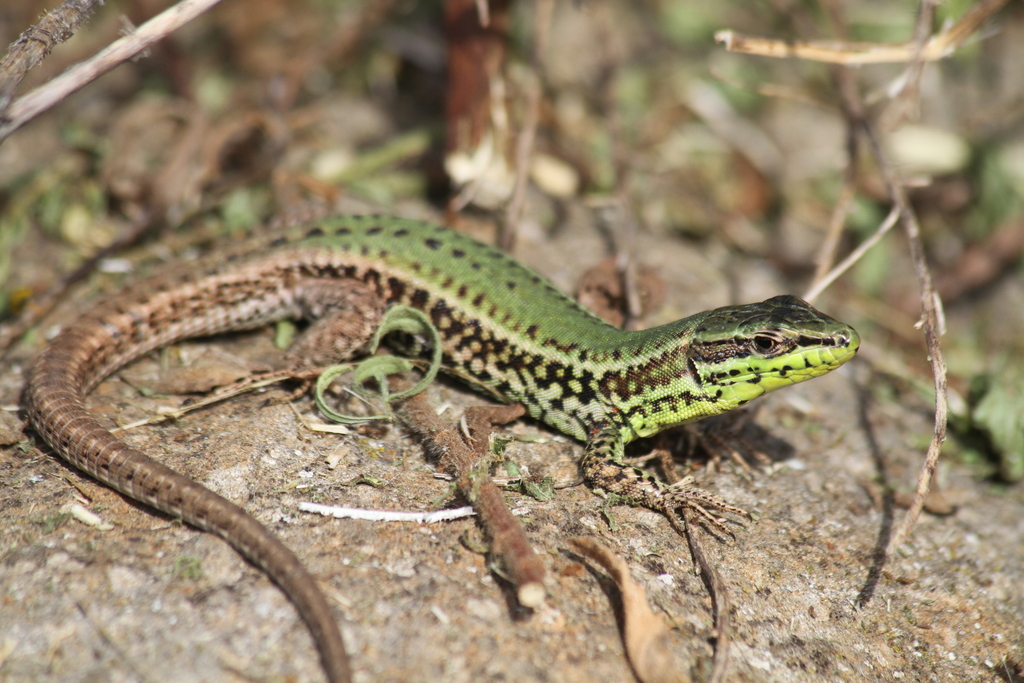
Sicilian Wall Lizard
Podarcis waglerianus
The Sicilian wall lizard (Podarcis waglerianus) is a species of lizard in the family Lacertidae. Endemic to Italy, it occurs in Sicily and the Aegadian Islands. Its natural habitats are temperate forests, temperate shrubland, Mediterranean-type shrubby vegetation, temperate grassland, arable land, pastureland, and rural gardens. The IUCN does not consider it to be a threatened species. Three subspecies are recognized: P. w. antoninoi, P. w. marettimensis, and P. w. waglerianus.
From the article Sicilian wall lizard on Wikipedia (CC BY-SA), quoted section by section
Description
The Sicilian wall lizard grows to a length around 7.5 cm (3 in), with males being slightly larger than females. The dorsal surface is usually green, but some females may be olive or brownish. Usually, it has a well-defined white or yellow dorsolateral stripe and often a brown stripe, or series of dots, running along the spine. Other dark spots occur in rows on the back and flanks of males, but females are often a more uniform colour. The underparts are white, with a spotted throat, but may be suffused with orange, pink, or red in breeding males. The Sicilian wall lizard differs from island populations of the Italian wall lizard in having a deeper head, more slender form, more speckled (rather than reticulated) markings, and the brighter colour of the underparts.
Range & habitat
The species is endemic to Sicily and the Aegadian Islands. It frequents areas with lush vegetation on the edges of woodland, bushy slopes, pasture, and cultivated land. It is often present in gardens, especially irrigated ones. In contrast to the Italian wall lizard, it does not climb much and occupies more densely vegetated areas. It is the more common wall lizard inland, while the Italian wall lizard is the more common near the coast.
Wikipedia: “Distribution and habitat”
In human culture
The specific name, waglerianus, is in honor of German herpetologist Johann Georg Wagler.
Wikipedia: “Etymology”
Where it lives
Recorded sightings
—
geo-referenced records in GBIF, from museums, herbaria and field observers.
Drag the globe to turn it. Dots are where records exist, not a range map; darker means more records.
In the stacks
Searching the stacks…
Every page naming Podarcis waglerianus in the Biodiversity Heritage Library →
This page is assembled live from iNaturalist, GBIF, Wikipedia, the Source Library and the Internet Archive. It is not yet part of the hand-edited codex. iNaturalist taxon 73922.