- Animals
- ›Chordates
- ›Vertebrates
- ›Mammals
- ›Therians
- ›Placental Mammals
- ›Primates, Rodents, and Allies
- ›Primates
- ›Monkeys, Apes, and Tarsiers
- ›Monkeys and Apes
- ›New World Monkeys
- ›Cebid Monkeys
- ›Capuchins
- ›Sapajus
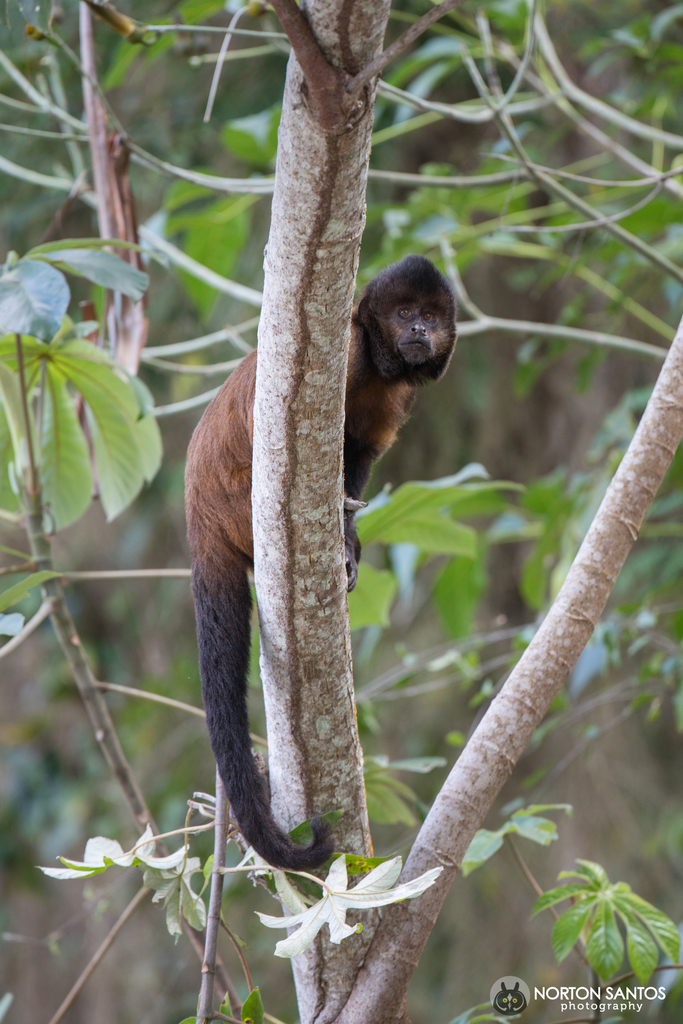
Crested Capuchin
Sapajus robustus
The crested capuchin or robust tufted capuchin (Sapajus robustus) is a species of robust capuchin monkey. It is endemic to Brazil. It was formerly considered a subspecies of the black capuchin but is now considered by some to be a separate species.
From the article Crested capuchin on Wikipedia (CC BY-SA), quoted section by section
Description
The crested capuchin, unlike other species of capuchins, has a conical crest on the crown which is bright red with a black spot. This cone may also continue around the sides of the head to create a black beard. The rest of the fur may be brownish red or yellowish brown. The forearms, lower legs, and tail of the crested capuchin are all black, although these areas may be a mix of black and light yellow fur in females. Females also may have two lateral tufts on their crown that the males do not have. Crested capuchins have a head-body length of 33–57 centimetres (13–22 in) and a tail length of 40–47 centimetres (16–19 in). The males are generally larger than the females of the species. They can weigh from 2.0–3.8 kilograms (4.4–8.4 lb).
Wikipedia: “Characteristics”
Range & habitat
The crested capuchin formerly occurred between the Doce and Jequitinhonha rivers, in Espírito Santo, Minas Gerais and Bahia, on the Atlantic coast of Brazil. However, due to loss of habitat, their current range has been restricted in Bahia, eastern Minas Gerais, south of Rio Jequitinhonha and north of Rio Doce. It generally frequents the mid-canopy to understory of tropical lowland and sub-montane forests, but may also live in semi-deciduous dry forests in the western part of their range.
Wikipedia: “Distribution and habitat”
What it does
The species has a broad diet, including fruits, seeds, and arthropods, as well as frogs or even small mammals. They are very skilled at manipulating food items to reach the food they want. While no crested capuchins have been recorded using tools, it is very possible that they do. Other species of robust capuchins that have been studied more, such as the black capuchin, have been documented using stones to open food items such as fruits with hard shells or oysters. Given the similarities between the two species and their ranges, crested capuchins may also use tools in this way. No observations have been made specifically on the crested capuchin, but they likely live in linear hierarchies that span both sexes, with the top-ranking male dominating the top-ranking female, similar to other closely related species of capuchin. Males ranked lower than the dominant male may also be a part of capuchin groups, but they often remain on the peripheral of the group.
Wikipedia: “Ecology”
Listen
Looking for field recordings…
Where it lives
Recorded sightings
—
geo-referenced records in GBIF, from museums, herbaria and field observers.
Drag the globe to turn it. Dots are where records exist, not a range map; darker means more records.
In the stacks
Searching the stacks…
Every page naming Sapajus robustus in the Biodiversity Heritage Library →
This page is assembled live from iNaturalist, GBIF, Wikipedia, the Source Library and the Internet Archive. It is not yet part of the hand-edited codex. iNaturalist taxon 499235.