On eBird ↗
Congo Pied Hornbill
Live sightings near you, the range map, bar charts of when it is seen, and Macaulay Library photos and recordings.
Congo Pied Hornbill
Lophoceros fasciatus
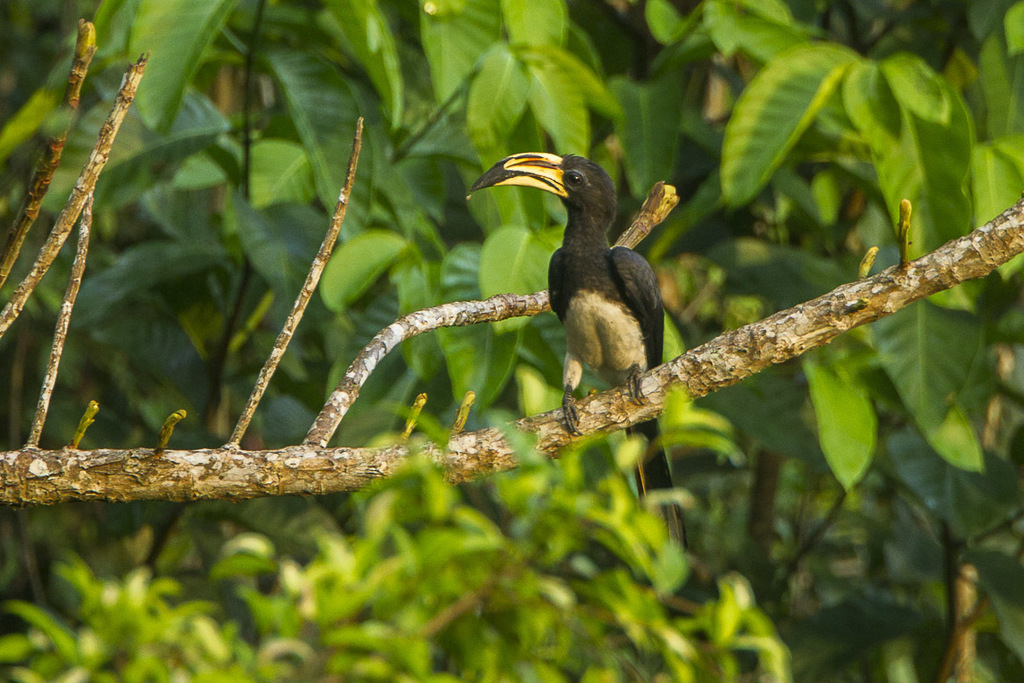
The Congo pied hornbill (Lophoceros fasciatus) is a bird of the hornbill family, a family of tropical birds found in the Old World.
The Congo pied hornbill is native to the Congo Basin. This is a bird of mainly forest habitats. The female lays up to four white eggs in a tree hole, which is blocked off during incubation with a cement made of mud, droppings and fruit pulp. There is only one narrow aperture, just big enough for the male to transfer food to the mother and the chicks.
From the article Congo pied hornbill on Wikipedia (CC BY-SA), quoted section by section
Description
This is a large bird, 54 centimetres (21 in) in length. It has mainly black plumage, with white belly and tail tip. The long, curved black and yellow bill has a medium-sized casque. The sexes are similar, but the female has a smaller casque. Immature birds are duller, have a smaller bill, and no casque. The flight is undulating.
Wikipedia: “Morphology”
What it does
The Congo pied hornbill is omnivorous and eats fruit and insects. It feeds mainly in trees and is attracted to oil palms. This conspicuous and gregarious bird advertises its presence with its whistling pii-pii-pii-pii- call. When the chicks and the female are too big to fit in the nest, the mother breaks out and rebuilds the wall. Then both parents feed the chicks.
Wikipedia: “Behaviour”
Listen
Looking for field recordings…
Where it lives
Recorded sightings
—
geo-referenced records in GBIF, from museums, herbaria and field observers.
Drag the globe to turn it. Dots are where records exist, not a range map; darker means more records.
In the stacks
Searching the stacks…
Every page naming Lophoceros fasciatus in the Biodiversity Heritage Library →
This page is assembled live from iNaturalist, GBIF, Wikipedia, the Source Library and the Internet Archive. It is not yet part of the hand-edited codex. iNaturalist taxon 512162.