- Animals
- ›Chordates
- ›Vertebrates
- ›Reptiles
- ›Snakes and Lizards
- ›Lizards
- ›Glass, alligator, monitor lizards and allies
- ›Glass and Alligator Lizards
- ›Glass Lizards
- ›Anguis
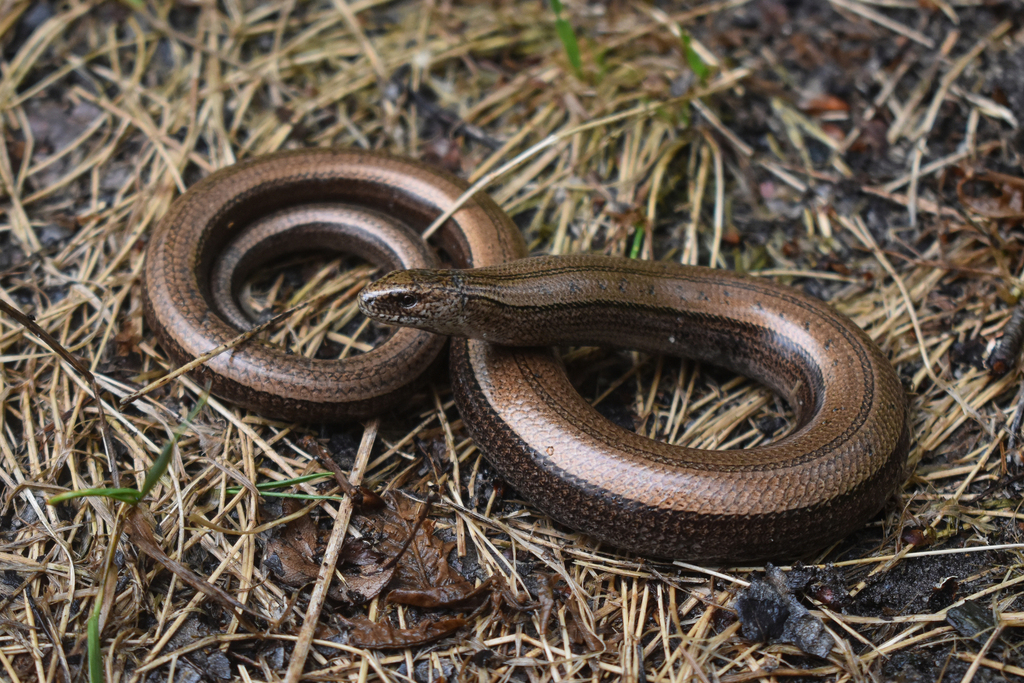
Eastern Slowworm
Anguis colchica
Anguis colchica, the eastern slow worm, is a species of legless lizard in the family Anguidae found in eastern and northern Europe and Asia. It is easily confused with the common slow worm, due to their physical similarities, and the proximity of their distribution.
From the article Anguis colchica on Wikipedia (CC BY-SA), quoted section by section
Range & habitat
Eastern slow worms live primarily in areas with partially closed, forest or shrub vegetation. They can be found most often on the edges of forests, forest clearings, and sometimes on tourist trails, where they can lie down to bask in the sun. They utilise stone piles, stone fences, coarse woody debris, and even the burrows of some rodents as hiding places. They commonly venture into gardens close to their habitat.
Wikipedia: “Habitat”
What it does
Eastern slow worms are mostly crepuscular animals, but are sometimes found to be active during the daytime, especially after rain. Their diet consists of small, slow moving invertebrates such as earthworms, slugs and insect larvae. The mating season of the species is usually between the end of April, and the beginning of June. Slow worms hibernate during the winter, starting from mid-October. During this time, they settle under logs, roots, in rock crevices or in rodent passages.
Wikipedia: “Behaviour”
Where it lives
Recorded sightings
—
geo-referenced records in GBIF, from museums, herbaria and field observers.
Drag the globe to turn it. Dots are where records exist, not a range map; darker means more records.
In the stacks
Searching the stacks…
Every page naming Anguis colchica in the Biodiversity Heritage Library →
This page is assembled live from iNaturalist, GBIF, Wikipedia, the Source Library and the Internet Archive. It is not yet part of the hand-edited codex. iNaturalist taxon 145895.