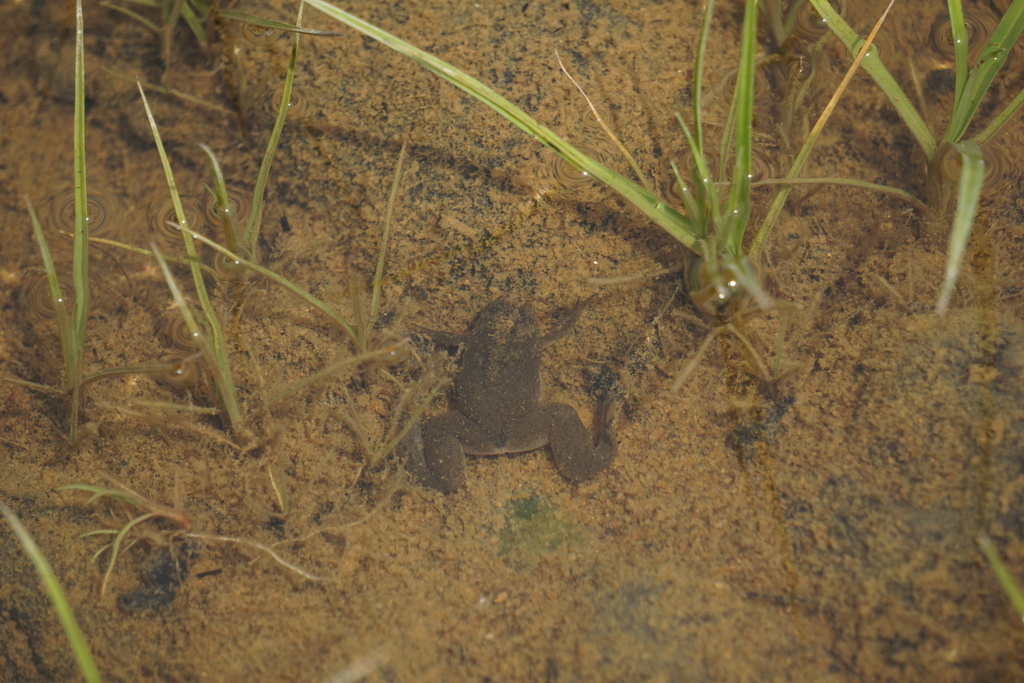
Tropical Clawed Frog
Xenopus tropicalis
The western clawed frog (Xenopus tropicalis) is a species of frog in the family Pipidae, also known as tropical clawed frog. It is the only species in the genus Xenopus to have a diploid genome. Its genome has been sequenced, making it a significant model organism for genetics that complements the related species Xenopus laevis (the African clawed frog), a widely used vertebrate model for developmental biology. X. tropicalis also has a number of advantages over X. laevis in research, such as a much shorter generation time (<5 months), smaller size (4–6 cm (1.6–2.4 in) body length), and a larger number of eggs per spawn.
It is found in Benin, Burkina Faso, Cameroon, Ivory Coast, Equatorial Guinea, Gambia, Ghana, Guinea, Guinea-Bissau, Liberia, Nigeria, Senegal, Sierra Leone, Togo, and possibly Mali. Its natural habitats are subtropical or tropical moist lowland forests, moist savanna, rivers, intermittent rivers, swamps, freshwater lakes, intermittent freshwater lakes, freshwater marshes, intermittent freshwater marshes, rural gardens, heavily degraded former forests, water storage areas, ponds, aquaculture ponds, and canals and ditches.
From the article Western clawed frog on Wikipedia (CC BY-SA), quoted section by section
Description
The western clawed frog is a medium-sized species with a somewhat flattened body and a snout-vent length of 28 to 55 mm (1.1 to 2.2 in), females being larger than males. The eyes are bulging and situated high on the head and there is a short tentacle just below each eye. A row of unpigmented dermal tubercles runs along the flank from just behind the eye, and are thought to represent a lateral line organ. The limbs are short and plump, and the fully webbed feet have horny claws. The skin is finely granular. The dorsal surface varies from pale to dark brown and has small grey and black spots. The ventral surface is dull white or yellowish with some dark mottling.
Range & habitat
The western clawed frog is an aquatic species and is found in the West African rainforest belt with a range stretching from Senegal to Cameroon and eastern Zaire. It is generally considered a forest-dwelling species and inhabits slow-moving streams, but it is also found in pools and temporary ponds in the northern Guinea and Sudan savannas.
Wikipedia: “Distribution and habitat”
Listen
Looking for field recordings…
Where it lives
Recorded sightings
—
geo-referenced records in GBIF, from museums, herbaria and field observers.
Drag the globe to turn it. Dots are where records exist, not a range map; darker means more records.
In the stacks
Searching the stacks…
Every page naming Xenopus tropicalis in the Biodiversity Heritage Library →
This page is assembled live from iNaturalist, GBIF, Wikipedia, the Source Library and the Internet Archive. It is not yet part of the hand-edited codex. iNaturalist taxon 134636.