- Animals
- ›Chordates
- ›Vertebrates
- ›Ray-finned Fishes
- ›Spiny-rayed fishes
- ›Jacks, Flounders, Barracudas, and Allies
- ›Jacks, Remoras, and Allies
- ›Jacks
- ›Caranginae
- ›Scyris
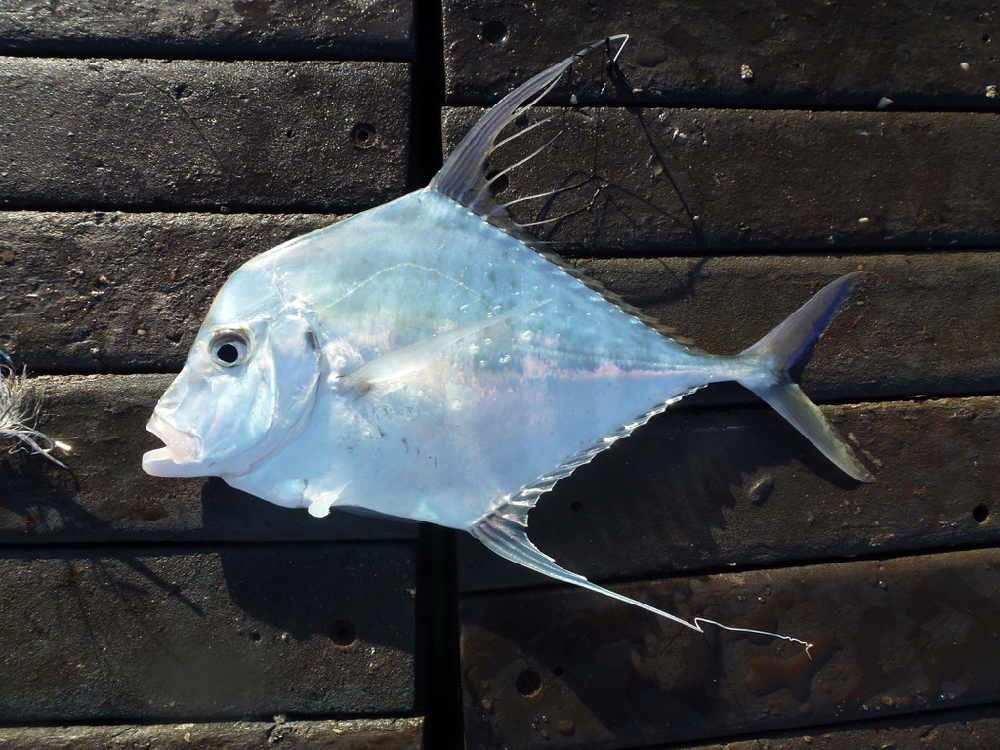
Diamond Trevally
Scyris indica
The Indian threadfish (Alectis indica), also known as the Indian threadfin, diamond trevally, mirror fish or plumed trevally, is a large species of coastal marine fish of the jack family, Carangidae. The species is widespread in the waters of the tropical Indo-West Pacific Ocean, ranging from east Africa to India, Asia, Indonesia and Australia. Adult fish tend to inhabit coastal waters over reefs down to 100 m in depth, while juveniles inhabit a variety of environments including estuaries and seagrass beds. The Indian threadfish is similar to the other two species in the genus Alectis, with a slight concavity in the profile of the head the most obvious distinguishing feature. It is a large species, growing to 165 cm and 25 kg in weight. The species is carnivorous, consuming fishes, cephalopods and crustaceans.
The Indian threadfish is of minor commercial importance, and has been the subject of aquaculture in Singapore.
From the article Indian threadfish on Wikipedia (CC BY-SA), quoted section by section
Description
The Indian threadfish has the typical body structure of a large jack, with a distinctly angular, strongly compressed body. The major identifying feature of the species is its head profile, having a slight concavity near the eyes which distinguishes it from its close relatives in the genus Alectis. The dorsal profile of the fish is more curved than the ventral profile, and the body is deepest between the origins of the soft dorsal and soft anal fins. The first section of the dorsal fin consists of 5 to 7 visible spines, with the second section having one spine and 18 or 19 soft rays. The anal fin has two spines followed by a single spine and 15 or 16 soft rays. The pectoral fin is long and curved, extending beyond the junction of the straight and curved sections of the lateral line. The body appears to be scaleless, but on closer inspection has minute, deeply embedded scales. The lateral line is strongly curved anteriorly, with a section of 6 to 11 scutes toward the tail. Juveniles have long, filamentous trailing anal and dorsal fin spines, much like those of Alectis ciliaris. The species is known to grow to 165 cm and 25 kg. The body of adults is a silvery blue-green colour above, being darkest on the head and silver below. The upper operculum has a small diffuse dark spot. …
Range & habitat
The Indian threadfish inhabits the tropical regions of the Indian and Western Pacific Oceans, ranging from Madagascar, east Africa and the Red Sea to India, China, South East Asia, north to Japan and south to Indonesia and northern Australia. The easternmost report is that of a specimen taken off French Polynesia in the Pacific. The species is generally an inhabitant of coastal waters from depths of 20 m to 100 m, although the juveniles may be pelagic, riding ocean currents. In some years currents bring the juveniles as far south as Sydney, Australia where they inhabit of estuaries in the summer, before dying off in the cold winter. The African pompano shows a similar pattern in Australian waters. The juveniles are also known to inhabit estuaries in other regions (including South Africa) as well as seagrass beds. Adults generally inhabit areas of reef below 20 m.
Wikipedia: “Distribution and habitat”
What it does
The Indian threadfish is a predatory fish, consuming of a wide range of fishes, small squids, jellyfish and crustaceans. As with A. ciliaris, the trailing fins of juveniles are thought to resemble jellyfish medusae, causing predators to avoid the young fish. Relatively little is known about reproduction in the species, although observations made in Indonesia show spawning occurs in pairs at daytime between ebbing and flooding tides. The spawning area in this instance was a shoal of 35–45 m, located in a deeper channel between two islands.
Wikipedia: “Ecology”
Where it lives
Recorded sightings
—
geo-referenced records in GBIF, from museums, herbaria and field observers.
Drag the globe to turn it. Dots are where records exist, not a range map; darker means more records.
In the stacks
Searching the stacks…
Every page naming Scyris indica in the Biodiversity Heritage Library →
This page is assembled live from iNaturalist, GBIF, Wikipedia, the Source Library and the Internet Archive. It is not yet part of the hand-edited codex. iNaturalist taxon 1360118.