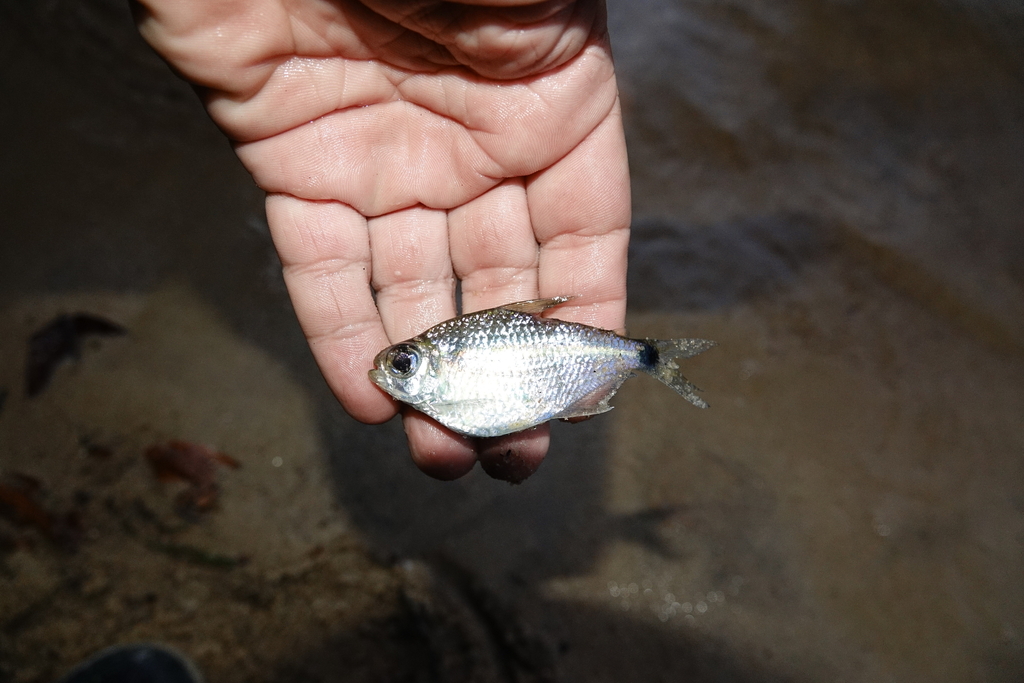
Tetragonopterus georgiae
Tetragonopterus georgiae (Géry, 1965)
Also calledTétra de Géorgie (fra) · tetra Georgiové (ces)
Descriptions from checklists and floras indexed by GBIF
description
Description. Morphometric data summarized in Table 4. Body shape compressed and deep. Greatest body depth at dorsal-fin origin. Dorsal profile slightly convex between tip of snout and vertical through middle of orbit; slightly concave from this point to end of occipital process; convex from tip of occipital process to dorsal-fin origin; then slightly convex between dorsal-fin origin and rear of adipose fin. Prepelvic region transversely flattened with distinct, longitudinally aligned lateral keels. Ventral profile of body slightly convex from lower lip to slightly behind vertical through pectoral-fin origin; convex from that point to anal-fin origin; straight along base of anal fin. Caudal peduncle with dorsal and ventral profiles slightly concaves. Olfactory lamellae 20 (3), 22 (2), 23 (1), 24 (1) or 25 (3). Mouth terminal. Upper and lower jaws of similar size. Premaxilla in two rows of relatively robust teeth. Outer row with 4 (7), 5 (9) or 6 (1) teeth with three cusps, central cusps longest. Inner row with 5 (14) or 6 (1) teeth with three or five cusps, central cusps twice as long as the lateral cusps. Maxilla with 2 (7) or 3 (8) either conic or tricuspidate teeth. Dentary beari
Revision of the South American genus Tetragonopterus Cuvier, 1816 (Teleostei: Characidae) with description of four new species
diagnosis
Diagnosis. Tetragonopterus georgiae is distinguished from all congeners, except T. rarus, by having 4.5 – 5.5 scale rows between lateral line and pelvic fin origin (vs. 3.5 scale rows). It can be diagnosed from T. rarus by the absence of longitudinal dark stripes on the trunk (vs. the presence of stripes). Tetragonopterus georgiae differs from T. anostomus, T. denticulatus, T. kuluene and T. juruena by having 4 principal teeth in dentary (vs. 5 – 6) and by having larger and more robust teeth (vs. thinner and sharper teeth). Tetragonopterus georgiae differs from T. anostomus and T. kuluene by the presence of two conspicuous humeral marks (vs. only one inconspicuous humeral mark); it also differs from T. anostomus by having a terminal mouth (vs. subsuperior mouth). Tetragonopterus georgiae differs from T. anostomus and T. araguaiensis by the presence of 10 – 12 gill rakers on the upper limb (vs. 17 – 20) and 7 – 8 gill rakers on the lower limb (vs. 10 – 12) of the first gill arch. Tetragonopterus georgiae also differs from T. argenteus by the presence of 8 predorsal scales (vs. 11 – 17), and from T. carvalhoi by the presence of a rounded dark mark on the caudal peduncle (vs. a lozeng
Revision of the South American genus Tetragonopterus Cuvier, 1816 (Teleostei: Characidae) with description of four new species
discussion
Remarks. Eigenmann’s (1917) definition of Moenkhausia is based on the presence of two parallel rows of premaxillary teeth, five or more teeth in the inner premaxillary tooth row, a completely pored lateral line, and the presence of scales covering the lobes of the caudal fin. Although Moenkhausia and Tetragonopterus are phenotypically similar in body shape, the later usually has a downward curved lateral line along with other apomorphic characters (Mirande 2010; Melo et al. 2011). Géry (1965) described M. georgiae and allocated it in Moenkhausia due to the non-proeminent curvature of the anterior portion of the lateral line. Later, Géry (1977) cited M. georgiae as “ a species strongly resembling Tetragonopterus chalceus. Four examined paratypes (ANSP 94708, ANSP 112246, ANSP 139714) (Fig. 5 a-b) have three supraneurals and a branched laterosensory canal in the sixth infraorbital, synapomorphies previously proposed for Tetragonopterus (Melo et al. 2011). The later authors discuss that such features are not present in any other species of Moenkhausia (including its type species, M. xinguensis), except M. georgiae. A molecular phylogeny of the genus Tetragonopterus placed M. georgiae
Revision of the South American genus Tetragonopterus Cuvier, 1816 (Teleostei: Characidae) with description of four new species
distribution
Distribution. Tetragonopterus georgiae is known from Siparuni, Rupununi and Potaro rivers of the Essequibo basin in Guyana; Río Nichare, Orinoco basin in Venezuela and the upper Rio Paru, a left tributary of the Amazon basin in northern Brazil. Vari et al. (2009) reported Moenkhausia georgiae (= T. georgiae) in French Guyana and Suriname. Mol et al. (2012) listed M. georgiae for the Corantijn, Nickerie, Coppename, Suriname, and Marowijne River basins of Suriname. Le Bail et al. (2012) reported M. georgiae for the Mana, Sinnamary, Comté, Orapu, Approuague, and Oyapock rivers of French Guyana at the boundary with Amapá in Brazil. We herein recorded T. georgiae for Venezuela at the Río Cuyuni (a tributary of Essequibo River) and Río Nichare (a tributary of Río Caura), the latter record extending the distribution of the species to the Río Orinoco basin. We also recorded T. georgiae in the upper Rio Paru, a left-margin tributary of the rio Amazonas with headwaters at the Guiana Shield (Fig. 2 a).
Revision of the South American genus Tetragonopterus Cuvier, 1816 (Teleostei: Characidae) with description of four new species
In the stacks
Searching the stacks…
Every page naming Tetragonopterus georgiae in the Biodiversity Heritage Library →
From the GBIF Backbone Taxonomy and occurrence records (GBIF.org), with Wikipedia and the Source Library. GBIF species 8901253.