- Animals
- ›Chordates
- ›Vertebrates
- ›Reptiles
- ›Snakes and Lizards
- ›Snakes
- ›Colubrid Snakes
- ›Natricine Snakes
- ›Rhabdophis
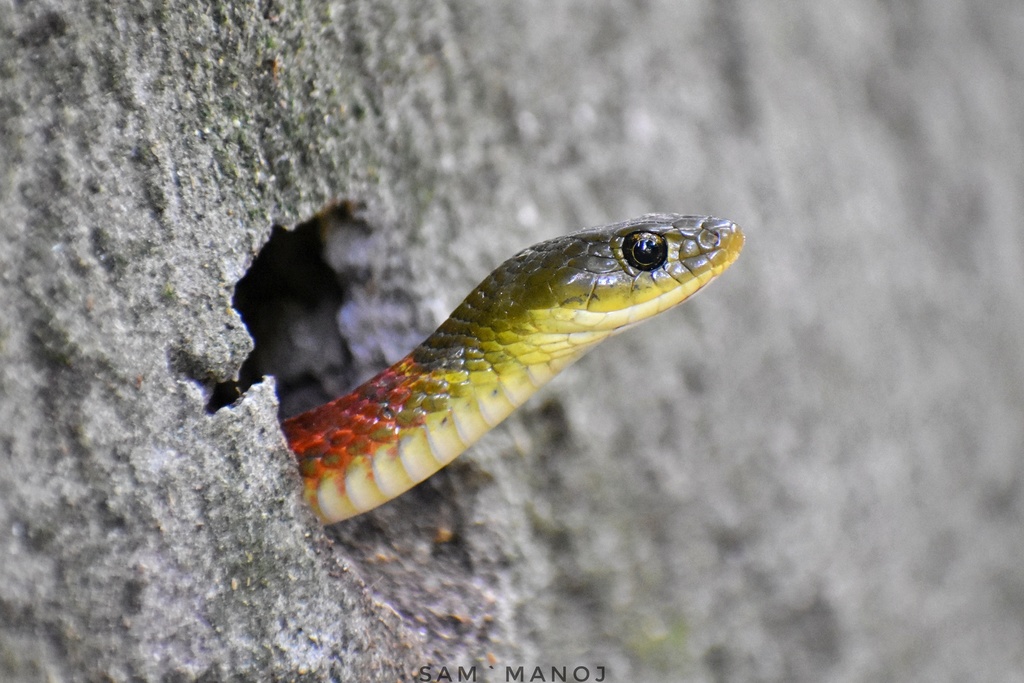
Red-necked Keelback
Rhabdophis subminiatus
Rhabdophis subminiatus, commonly called the red-necked keelback or red-necked keelback snake, is a species of venomous snake in the subfamily Natricinae of the family Colubridae. Unusual for colubrids, it is venomous.
From the article Rhabdophis subminiatus on Wikipedia (CC BY-SA), quoted section by section
Description
Rhabdophis subminiatus has a greenish hue with red and yellow regions near the head. It grows to 70 to 90 cm (27.5 to 35.5 in) in total length (including tail). Female is much larger than male. During mating, multiple males may swarm a single female.
Range & habitat
Rhabdophis subminiatus is restricted to the Indonesian islands of Java and Sumatra. Historically the species was considered to have a much wider distribution, but this changed when it was realized that the species was actually a species complex.
Wikipedia: “Geographic range”
What it does
The red-necked keelback generally lives near ponds, where it consumes frogs, fish, lizards and small mammals.
Wikipedia: “Habitat and diet”
Toxicity
Rhabdophis subminiatus is a rear-fanged species and was previously thought to be harmless. However, following one fatal and several near-fatal envenomations, the toxicity of its venom was investigated. As a result, it has recently been reclassified as a dangerous species. In general, rear-fanged snakes need to bite and hold on, or repeatedly bite, to have any effect on humans. But recently, there have been reports of cases where even brief bites have resulted in severe envenomation and organ failure, affecting the kidneys and liver. A chewing action facilitates envenomation, as the venom ducts open to fangs that are externally grooved (not hollow) and are posterior in the oral cavity. R. subminiatus has enlarged and ungrooved teeth. The species has two enlarged teeth in the back of the jaw. Located in the upper jaw is a gland known as Duvernoy's gland, which produces an extremely venomous secretion.
Symptoms caused by venom and poison. When the snake bites, the salivary venom mixture is not injected, but it flows into the punctures produced by the upper jaw's rear teeth, which can penetrate the skin of humans. The venom from R. subminiatus has been responsible for internal hemorrhaging, including hemorrhaging of the brain, as well as nausea, coagulopathy, and even disseminated intravascular coagulation. Also, when the venom was tested on animals, kidney failure was reported. …
Wikipedia: “Venom and poison”
In human culture
The specific name subminiatus refers to the typical reddish coloration ("miniatus" = "scarlet, vermilion"), which may be limited to the neck, or more extensive (e.g., photo at left). The subspecific name, helleri, is in honor of American zoologist Edmund Heller.
Wikipedia: “Etymology”
Where it lives
Recorded sightings
—
geo-referenced records in GBIF, from museums, herbaria and field observers.
Drag the globe to turn it. Dots are where records exist, not a range map; darker means more records.
In the stacks
Searching the stacks…
Every page naming Rhabdophis subminiatus in the Biodiversity Heritage Library →
This page is assembled live from iNaturalist, GBIF, Wikipedia, the Source Library and the Internet Archive. It is not yet part of the hand-edited codex. iNaturalist taxon 28827.