- Animals
- ›Chordates
- ›Vertebrates
- ›Mammals
- ›Therians
- ›Placental Mammals
- ›Primates, Rodents, and Allies
- ›Rodents
- ›Squirrels, Dormice, and Mountain Beavers
- ›Squirrels
- ›Ground and African Tree Squirrels
- ›Holarctic Ground Squirrels
- ›Marmota
- ›Marmota
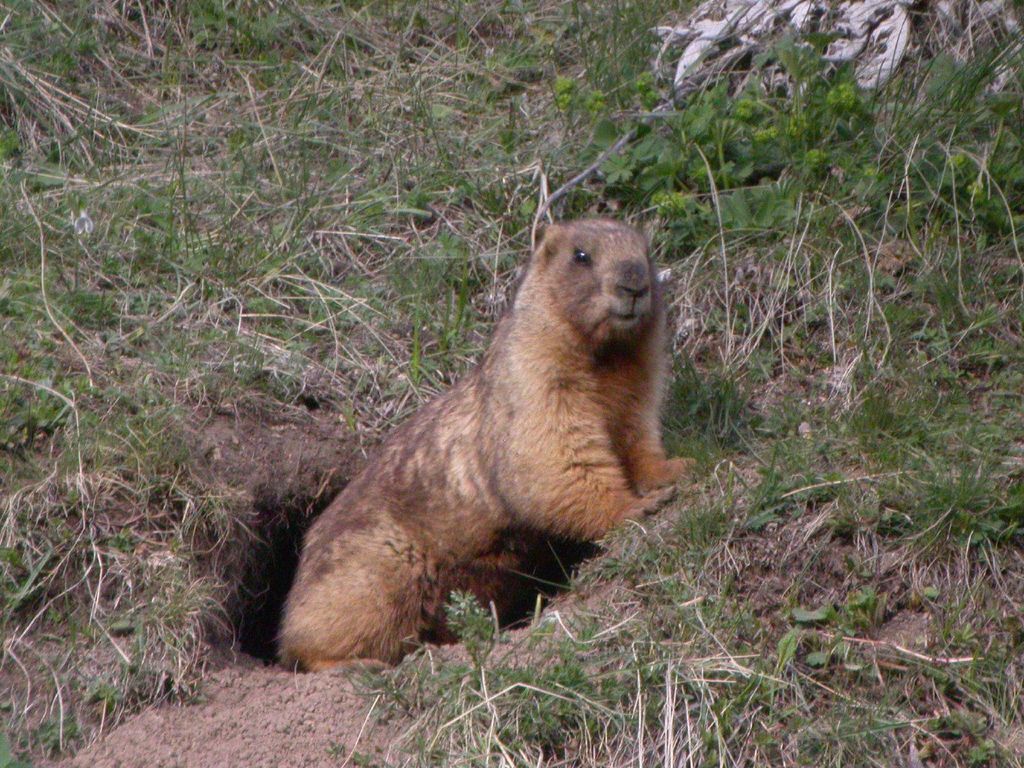
Grey Marmot
Marmota baibacina
The gray marmot, grey marmot, or Altai marmot (Marmota baibacina) is a species of rodent in the squirrel family Sciuridae. It is one of the larger marmots in the genus Marmota. It occurs in mountainous grasslands and shrub lands of central Asia, and is one of the 9 Palearctic (Eurasia) species. It is found in Xinjiang Province in China, southeastern Kazakhstan, Kyrgyzstan, Mongolia, and in the Altai and Tien Shan Mountains in southeastern Siberia in Russia. In the Mongolian Altai, its range overlaps with that of the Tarbagan marmot. Gray marmots form social groups, live in burrows, and hibernate.
From the article Gray marmot on Wikipedia (CC BY-SA), quoted section by section
Description
Gray marmots are one of the largest palearctic species, weighing 4 to 6.5 kg (9 to 14.5 pounds), with some individuals reaching near 8 kg (18 pounds) before hibernation. Body size varies based on the time of year (before/after hibernation), and with latitude and elevation. Overall, body size increases at higher latitude and elevation and decreases at lower latitudes and elevation. Gray marmots may lose up to 30% of body mass during long seasonal hibernation. They are short and stocky with brawny limbs and short tails. The total body length ranges from about 60 to 80 cm (25 to 30 inches) which includes the 13-to-15-centimetre-long (5 to 6 in) tail. Forefeet have 4 digits and strong claws for digging, while the hindfeet have 5 digits. On the dorsal (back) side, the fur is beige to tan with brown to black hairs or hair tips blended throughout giving the coat a gray appearance. The ventral (belly) side is a more orange-reddish brown. The length of the tail is much like the body but has a dark brown to black tip. The ears are small and round and light colored. The face is darker brown at the cheeks with lighter yellowish brown around the mouth. Albinism occurs in this species. Gray marmots are not known to exhibit sexual dimorphism (differences between males and females), but in most marmot species the adult males are larger than adult females. …
Range & habitat
Gray marmots live in mountain meadows and steppes, where they forage on sage bush in the spring, grasses and flowering plants in summer and fall. They occur in elevations from 150 to 4,000 m (490 to 13,120 feet), but may prefer mild to moderate well draining slopes with suitable soil for burrowing. The soil ranges from fine grained soft soil to soil including sand or pebbles. Their distribution extends from the Altai mountains of southwestern Siberia (Tuva, Russia), western Mongolia, northwestern China (Xinjiang), and eastern Kazakhstan, into the Tien Shan mountains of northwestern China, Kyrgyzstan, and southeastern Kazakhstan. In southeastern Kazakhstan and southwestern Siberia the range enters lower elevation, dry steppes. The gray marmot is an introduced species in the Caucasus mountains of Dagestan, Russia. In the Altai mountains of western Mongolia, the range overlaps with the Tarbagan marmot (Marmota sibirica). In this area of range overlap, competition restricts the gray marmot habitat to elevations above 3,000 m (9,800 feet) in areas with scattered boulders and rocks. Observation of hybridization between the two species and living in the same area are rare.
Wikipedia: “Distribution and habitat”
What it does
Gray marmots mate in early May, and often mate in burrows before they emerge from hibernation. Mating may be monogamous or polyandrous. Gestation last 40 days and the female gives birth to 2–6 babies. Females reach reproductive maturity at 2–3 years. Females alternate years of reproduction, and reabsorb embryos in harsh environmental conditions.
Wikipedia: “Reproduction”
Listen
Looking for field recordings…
Where it lives
Recorded sightings
—
geo-referenced records in GBIF, from museums, herbaria and field observers.
Drag the globe to turn it. Dots are where records exist, not a range map; darker means more records.
In the stacks
Searching the stacks…
Every page naming Marmota baibacina in the Biodiversity Heritage Library →
This page is assembled live from iNaturalist, GBIF, Wikipedia, the Source Library and the Internet Archive. It is not yet part of the hand-edited codex. iNaturalist taxon 46083.