- Animals
- ›Chordates
- ›Vertebrates
- ›Reptiles
- ›Snakes and Lizards
- ›Lizards
- ›Iguanas and Allies
- ›Dragons and Chameleons
- ›Dragons
- ›Flying Dragons and Allies
- ›Calotes
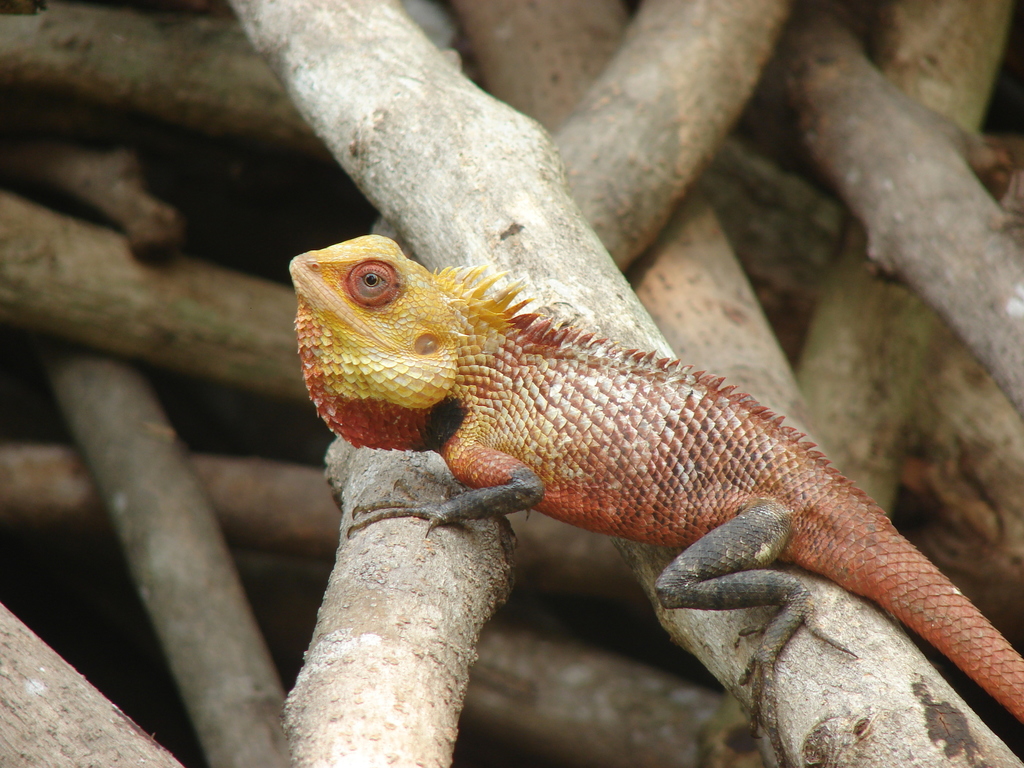
Indian Garden Lizard
Calotes versicolor
The oriental garden lizard (Calotes versicolor), also called the eastern garden lizard, Indian garden lizard, common garden lizard, bloodsucker or changeable lizard, is an agamid lizard found widely distributed in Indo-Malaya. It has also been introduced in many other parts of the world.
From the article Oriental garden lizard on Wikipedia (CC BY-SA), quoted section by section
Description
Calotes versicolor is an insectivore, and the male gets a bright red throat in the breeding season. It measures over 10 cm (3.9 in) in length snout-to-vent. Total length including the tail is up to 37 cm (14.5 in). Two small groups of spines, perfectly separated from each other, above each tympanum. Dorsal crest moderately elevated on the neck and anterior part of the trunk, extending on to the root of the tail in large individuals, and gradually disappearing on the middle of the trunk in younger ones. No fold in front of the shoulder, but the scales behind the lower jaw are much smaller than the others; gular sac not developed. From thirty-nine to forty-three series of scales round the middle of the trunk. The hind foot (measured from the heel to the extremity of the fourth toe) is not much longer than the head in the adult, whilst it is considerably longer in the young. The coloration is very variable, sometimes uniform brownish or greyish-olive or yellowish. Generally broad brown bands across the back, interrupted by a yellowish lateral band. …
Range & habitat
The native range of the species includes southeastern Iran, Afghanistan, Bangladesh, Bhutan, Cambodia, India (including the Andaman Islands), Indonesia (Sumatra), Malaysia (western), Maldives, Mauritius (Reunion, Rodrigues), Myanmar, Nepal, Pakistan, Philippines, Sri Lanka (Ceylon), Thailand, Vietnam (including Pulo Condore Island). It has been introduced to Brunei, Celebes, Oman, Seychelles, Singapore and United States. The lizards were introduced to Singapore from Malaysia and Thailand in the 1980s. In Singapore, they are a threat to the native green-crested lizard. The changeable lizard is relatively common and found in a wide range of habitats. They appear to adapt well to humans and are thus not endangered. They are commonly found among undergrowth, in open habitats as well as highly urban areas. However, in China people regularly kill them, as they are viewed as pests.
Wikipedia: “Distribution”
What it does
Changeable lizards eat mainly insects such as ants, beetles, dragonflies, and grasshoppers; as well as small vertebrates, including rodents and other lizards including agamids, geckos, and lizards. They have teeth which are designed for gripping prey and not tearing, and thus they usually shake prey to stun it then swallow it whole. Sometimes, young, inexperienced changeable lizards may choke on prey that is too large. Changeable lizards also occasionally consume plant matter.
Wikipedia: “Diet”
Where it lives
Recorded sightings
—
geo-referenced records in GBIF, from museums, herbaria and field observers.
Drag the globe to turn it. Dots are where records exist, not a range map; darker means more records.
In the stacks
Searching the stacks…
Every page naming Calotes versicolor in the Biodiversity Heritage Library →
This page is assembled live from iNaturalist, GBIF, Wikipedia, the Source Library and the Internet Archive. It is not yet part of the hand-edited codex. iNaturalist taxon 31281.