- Animals
- ›Chordates
- ›Vertebrates
- ›Mammals
- ›Therians
- ›Placental Mammals
- ›Primates, Rodents, and Allies
- ›Primates
- ›Monkeys, Apes, and Tarsiers
- ›Monkeys and Apes
- ›Apes and Old World Monkeys
- ›Old World Monkeys
- ›Colobines
- ›Langurs, Surilis, and Lutungs
- ›Trachypithecus
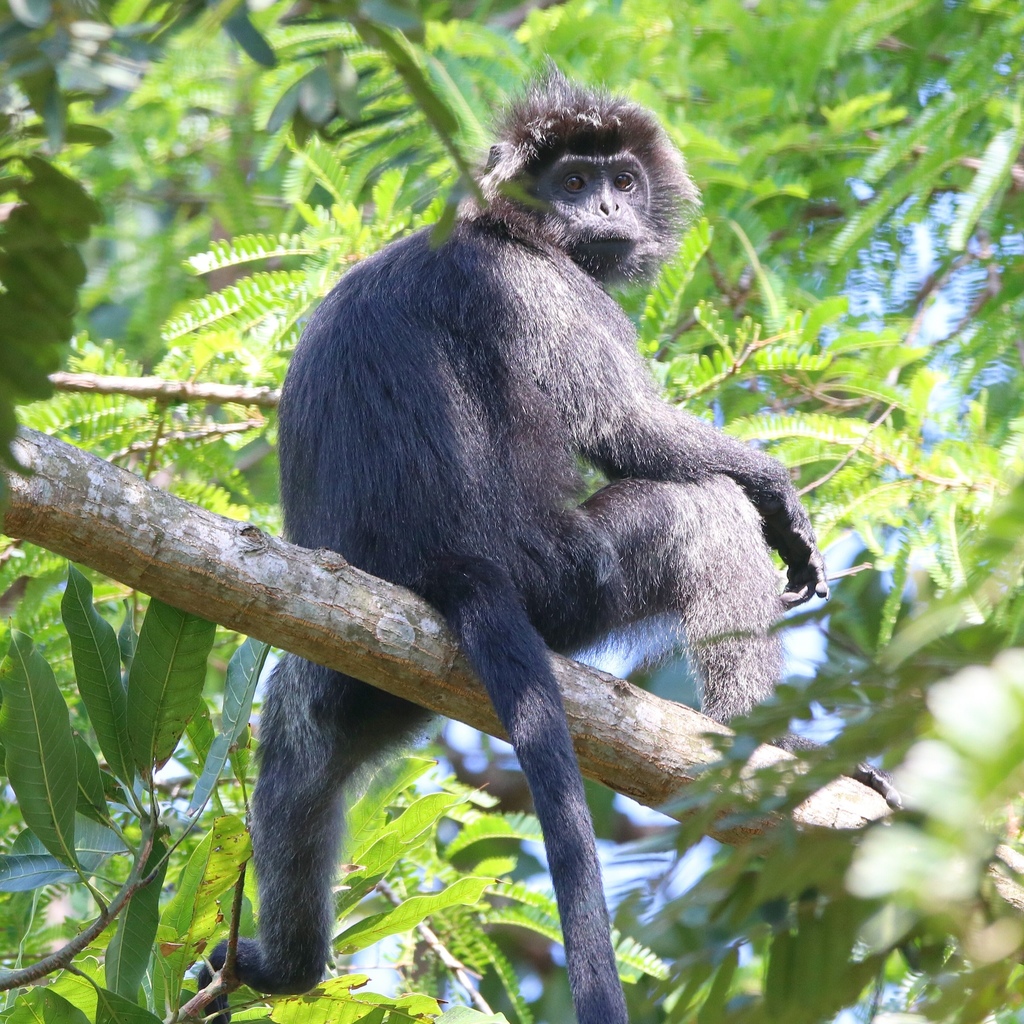
Javan Lutung
Trachypithecus auratus
The East Javan langur (Trachypithecus auratus), also known as the ebony lutung, Javan langur or Javan lutung, is an Old World monkey from the Colobinae subfamily. It is most commonly glossy black with a brownish tinge to its legs, sides, and "sideburns". It is found on the island of Java, as well as on several of the surrounding Indonesian islands. The Latin word auratus in its scientific name means "golden" and refers to a less common color variant. The common name golden langur refers to a different species.
From the article East Javan langur on Wikipedia (CC BY-SA), quoted section by section
Description
Like all langurs, this species' tail is noticeably long, measuring up to 98 cm in length while the body is only around 55 cm long. The two subspecies of this monkey are fairly similar in appearance and are geographically separated; males and females are both usually glossy black, although the females pale, yellowish-white patch around the pubic area. Juveniles of both subspecies are orange in color. The nominate subspecies Trachypithecus auratus auratus has a rare morph that does not lose its juvenile coloration when it matures, instead, the coloration darkens slightly, with yellow tinges on its sides, limbs, and around its ears, and a black tinge on its back.
Range & habitat
The East Javan langur inhabits the interior and peripheral areas of rainforests. This primate is diurnal and arboreal. Its diet is primarily herbivorous, eating leaves, fruit, flowers, and flower buds, although it also eats insect larvae. As with other colobines, it has evolved a specialised stomach to digest plant material more efficiently. This species also has enlarged salivary glands to assist it in breaking down food.
Wikipedia: “Habitat”
What it does
Like other langurs, the East Javan langur is a social animal, living in groups of around seven individuals, with one or two adult males in the group. Although they will look after offspring of other mothers as well as their own, adult females are aggressive towards females from other groups. The brighter coloring of juveniles may alert females to their presence and ensure that they will always be noticed and protected. This species has no discernible mating season and females produce one offspring at a time.
Wikipedia: “Behavior”
Listen
Looking for field recordings…
Where it lives
Recorded sightings
—
geo-referenced records in GBIF, from museums, herbaria and field observers.
Drag the globe to turn it. Dots are where records exist, not a range map; darker means more records.
In the stacks
Searching the stacks…
Every page naming Trachypithecus auratus in the Biodiversity Heritage Library →
This page is assembled live from iNaturalist, GBIF, Wikipedia, the Source Library and the Internet Archive. It is not yet part of the hand-edited codex. iNaturalist taxon 43498.