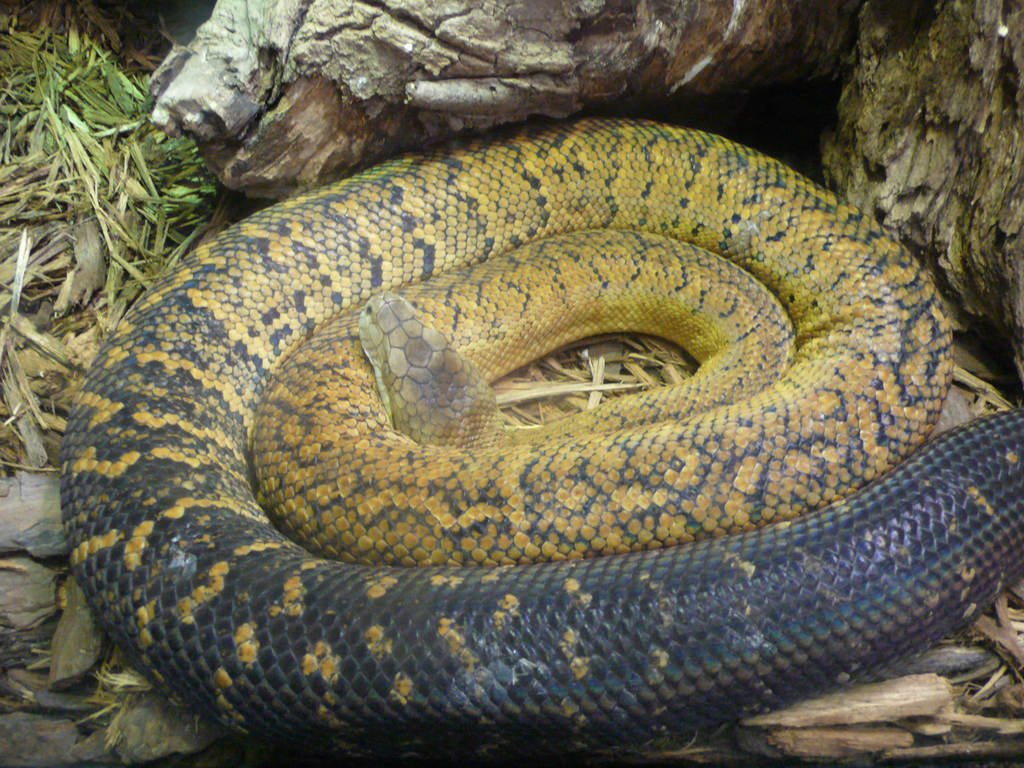
Jamaican Boa
Chilabothrus subflavus
The Jamaican boa, Jamaican yellow boa, yellow snake or Jamaican green snake (Chilabothrus subflavus); in Jamaican Patois: nanka) is a boa species endemic to Jamaica. No subspecies are recognized. Like all other boas, it is not venomous.
From the article Jamaican boa on Wikipedia (CC BY-SA), quoted section by section
Description
The Jamaican boa is golden-green around the head and along the anterior section of the body, with black zigzag crossbars, becoming black toward the posterior end of its body. The snake's body is quite long, up to 2 metres (6 feet 7 inches) in total length.
Range & habitat
Found in Jamaica in the Cockpit Country, historically once prevalent throughout much of Jamaica, notably in rural areas, as well as some smaller adjacent islands, such as Goat Islands. However, after the introduction of the small Indian mongoose (Herpestes auropunctatus) in 1872, sightings of the snake on the mainland dropped. The snake is known to be elusive, which further complicates its detection. Recent surveys have failed to confirm the snake's presence on Great Goat Island, an area dominated by dry limestone forest. Comprehensive island-wide surveys have been conducted, indicating the snake's presence in various parishes such as Trelawny, St. Anne, Westmoreland, and Hanover. The Jamaican boa is now confined to approximately 1,000.6 km2, about 9% of Jamaica's land area. Habitat fragmentation and human activities have localized and severely fragmented the population. Major strongholds for the boa now appear to be Cockpit Country, Blue Mountains, Yallah Mountains, Hellshire Hills, and Portland Bight, which together account for 93% of the known habitat of the species.
Wikipedia: “Distribution and habitat”
What it does
The Jamaican boa is primarily nocturnal and arboreal. The species may also display crepuscular activity, influenced by factors such as environmental conditions, prey availability, and seasonal activities. During daytime, this species seeks shelter in various locations such as epiphytes, trees, rock crevices, termite nests, or caves. It has been observed at the far end of Portland Cave. This species is also known to bask on rocks following heavy rains and to rest on roads and trails during the evening, suggesting crepuscular behavior under certain conditions.
Wikipedia: “Behavior”
Where it lives
Recorded sightings
—
geo-referenced records in GBIF, from museums, herbaria and field observers.
Drag the globe to turn it. Dots are where records exist, not a range map; darker means more records.
In the stacks
Searching the stacks…
Every page naming Chilabothrus subflavus in the Biodiversity Heritage Library →
This page is assembled live from iNaturalist, GBIF, Wikipedia, the Source Library and the Internet Archive. It is not yet part of the hand-edited codex. iNaturalist taxon 539463.