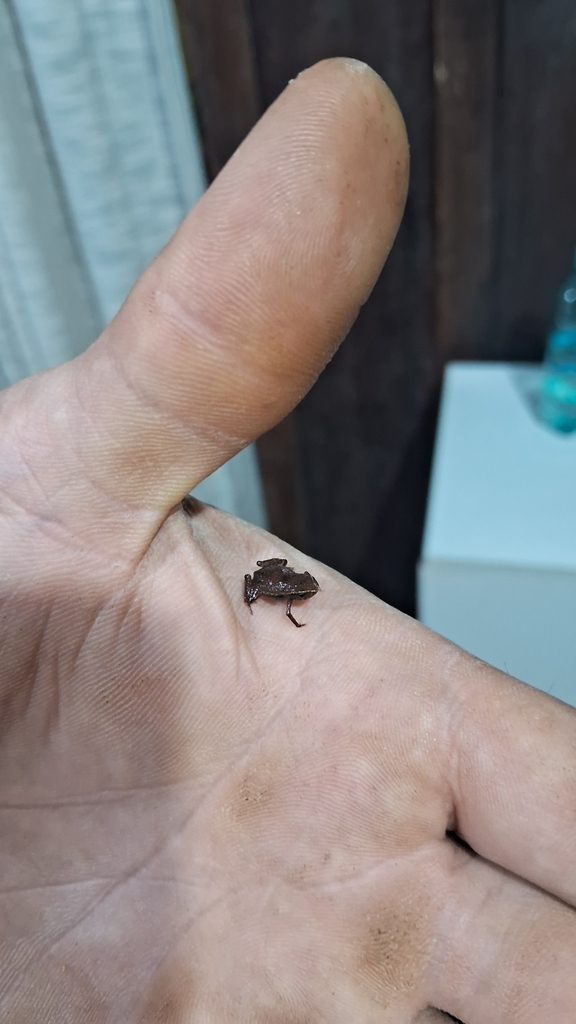

Yellow-blotched Flea Toad
Brachycephalus sulfuratus Condez, Monteiro, Comitti, Garcia, Amaral & Haddad, 2016
First described in: Condez, Thais Helena, Monteiro, Juliane Petry De Carli, Comitti, Estevão Jasper, Garcia, Paulo Christiano De Anchietta, Amaral, Ivan Borel, Haddad, Célio Fernando Baptista (2016): A new species of flea-toad (Anura: Brachycephalidae) from southern Atlantic Forest, Brazil. Zootaxa 4083 (1): 40-56, DOI: http://doi.org/10.11646/zootaxa.4083.1.2
Descriptions from checklists and floras indexed by GBIF
description
Description of holotype. The holotype of Brachycephalus sulfuratus sp. nov. has a “ leptodactyliform ” body (Figure 1 and 2); head wider than long, narrower than body; head length approximately 26 % of SVL; snout long, with length slightly short than the eye diameter, rounded in lateral and dorsal views (Figure 3 A and 3 B); nostrils protuberant, directed anterolaterally; canthus rostralis distinct and straight; loreal region weakly concave; mouth nearly sigmoid; eye slightly protruding in dorsal and lateral views, eye diameter 48 % of HL; tympanum absent; tongue longer than wide, posterior half not adherent to floor of mouth; choanae relatively small and round; vomerine odontophores absent. Upper arm slightly shorter than forearm; length of upper arm plus forearm 43 % of SVL; hands approximately as long as upper arm; fingers II and III thin and distinct; finger I and IV very small, vestigial; tip of fingers II and III slightly pointed; relative lengths of fingers II <III; metacarpal tubercles present, outer large and rounded, inner thin and elongated; subarticular tubercles undefined in hand (Figure 3 C). Tibia shorter than thigh; total leg length 85 % of SVL; foot length larger t
A new species of flea-toad (Anura: Brachycephalidae) from southern Atlantic Forest, Brazil
description
hermogenesi, and B. sulfuratus sp. nov. were not recovered as a clade. Brachycephalus didactylus is nested among the species from the second major clade, while the position of B. hermogenesi and B. sulfuratus sp. nov. was not resolved. The populations of the new species are clustered in a monophyletic group. Despite of the uncertainty of the position of B. hermogenesi, the genetic distances between this species and B. sulfuratus sp. nov. range from 0.169 – 0.170 (average = 0.170, SD = 0), corroborating the distinction between these two species. We found also low genetic distances among the analyzed specimens of B. sulfuratus sp. nov., with maximum values corresponding to 0.001 between the specimen from Parque Estadual da Ilha do Cardoso and the other three specimens.
A new species of flea-toad (Anura: Brachycephalidae) from southern Atlantic Forest, Brazil
diagnosis
Diagnosis. Brachycephalus sulfuratus sp. nov. is a new species of flea-toad, distinguished from all its congeners by the following combination of characters: (1) small body size (SVL of adults: 7.4 – 8.5 mm for males and 9.0 – 10.8 mm for females); (2) “ leptodactyliform ” body; (3) pectoral girdle arciferal and less robust compared to the Brachycephalus species with “ bufoniform ” body; (4) procoracoid and epicoracoid fused with coracoid but separated from the clavicle by a large fenestrae; (5) toe I externally absent; toes II, III, IV, and V distinct; phalanges of toes II and V reduced; (6) skin smooth with no dermal ossifications; (7) in life, general background color brown with small dark-brown spots; skin of throat, chest, arms, and forearms with irregular yellow blotches; in ventral view, cloacal region of alive and preserved specimens surrounded by a dark-brown inverted v-shaped mark outlined with white; (8) advertisement call long, composed of a set of 4 – 7 high-frequency notes (6.2 – 7.2 kHz) repeated regularly.
A new species of flea-toad (Anura: Brachycephalidae) from southern Atlantic Forest, Brazil
discussion
Remarks. Brachycephalus has been a target species for herpetological surveys of mountainous areas in the Atlantic Forest due to its restricted geographic distribution and the extraordinary number of species that are expected to be discovered (Ribeiro et al. 2015; Pie & Ribeiro 2015). Even so, the diminutive size, inconspicuous color and discrete habits of flea-toads, seem to have hampered a better understanding of their species diversity. Interestingly, and unlike most other known species within this genus, flea-toads can be widely distributed. Brachycephalus didactylus and B. hermogenesi are known from more than five localities (see Appendix 1), and cover a wide elevational gradient ranging from the sea level up to 1000 m (Izecksohn 1971; Pimenta et al. 2007; Verdade et al. 2008; Oliveira et al. 2012). In the same way, B. sulfuratus sp. nov. is known from six localities and its distribution also covers a wide elevational gradient. Brachycephalus pulex, the northernmost species, is an exception among flea-toads, being known only from type locality at 840 meters above sea level (Napoli et al. 2011). Despite recent advances in the taxonomy of Brachycephalus, the knowledge of the natu
A new species of flea-toad (Anura: Brachycephalidae) from southern Atlantic Forest, Brazil
In the stacks
Searching the stacks…
Every page naming Brachycephalus sulfuratus in the Biodiversity Heritage Library →
From the GBIF Backbone Taxonomy and occurrence records (GBIF.org), with Wikipedia and the Source Library. GBIF species 9247446.