- Animals
- ›Chordates
- ›Vertebrates
- ›Cartilaginous Fishes
- ›Sharks and Rays
- ›Rays
- ›Stingrays
- ›Whiptail Stingrays
- ›Whiprays and allies
- ›Maculabatis
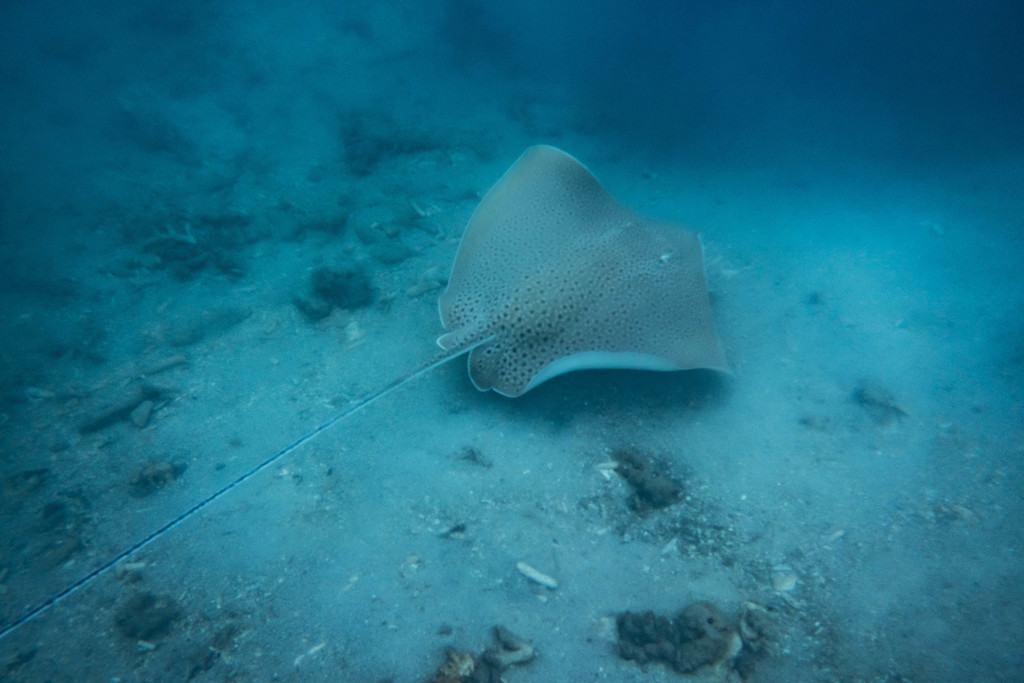
Blackspotted Whipray
Maculabatis astra
The black-spotted whipray (Maculabatis astra) is a species of stingray in the family Dasyatidae, found in the coastal waters off southern New Guinea and northern Australia. Long thought to be a variant of the related brown whipray (M. toshi), this species has an angular, diamond-shaped pectoral fin disc and a whip-like tail without fin folds. It is characterized by its dorsal color pattern, which consists of a variably extensive covering of small, close-set dark, and sometimes also white spots, on a grayish-brown background. In addition, the tail has alternating light and dark saddles past the stinging spine. This species reaches a maximum recorded width of 80 cm (31 in).
Crustaceans are the main type of food consumed by the black-spotted whipray. It is aplacental viviparous, with females gestating 1–3 young at a time, supplying them with histotroph ("uterine milk"). Most of the black-spotted whipray's range lies within Australian waters, where it faces minimal conservation threats since the widespread deployment of bycatch-reducing measures on commercial trawlers. It is caught in small numbers for meat, skin, and cartilage by Indonesian fishers, as well as by prawn seine fishers off Papua New Guinea. A 2004 assessment of the brown whipray by the International Union for Conservation of Nature (IUCN), which also included data on the black-spotted whipray, listed them under Least Concern.
From the article Black-spotted whipray on Wikipedia (CC BY-SA), quoted section by section
Description
The black-spotted whipray can grow to 80 cm (31 in) across and 1.8 m (5.9 ft) long; reports of rays 1 m (3.3 ft) or more across are likely in error. It has a diamond-shaped, relatively thin pectoral fin disc approximately 1.1–1.2 times wider than long. The outer corners of the disc are fairly angular, and the leading margins are nearly straight. The snout is triangular and forms a broadly obtuse angle with a barely protruding, pointed tip. The eyes are small and immediately followed by larger, oval spiracles. The long, slender nostrils have a short, skirt-shaped curtain of skin between them; the posterior margin of the curtain is concave on either side and finely fringed. The mouth is strongly bow-shaped and contains a row of four papillae (nipple-like structures) across the floor. The small, blunt teeth number 41–49 rows in the upper jaw and 40–50 rows in the lower jaw. The pelvic fins are small and somewhat narrow, with a curving posterior margin; males have stout claspers. The very thin, gently tapering whip-like tail measures 2.1–2.7 times as long as the disc is wide, and lacks fin folds. One or two slender stinging spines are present atop the tail; many individuals have the sting missing. Behind the sting, there is a deep ventral groove and prominent lateral ridges running to the tip of the tail. …
Range & habitat
The black-spotted whipray is found widely off northern Australia from Shark Bay in Western Australia and Moreton Bay in Queensland, including the Timor Sea, and is particularly abundant in the Gulf of Carpentaria. It has also been reported from off southern New Guinea. This bottom-dwelling species inhabits coastal waters 1–141 m (3.3–462.6 ft) deep, favoring sandy habitats, and tends to be found farther from shore than the brown whipray. In Shark Bay, it is found in greater numbers during the warm season than the cold.
Wikipedia: “Distribution and habitat”
What it does
Over 90% of the black-spotted whipray's diet consists of crustaceans. In the Gulf of Carpentaria, it is a major predator of penaeid prawns, which constitute over half of its diet. Shrimp are the predominant prey of young rays under 23 cm (9.1 in) across, while stomatopods and crabs become more important with age. For rays off Queensland and in the Torres Strait, polychaete worms constitute an important secondary food source to crustaceans. This species has also been known to take bony fishes. Like other stingrays, the black-spotted whipray is aplacental viviparous, with females nourishing their young with nutrient-rich histotroph ("uterine milk"). Females have a single functionary ovary and uterus (on the left), and produce litters of 1–3 pups. The newborns measure 17–19 cm (6.7–7.5 in) across; both sexes mature at about 46–50 cm (18–20 in) across. The growth rate is relatively low, with females growing much more slowly than males.
Wikipedia: “Biology and ecology”
Where it lives
Recorded sightings
—
geo-referenced records in GBIF, from museums, herbaria and field observers.
Drag the globe to turn it. Dots are where records exist, not a range map; darker means more records.
In the stacks
Searching the stacks…
Every page naming Maculabatis astra in the Biodiversity Heritage Library →
This page is assembled live from iNaturalist, GBIF, Wikipedia, the Source Library and the Internet Archive. It is not yet part of the hand-edited codex. iNaturalist taxon 623860.