- Animals
- ›Chordates
- ›Vertebrates
- ›Cartilaginous Fishes
- ›Sharks and Rays
- ›Rays
- ›Stingrays
- ›Whiptail Stingrays
- ›Whiprays and allies
- ›Pateobatis
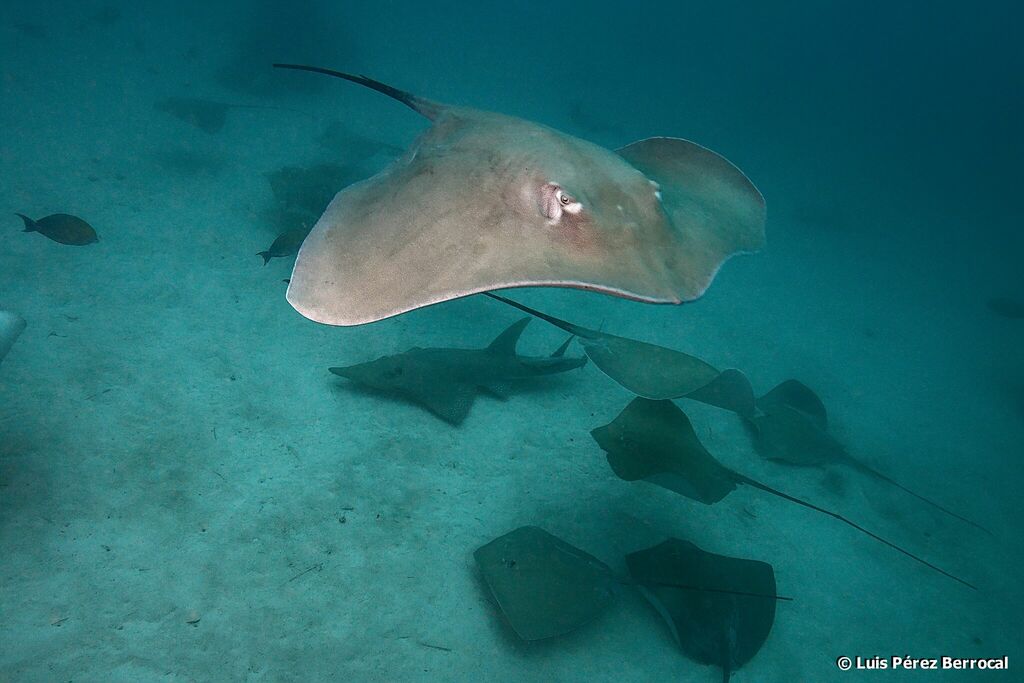
Pink Whipray
Pateobatis fai
The pink whipray (Pateobatis fai) is a species of stingray in the family Dasyatidae, with a wide but ill-defined distribution in the tropical Indo-Pacific from southern Africa to Polynesia. It is a bottom dweller that generally inhabits shallow water under 70 m (230 ft) deep, in sandy areas associated with coral reefs. Individuals exhibit a high degree of fidelity to particular locations. The pink whipray has a diamond-shaped pectoral fin disc wider than long, with a broad-angled snout and a very long, whip-like tail without fin folds. It has only a few small thorns on its back and is uniform brownish to grayish pink in color, becoming much darker past the tail sting. This large ray can reach 1.8 m (5.9 ft) across and over 5 m (16 ft) long.
Gregarious in nature, the pink whipray has been known to form large active and resting aggregations, and associate with other large ray species. It preys mainly on prawns, but also consumes other benthic invertebrates and bony fishes. This species is aplacental viviparous, in which the unborn young are nourished by histotroph ("uterine milk") produced by the mother. Across much of its range, substantial numbers of pink whiprays are caught incidentally by a variety of fishing gear and marketed for meat, skin, and cartilage. It is also of importance to ecotourism, being attracted to visitors with bait. In 2009, the International Union for Conservation of Nature (IUCN) had listed this species as Least Concern, due to its wide distribution that includes relatively protected areas, such as northern Australia.
From the article Pink whipray on Wikipedia (CC BY-SA), quoted section by section
Description
The pectoral fin disc of the pink whipray is diamond-shaped and thick at the center, measuring about 1.1–1.2 times wider than long. The outer corners of the disc are angular. The snout forms a very obtuse angle, with the tip barely protruding. The small, widely spaced eyes are followed by larger spiracles. There is a short and broad curtain of skin with a finely fringed posterior margin between the long, thin nostrils. The mouth is fairly small and surrounded by prominent furrows; the lower jaw has a small indentation in the middle. There are two large central and two tiny lateral papillae on the floor of the mouth. The teeth are small and arranged into pavement-like surfaces. Five pairs of gill slits are located beneath the disc. The pelvic fins are small and narrow. The tail is extremely long and thin, measuring at least twice the disc length when intact. It lacks fin folds and usually bears a single serrated stinging spine. Adults have small, rounded dermal denticles covering the central dorsal surface of the disc, beginning in front of the eyes and extending to cover the entire tail; there are also small, sharp thorns on the midline, which become densest at the base of the tail. Juveniles are either smooth-skinned or have a sparser covering of flat, heart-shaped denticles. …
Range & habitat
The exact range of the pink whipray is unclear due to confusion with the Jenkins' whipray (H. jenkinsii). It is believed to be common throughout the tropical waters of the Indo-Pacific, probably occurring all around Indian Ocean periphery from South Africa to northern Australia, from the year 2014 appears in the Red Sea. Its range extends to the Pacific Ocean, northward to the Philippines, the Ryukyu Islands, and Iriomote, and eastward to various islands including Micronesia, the Marquesas Islands, and Samoa. The pink whipray has been recorded from as deep as 200 m (660 ft), but is usually found from the intertidal zone to a depth of 70 m (230 ft). This bottom-dwelling species prefers sandy flats, lagoons, and other soft-bottomed habitats, often near cays and atolls in coral reefs. It tends to be found closer to shore during the warm season. Genetic and telemetry studies across Polynesian islands have found that individual rays tend to remain within a local area, with very little between-island movement.
Wikipedia: “Distribution and habitat”
What it does
Small to large gatherings of pink whiprays have been observed over sandy flats and coral reefs in Shark Bay, on the Great Barrier Reef, and in the Caroline Islands. When resting, up to ten individuals may pile atop one another, sometimes mixing with other species. On Ningaloo Reef, it has been seen "riding" on larger species of rays. The pink whipray feeds primarily on decapod crustaceans, but also takes cephalopods, and teleost fishes. In Shark Bay, penaeid prawns are by far the dominant prey type for rays of all sizes. At Rangiroa Atoll in French Polynesia, sizable feeding aggregations are known to form at night in shallow water. However, at Moorea it tends to be a solitary forager with a large home range. Like other stingrays, the pink whipray is aplacental viviparous, with the mother supplying her developing embryos with nutrient-rich histotroph ("uterine milk") through specialized uterine structures. The newborns measure 55–60 cm (22–24 in) across. Shark Bay may be a nursery area for this species. Males reach sexual maturity at 1.1–1.2 m (3.6–3.9 ft) across, while the maturation size for females is unknown. Known parasites of the pink whipray include the monogeneans Heterocotyle capricornensis, Monocotyle helicophallus, M. spiremae, M. …
Wikipedia: “Biology and ecology”
Where it lives
Recorded sightings
—
geo-referenced records in GBIF, from museums, herbaria and field observers.
Drag the globe to turn it. Dots are where records exist, not a range map; darker means more records.
In the stacks
Searching the stacks…
Every page naming Pateobatis fai in the Biodiversity Heritage Library →
This page is assembled live from iNaturalist, GBIF, Wikipedia, the Source Library and the Internet Archive. It is not yet part of the hand-edited codex. iNaturalist taxon 623869.