- Animals
- ›Chordates
- ›Vertebrates
- ›Cartilaginous Fishes
- ›Sharks and Rays
- ›Rays
- ›Stingrays
- ›Whiptail Stingrays
- ›Whiprays and allies
- ›Maculabatis
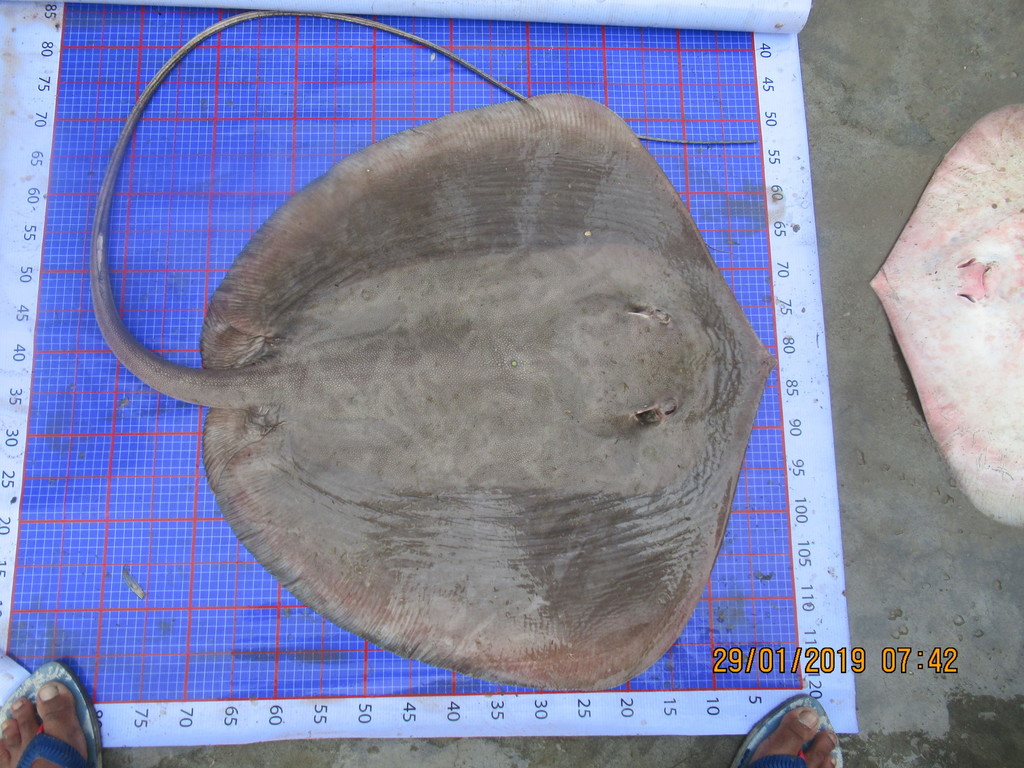
Round Whipray
Maculabatis pastinacoides
The round whipray (Maculabatis pastinacoides) is a species of stingray within the family Dasyatidae. Populations of round whipray are primarily located in the Malay Archipelago, more specifically, parts of Brunei Darussalam, Indonesia, Malaysia, Myanmar, Singapore, and Thailand. There is also the possibility this species of stingray exists in areas of Bangladesh and Sri Lanka as well. In 2004, the round whipray was assessed by the International Union for Conservation of Nature (IUCN) Red List and determined to be a vulnerable species. The most recent assessment in 2020 has determined this species to now be endangered. While there is no data accumulated to identify the population size of round whiprays specifically, data collected regarding similar whipray species from fisheries in the Malay Archipelago area, indicate a decline in the population of round whiprays.
From the article Round whipray on Wikipedia (CC BY-SA), quoted section by section
Description
Round whiprays give birth to live young, with the size at birth of their offspring ranging from 15–16 cm (5.9–6.3 in) in disc width. Male round whiprays reach maturity once they are 43–46 cm (17–18 in) in disc width, whereas females are not considered mature until they are roughly 58 cm (23 in) in disc width. An adult round whipray can reportedly reach a maximum size of 86 cm (34 in) in disc width. Round whiprays reproduce by pairing with embrace. This species has the potential of reproducing only one pup per litter, with each generation of round whipray living for about 20 years.
Wikipedia: “Morphology and behavior”
Range & habitat
The round whipray prefers to live close to the floor in the Indo-Pacific Ocean. They can be found on surface waters all the way down to a maximum depth of 60 m (200 ft).
Wikipedia: “Habitat”
Where it lives
Recorded sightings
—
geo-referenced records in GBIF, from museums, herbaria and field observers.
Drag the globe to turn it. Dots are where records exist, not a range map; darker means more records.
In the stacks
Searching the stacks…
Every page naming Maculabatis pastinacoides in the Biodiversity Heritage Library →
This page is assembled live from iNaturalist, GBIF, Wikipedia, the Source Library and the Internet Archive. It is not yet part of the hand-edited codex. iNaturalist taxon 623863.