- Animals
- ›Chordates
- ›Vertebrates
- ›Cartilaginous Fishes
- ›Sharks and Rays
- ›Rays
- ›Stingrays
- ›Whiptail Stingrays
- ›Whiprays and allies
- ›Pateobatis
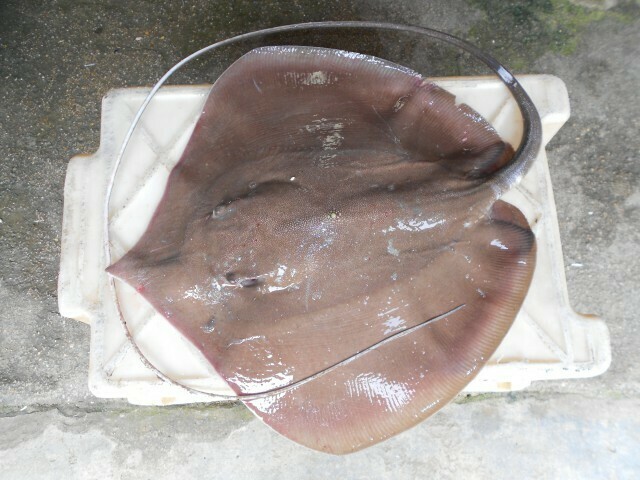
Whitenose whipray
Pateobatis uarnacoides
The whitenose whipray (Pateobatis uarnacoides) is a species of stingray in the family Dasyatidae native to the eastern Indian Ocean and the western central Pacific Ocean, where it is found in shallow water including estuaries.
This species was first described by the Dutch ichthyologist Pieter Bleeker in 1852. He was an army surgeon who worked for 20 years for the Dutch East India Company in Indonesia, amassing a collection of over 12,000 fish which he took home with him when he returned to Holland. They are mostly lodged in the Natural History Museum in Leiden.
From the article Whitenose whipray on Wikipedia (CC BY-SA), quoted section by section
Range & habitat
The whitenose whipray is found in the eastern Indian Ocean and the western central Pacific Ocean, its range extending from India to Malaysia and Indonesia; it is a demersal fish and is usually found over soft substrates in water that is shallower than 30 m (100 ft), including the lower reaches of rivers and estuaries. One individual was found in a saltwater lagoon.
Wikipedia: “Distribution and habitat”
At the table
The species is caught in large quantities by bottom trawling, demersal tangle netting, trammel netting, and Danish seine fishing in India, Malaysia, and Indonesia. The flesh is consumed fresh or preserved by salting and drying, and the cartilage (vertebrae) is dried and exported to the Far East. The skins are dried and used in the manufacture of galuchat bags, wallets, belts, and shoes.
Wikipedia: “Uses”
Where it lives
Recorded sightings
—
geo-referenced records in GBIF, from museums, herbaria and field observers.
Drag the globe to turn it. Dots are where records exist, not a range map; darker means more records.
In the stacks
Searching the stacks…
Every page naming Pateobatis uarnacoides in the Biodiversity Heritage Library →
This page is assembled live from iNaturalist, GBIF, Wikipedia, the Source Library and the Internet Archive. It is not yet part of the hand-edited codex. iNaturalist taxon 623872.