- Animals
- ›Chordates
- ›Vertebrates
- ›Cartilaginous Fishes
- ›Sharks and Rays
- ›Rays
- ›Stingrays
- ›Whiptail Stingrays
- ›Common Whiptail Stingrays
- ›Hemitrygon
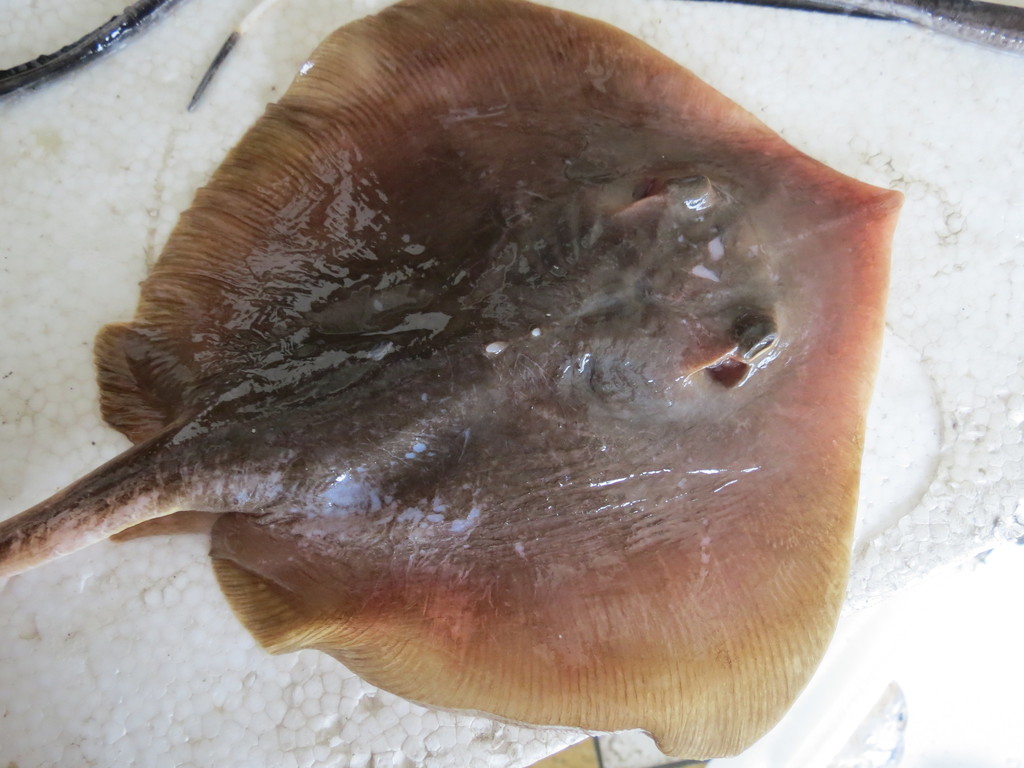
Yantai stingray
Hemitrygon laevigata
The Yantai stingray (Hemitrygon laevigata; often misgendered laevigatus), is a little-known species of stingray in the family Dasyatidae, inhabiting shallow waters in the northwestern Pacific Ocean off the coasts of China and Japan. Measuring no more than 20–30 cm (7.9–11.8 in) across, this species is characterized by its diamond-shaped pectoral fin disc wider than long, completely smooth skin, dorsal coloration of dark irregular spots on a yellowish gray-brown background, and ventral coloration of more spots on a white background with yellowish margins. One of the three most common stingrays sold for food in China, the slow-reproducing Yantai stingray faces possible overfishing and habitat degradation, and its numbers appear to be declining. The International Union for Conservation of Nature (IUCN) has assessed it as vulnerable.
From the article Yantai stingray on Wikipedia (CC BY-SA), quoted section by section
Description
A small species, male and female Yantai stingrays grow to no more than 20 cm (7.9 in) and 30 cm (12 in) across respectively. Its pectoral fin disc is diamond-shaped and 1.2–1.3 times wider than long, with nearly straight anterior margins converging to a blunt-angled snout, and rounded outer margins. The large, protruding eyes are immediately followed by a pair of equal-sized or slightly smaller, elliptical spiracles. There is a flap of skin between the nares that reaches the mouth, with a straight and fringed rear margin. The mouth is small and bow-shaped, with three papillae across the floor. The teeth are arranged with a quincunx pattern into pavement-like surfaces; the teeth of adult males have a sharp recurved cusp, while those of females and juveniles are blunt. There are around 40 tooth rows in the upper jaw. The five pairs of gill slits are short. The pelvic fins are almost rectangular in shape, with those of females being wider and more strongly curved posteriorly than those of males. The tail measures 1.4–1.8 times the disc length and is laterally compressed, becoming whip-like towards the tip. The stinging tail spine measures about 42 mm (1.7 in) long and bears on average 60 serrations. Following the spine is a short, narrow dorsal fin fold and a wider ventral fin fold running along two-fifths of the tail. …
Range & habitat
The Yantai stingray is found in the Yellow Sea and the East China Sea, as far north as Japan and as far south as the Taiwan Strait; it is reportedly abundant off southern Japan and northern China. This bottom-dwelling species inhabits inshore waters to a depth of 50 m (160 ft), and has been known to enter estuaries.
Wikipedia: “Distribution and habitat”
What it does
Little is known of the Yantai stingray's natural history. Like other stingrays, it is aplacental viviparous with females probably giving birth to only 1–2 pups at a time.
Wikipedia: “Biology and ecology”
Where it lives
Recorded sightings
—
geo-referenced records in GBIF, from museums, herbaria and field observers.
Drag the globe to turn it. Dots are where records exist, not a range map; darker means more records.
In the stacks
Searching the stacks…
Every page naming Hemitrygon laevigata in the Biodiversity Heritage Library →
This page is assembled live from iNaturalist, GBIF, Wikipedia, the Source Library and the Internet Archive. It is not yet part of the hand-edited codex. iNaturalist taxon 623844.