- Animals
- ›Chordates
- ›Vertebrates
- ›Mammals
- ›Therians
- ›Placental Mammals
- ›Primates, Rodents, and Allies
- ›Primates
- ›Monkeys, Apes, and Tarsiers
- ›Monkeys and Apes
- ›Apes and Old World Monkeys
- ›Old World Monkeys
- ›Cercopithecines
- ›Guenons, Vervet Monkeys, and Talapoins
- ›Erythrocebus
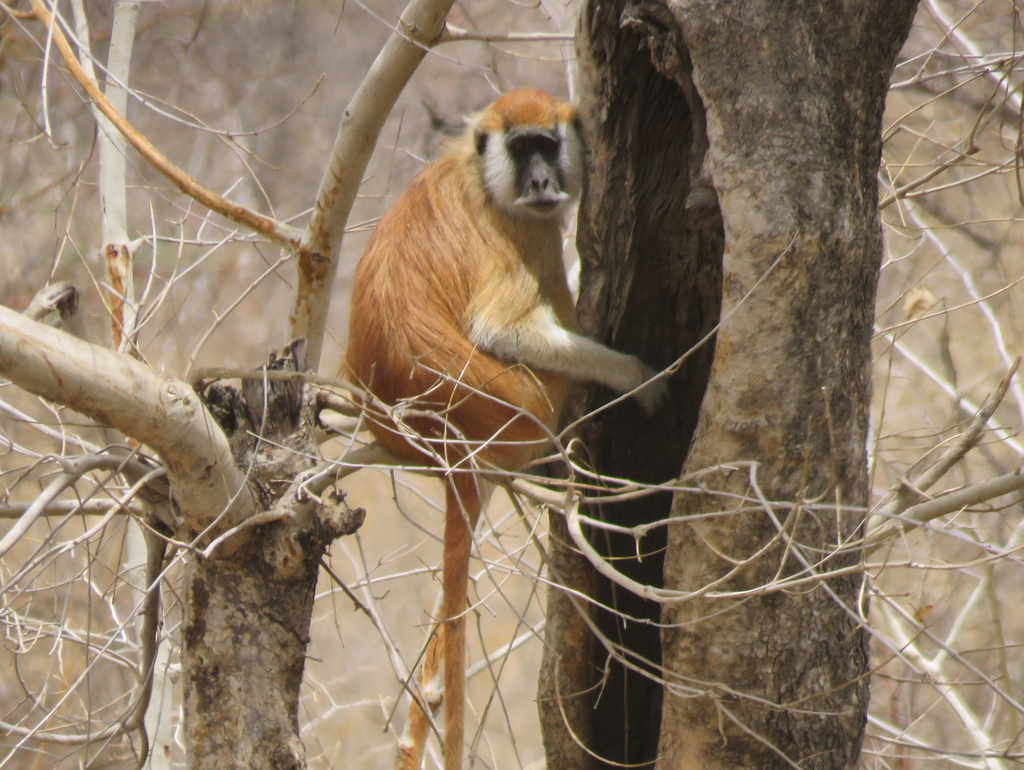
Blue Nile Patas Monkey
Erythrocebus poliophaeus
The Blue Nile patas monkey (Erythrocebus poliophaeus) or Heuglin's patas monkey is a species of Old World monkey found in Africa along the Blue Nile river valley in Ethiopia, Sudan, and potentially South Sudan. While first described in 1862, it was synonymized with the common patas monkey (E. patas) in 1927. A 2017 study reclassified it as a distinct species.
From the article Blue Nile patas monkey on Wikipedia (CC BY-SA), quoted section by section
Description
This species has white hairs on upper lip hair which forms the shape of a handlebar moustache. This, when combined with the lack of the band between the ear and eye found in other members of Erythrocebus, distinguishes it from the rest of the genus.
Range & habitat
This species is thought to be restricted to the area between the Nile and the western escarpment of the Great Rift Valley. It ranges from the vicinity of Metemma south to the Sudd. Although it is only known from Ethiopia and Sudan, it could potentially occur in South Sudan. In prehistoric times, this species may have had its range restricted to a montane refugium in western Ethiopia, through which it survived a period of aridification.
Wikipedia: “Distribution”
Listen
Looking for field recordings…
Where it lives
Recorded sightings
—
geo-referenced records in GBIF, from museums, herbaria and field observers.
Drag the globe to turn it. Dots are where records exist, not a range map; darker means more records.
In the stacks
Searching the stacks…
Every page naming Erythrocebus poliophaeus in the Biodiversity Heritage Library →
This page is assembled live from iNaturalist, GBIF, Wikipedia, the Source Library and the Internet Archive. It is not yet part of the hand-edited codex. iNaturalist taxon 1369317.