- Animals
- ›Chordates
- ›Vertebrates
- ›Reptiles
- ›Snakes and Lizards
- ›Lizards
- ›Wall lizards, amphisbaenians, and allies
- ›Wall Lizards
- ›Lacertinae
- ›Zootoca
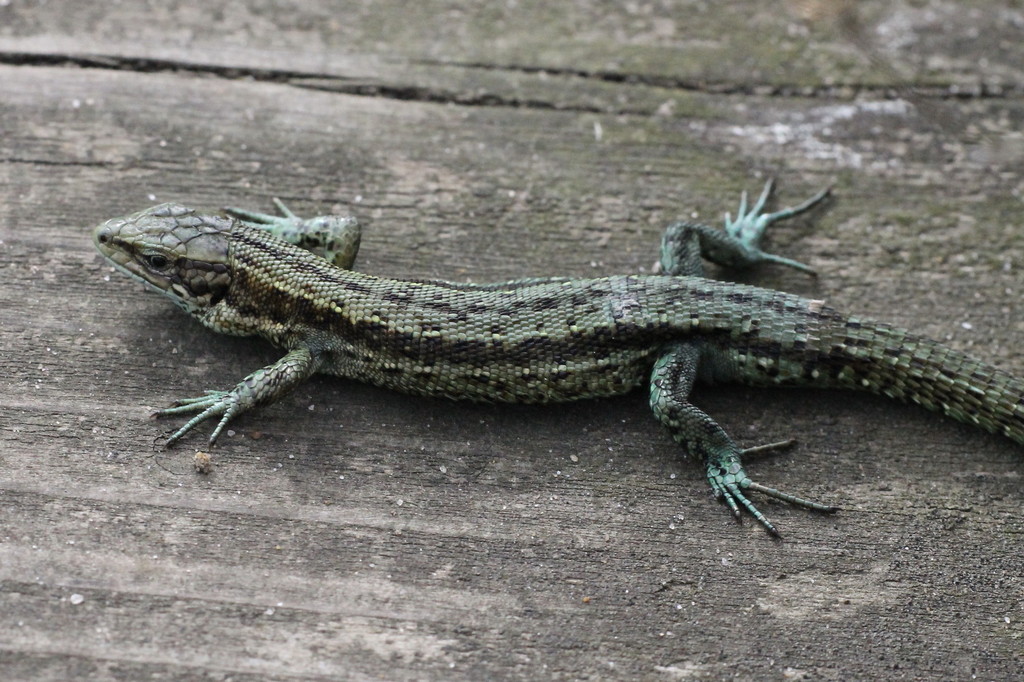
Viviparous Lizard
Zootoca vivipara
The viviparous lizard or common lizard (Zootoca vivipara) is a Eurasian lizard. It lives farther north than any other non-marine, non-avian reptile species, and is named for the fact that it is viviparous, meaning it gives birth to live young (although they will sometimes lay eggs normally). Both "Zootoca" and "vivipara" mean "live birth", in (Latinized) Greek and Latin respectively. It was called Lacerta vivipara until the genus Lacerta was split into nine genera in 2007 by Arnold, Arribas & Carranza.
Zootoca vivipara lives in very cold climates, yet participates in normal thermoregulation instead of thermoconformity. They have the largest range of all terrestrial lizards which even include subarctic regions. It is able to survive these harsh climates as individuals will freeze in especially cold seasons and thaw two months later. They also live closer to geological phenomena that provide a warmer environment for them.
From the article Viviparous lizard on Wikipedia (CC BY-SA), quoted section by section
Description
Zootoca vivipara is a small lizard, with an average length between 50 and 77 mm (2–3 in) and an average mass of 2 to 5 g (0.1–0.2 oz). They exhibit no particular colour, but can be brown, red, grey, green, or black. The species exhibits some sexual dimorphisms. Female Z. vivipara undergo colour polymorphism more commonly than males. A female lizard's display differs in ventral coloration, ranging from pale yellow to bright orange and a mixed coloration. There have been many hypotheses for the genetic cause of this polymorphic coloration. These hypotheses test for coloration due to thermoregulation, predator avoidance, and social cues, specifically sexual reproduction. Through an experiment conducted by Vercken et al., colour polymorphism in viviparous lizard is caused by social cues, rather than the other hypotheses. More specifically, the ventral coloration that is seen in female lizards is associated with patterns of sexual reproduction and sex allocation. The underside of the male is typically more colourful and bright, with yellow, orange, green, and blue, and the male typically has spots along its back. On the other hand, females typically have darker stripes down their backs and sides. Additionally, males have been found to have larger heads than their female counterparts, and this trait appears to be sexually selected for. …
Range & habitat
Z. vivipara is terrestrial, so they spend most of their time on the ground, though they do occasionally visit sites of higher elevation. The lizard thermoregulates by basking in the sun for much of the time. In colder weather, they have been known to hibernate to maintain proper body temperatures. They hibernate between October and March. Their typical habitats include heathland, moorland, woodland and grassland. The viviparous lizard is native to much of northern Eurasia. In Europe, it is mainly found north of the Alps and the Carpathians, including the British Isles but not Iceland, as well as in parts of northern Iberia and the Balkans; In Asia it is mostly found in Russia, excluding northern Siberia, and in northern Kazakhstan, Mongolia, China, and Japan. Z. vivipara has the largest distribution of any species of lizard in the world. The viviparous lizard holds the distinction of being Ireland's only native terrestrial reptile.
Wikipedia: “Habitat”
What it does
Unlike many other lizards, Z. vivipara is exclusively insectivorous. Their diet consists of flies, spiders, and various other insects, including hemipterans (such as cicadas), moth larvae, and mealworms. The species is a predator, so it actively hunts down all of its prey. One study found that when controlled for body size, females consumed more food than males. Feeding rates also increased with increased sunshine.
Wikipedia: “Diet”
Where it lives
Recorded sightings
—
geo-referenced records in GBIF, from museums, herbaria and field observers.
Drag the globe to turn it. Dots are where records exist, not a range map; darker means more records.
In the stacks
Searching the stacks…
Every page naming Zootoca vivipara in the Biodiversity Heritage Library →
This page is assembled live from iNaturalist, GBIF, Wikipedia, the Source Library and the Internet Archive. It is not yet part of the hand-edited codex. iNaturalist taxon 35453.