On eBird ↗
Red-billed Tropicbird
Live sightings near you, the range map, bar charts of when it is seen, and Macaulay Library photos and recordings.
Red-billed Tropicbird
Phaethon aethereus
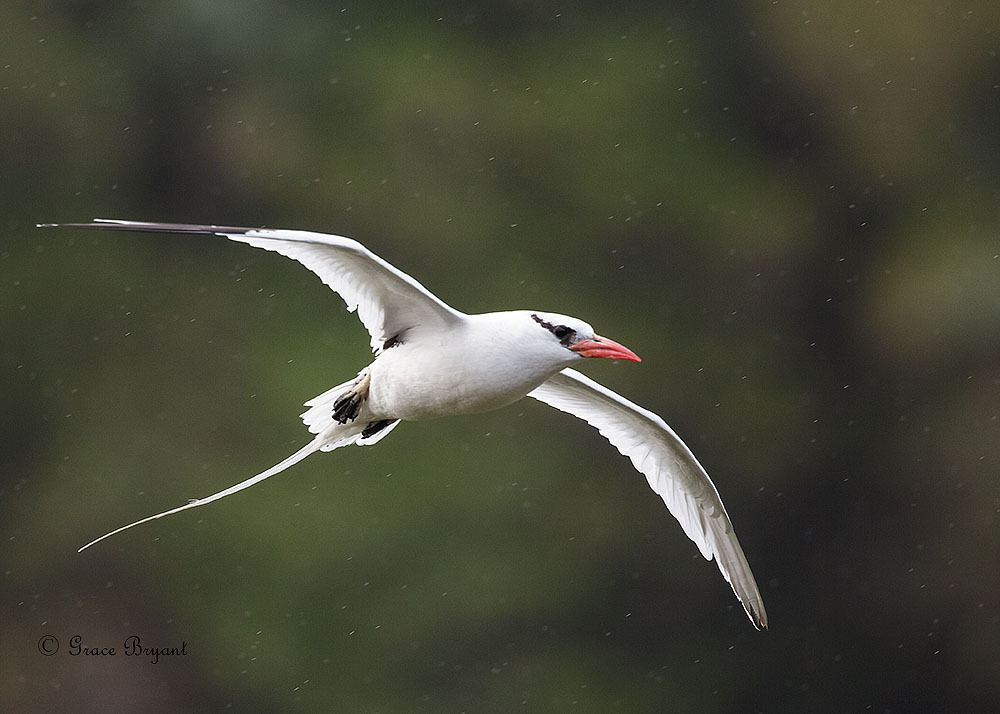
The red-billed tropicbird (Phaethon aethereus) is a tropicbird, one of three closely related species of seabird of tropical oceans. Superficially resembling a tern in appearance, it has mostly white plumage with some black markings on the wings and back, a black mask and, as its common name suggests, a red bill. Most adults have tail streamers that are about two times their body length, with those in males being generally longer than those in females. The red-billed tropicbird itself has three subspecies recognized, including the nominate. The subspecies mesonauta is distinguished from the nominate by the rosy tinge of its fresh plumage, and the subspecies indicus can be differentiated by its smaller size, more restricted mask, and more orange bill. This species ranges across the tropical Atlantic, eastern Pacific, and Indian Oceans. The nominate is found in the southern Atlantic Ocean, the subspecies indicus in the waters off of the Middle East and in the Indian Ocean, and the subspecies mesonauta in the eastern portions of both the Atlantic and the Pacific Oceans and in the Caribbean. It was one of the many species described by Carl Linnaeus in his 1758 10th edition of Systema Naturae.
Nesting takes place in loose colonies, as they nest a scrape found on a cliff face that is easy to take off from. A single egg is laid and is incubated by both sexes for about six weeks. Whether the egg hatches or not can be influenced by pollution and weather, although the latter has a minimal effect on whether a chick fledges or not.
From the article Red-billed tropicbird on Wikipedia (CC BY-SA), quoted section by section
Description
The red-billed tropicbird measures 90 to 105 cm (35 to 41 in) on average, which includes the 46 to 56 cm (18 to 22 in)-long tail streamers. Without them the tropicbird measures about 48 cm (19 in). It has a wingspan of 99 to 106 cm (39 to 42 in). In overall appearance it is tern-like in shape. Its plumage is white, with black wing tips, and a back that is finely barred in black. It has a black mask that extends up from just above the lores to the sides of its nape, with gray mottling usually seen near the nape and hindneck. The tail has black shaft streaks, as do tail streamers. The underparts are white, with some black on the outermost primaries and tertials and occasionally with black markings on the flanks. The iris is blackish-brown, and the bill is red. The legs, base of the central toe, and parts of the outer toes are orange-yellow while the rest of the feet are black. Although the sexes are similar, the males are generally larger than females, with the tail streamers being around 12 cm (4.7 in) longer on the male than on the female. The subspecies of this bird can usually be distinguished by their difference in size and plumage. The subspecies Phaethon aethereus mesonauta can be differentiated by its slightly rosy tinge when its plumage is fresh, the bolder look of the black barring on the upper wing, and the more solid look of the black on the outer wing. …
Range & habitat
The red-billed tropicbird has the smallest range of the three tropicbird species, yet it still ranges across the Neotropics, as well as the tropical Atlantic, eastern Pacific, and Indian oceans. The nominate subspecies Phaethon aethereus aethereus breeds on islands in the Atlantic south of the equator, including Ascension, and Saint Helena on the Mid-Atlantic Ridge, and Fernando de Noronha and Abrolhos Archipelago in Brazilian waters. It is a vagrant to the coastline of Namibia and South Africa. The subspecies P. a. mesonauta is found in the east Atlantic, the east Pacific, and in the Caribbean. This subspecies was restricted to the Cape Verde Islands in the eastern Atlantic but it has colonised the Canary Islands in the 21st century, especially Fuerteventura but also on other islands in that archipelago. The Indian Ocean subspecies, P. a. indicus is found in waters off Pakistan, western India, southwestern Sri Lanka, the Horn of Africa and Arabian Peninsula. The subspecies is also a rare but regular vagrant to Seychelles. Within the West Indies, this species is most common in the Lesser Antilles, Virgin Islands and small islands east of Puerto Rico. Breeding in the Western Palearctic occurs on the Cape Verde Islands and the Îles des Madeleines off Senegal. In 2000, the total number of pairs there was probably less than 150. …
Wikipedia: “Distribution and habitat”
What it does
The red-billed tropicbird can reach speeds of 44 kilometers per hour (27 mph) when flying out at sea, cruising a minimum of 30 meters (100 ft) above the sea. It cannot stand and is not proficient at walking, and requires an unobstructed takeoff to fly from land. Conversely it can lift off the sea without much effort. Its plumage is waterproof and it floats on water.
Breeding. The red-billed tropicbird usually nests on isolated cliff faces, in loose colonies. It uses a simple scrape nest, located in a place it can easily take off from. The age of first breeding is usually five years, although this age is variable; a three-year-old tropicbird was once seen breeding. In some locations, breeding happens year-round, while in others, breeding occurs seasonally. For example, for islands in the California Current, breeding starts in November or December, while it occurs year round in the Galápagos. Breeding is influenced by the availability of food, with an increase in food generally causing an increase in breeding. Individually, this bird only breeds every nine to twelve months. A breeding bird usually returns to its partner and nest location from the previous breeding cycle.
Courtship and pairing usually lasts three to five weeks, during which this bird performs aerial courtship displays to potential mates. …
Wikipedia: “Behavior”
In human culture
English naturalist Francis Willughby wrote about the red-billed tropicbird in the 17th century, having seen a specimen held by the Royal Society. It was one of the many bird species originally described by Linnaeus in the landmark 1758 10th edition of his Systema Naturae, and still bears its original scientific name, Phaethon aethereus. The genus name is derived from Ancient Greek phaethon, "sun" while the species name comes from Latin aetherius, "heavenly". This bird is called the red-billed tropicbird due to its red bill and its location in the tropicbird genus. An alternative common name was "bosun bird", also spelt "boatswain bird", from the similarity of its shrill call to a boatswain's whistle. An alternative derivation of the name is from the semblance of the tail feathers to marlin spikes. Local names used in the West Indies include "truphit", "trophic", "white bird", "paille-en-queue", "paille-en-cul", "flèche-en-cul", and "fétu". In a 1945 paper, American ornithologist Waldo Lee McAtee proposed it be called the barred-backed tropicbird after its most distinguishing feature. The red-billed tropicbird is basal (the earliest offshoot) in the genus Phaethon, the sole extant genus in the family Phaethontidae, the tropicbirds. …
Wikipedia: “Taxonomy and etymology”
Listen
Looking for field recordings…
Where it lives
Recorded sightings
—
geo-referenced records in GBIF, from museums, herbaria and field observers.
Drag the globe to turn it. Dots are where records exist, not a range map; darker means more records.
In the stacks
Searching the stacks…
Every page naming Phaethon aethereus in the Biodiversity Heritage Library →
This page is assembled live from iNaturalist, GBIF, Wikipedia, the Source Library and the Internet Archive. It is not yet part of the hand-edited codex. iNaturalist taxon 4317.