On eBird ↗
Ring-necked Pheasant
Live sightings near you, the range map, bar charts of when it is seen, and Macaulay Library photos and recordings.
Ring-necked Pheasant
Phasianus colchicus
The common pheasant (Phasianus colchicus), ring-necked pheasant, or blue-headed pheasant, is a bird in the pheasant family (Phasianidae). The genus name comes from Latin phasianus 'pheasant'. The species name colchicus is Latin for 'of Colchis' (modern day Georgia), a country on the Black Sea where pheasants became known to Europeans. Although Phasianus was previously thought to be closely related to the genus Gallus, the genus of junglefowl and domesticated chickens, recent studies show that they are in different subfamilies, having diverged over 20 million years ago.
It is native to Asia, where it is widespread, and also to the extreme southeast of Europe in the northern foothills of the Caucasus Mountains. It has been widely introduced elsewhere as a game bird. In parts of its range, mainly in places where none of its relatives occurs such as in Europe, where it is naturalised, it is simply known as the pheasant. Ring-necked pheasant is both the collective name for a number of subspecies and their intergrades that have white neck rings and the name used for the species as a whole in North America.
From the article Common pheasant on Wikipedia (CC BY-SA), quoted section by section
Description
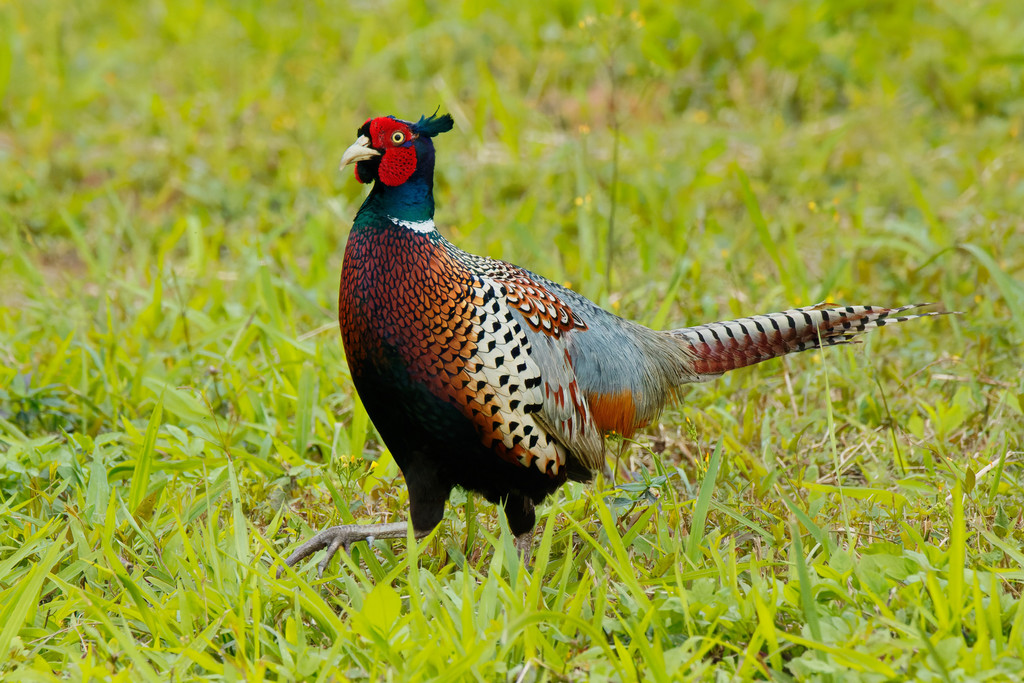
There are many colour forms of the male common pheasant, ranging in colour from nearly white to almost black in some melanistic examples. These are due to captive breeding and hybridisation between subspecies and with the green pheasant, reinforced by continual releases of stock from varying sources to the wild. For example, the "ring-necked pheasants" common in Europe, North America and Australia do not pertain to any specific taxon, they rather represent a stereotyped hybrid swarm. Body weight can range from 0.5 to 3 kg (1 to 7 lb), with males averaging 1.2 kg (2 lb 10 oz) and females averaging 0.9 kg (2 lb 0 oz). Wingspan ranges from 56–86 cm (22–34 in). The adult male common pheasant of the nominate subspecies Phasianus colchicus colchicus is 60–89 cm (23+1⁄2–35 in) in length with a long brown streaked black tail, accounting for almost 50 cm (20 in) of the total length. The body plumage is barred bright gold or fiery copper-red and chestnut-brown plumage with iridescent sheen of green and purple; but rump uniform is sometimes blue. The wing coverage is white or cream and black-barred markings are common on the tail. The head is bottle green with a small crest and distinctive red wattle. P. c. colchicus and some other races lack a white neck ring. …
Range & habitat
Common pheasants are native to Asia and parts of Europe, their original range extending from the eastern Black Sea and the Caspian Sea to Manchuria, Siberia, Korea, Mainland China, and Taiwan. Southern Caucasian pheasants (P. c. colchicus) were common in Greece during the classical period and it is a widespread myth that the Greeks took pheasants to the Balkans when they colonised Colchis in the Caucasus. This colonisation happened during the 6th century BC, but pheasant archaeological remains in the Balkans are much older dating to 6th millennium BC. This fact indicates that probably pheasants reached the area naturally. Additionally it seems that they had a continuous range in Turkey from the Sea of Marmara on the edge of the Balkans, across the northern shore of the country till Caucasus. The last remnants of the Balkan population survive in the Kotza-Orman riparian forest of Nestos, in Greece with an estimated population of 100–200 adult birds. In Bulgaria they were lost in the 1970s because they hybridised with introduced eastern subspecies. Besides the Balkans the species lives in Europe in the area north of Caucasus where the local subspecies P. c. septentrionalis survives pure around the lower reaches of the Samur River. Reintroduction efforts in the rest of the north Caucasian range may include hybrid birds.
Introduced populations. …
Wikipedia: “Distribution”
What it does
These birds are found in woodland, farmland, scrub, and wetlands. In their natural habitat, common pheasants live in grassland near water with small copses of trees, and are tolerant of both dry and humid soils. Extensively cleared farmland, however, is marginal habitat that cannot maintain self-sustaining populations for long.
Common pheasants are gregarious birds and outside the breeding season form loose flocks. However, captive bred common pheasants can show strong sexual segregation, in space and time, with sex differences in the use of feeding stations throughout the day. Wherever they are hunted they are always timid once they associate humans with danger, and will quickly retreat for safety after hearing the arrival of hunting parties in the area. They eat a wide variety of animal and vegetable type-food. Vegetable forage includes fruit, seeds, grain, mast, berries and leaves, while animal food includes a wide range of invertebrates, such as slugs, earthworms, leatherjackets, ant eggs, wireworms, caterpillars, grasshoppers and other insects. Small vertebrates like lizards, field voles, other small mammals, and small birds are occasionally taken. While common pheasants are able short-distance fliers, they prefer to run. …
Wikipedia: “Ecology”
How it is grown
Pheasant farming is a common practice and is frequently done intensively, with serious adverse impacts on native species. Birds are supplied both to hunting preserves/estates and restaurants, with smaller numbers being available for home cooks. In the United Kingdom, about 50 million pheasants reared in captivity are released each summer, a number which has significantly increased since the 1980s. Most of these birds are shot during the open season (1 October to 1 February), and few survive for a year. The result is a wildly fluctuating population, from 50 million in July to less than 5 million in June.
Management strategies. A variety of management strategies have been suggested for areas that are home to species that are particularly threatened by pheasants, such as the prairie chickens and grey partridge. These strategies include mowing grass to decrease the nesting cover preferred by pheasants, decreasing pheasant roosting habitat, shooting pheasants in organised hunts, trapping and removing them from areas where there are high concentrations of birds of threatened species, and others. While pheasant populations are not in any danger in the United States, they have been decreasing over the last 30 years, largely in agricultural areas. …
Wikipedia: “Cultivation”
Listen
Looking for field recordings…
Where it lives
Recorded sightings
—
geo-referenced records in GBIF, from museums, herbaria and field observers.
Drag the globe to turn it. Dots are where records exist, not a range map; darker means more records.
In the stacks
Searching the stacks…
Every page naming Phasianus colchicus in the Biodiversity Heritage Library →
This page is assembled live from iNaturalist, GBIF, Wikipedia, the Source Library and the Internet Archive. It is not yet part of the hand-edited codex. iNaturalist taxon 981.