- Animals
- ›Chordates
- ›Vertebrates
- ›Cartilaginous Fishes
- ›Sharks and Rays
- ›Rays
- ›Stingrays
- ›Whiptail Stingrays
- ›Whiprays and allies
- ›Himantura
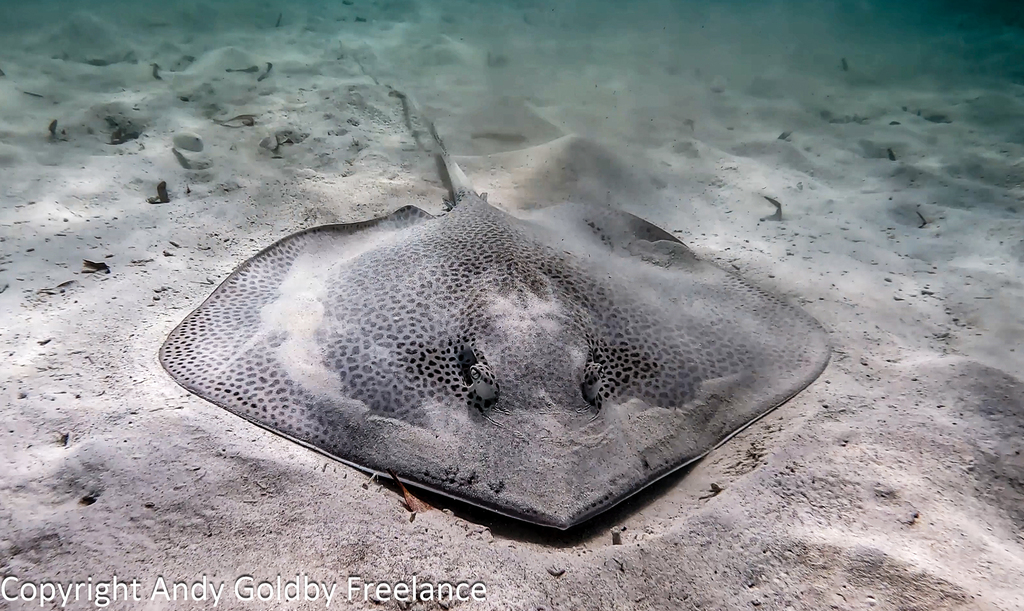
Reticulate Whipray
Himantura uarnak
The reticulate whipray or honeycomb stingray (Himantura uarnak) is a species of stingray in the family Dasyatidae. It inhabits coastal waters in the western Indian Ocean including the Red Sea, Natal and the Arabian Sea; also a Lessepsian transmigrant in the eastern Mediterranean. A large species reaching 2 m (6.6 ft) in width, the reticulate whipray has a diamond-shaped pectoral fin disc and an extremely long tail without fin folds. Both its common and scientific names refer to its ornate dorsal color pattern of many small, close-set dark spots or reticulations on a lighter background. However, the reticulate whipray is only one of several large spotted stingrays in the Indo-Pacific which, coupled with the variability of its coloration with age and locality, has resulted in a great deal of taxonomic confusion.
Often encountered resting on the bottom during daytime, the reticulate whipray is a predator of bottom-dwelling invertebrates and bony fishes. Like other stingrays, it is aplacental viviparous, with the developing embryos nourished at first by yolk and later by histotroph ("uterine milk"). Females bear litters of up to five pups in summer, following a gestation period of a year. The reticulate whipray is fished in parts of the Indian Ocean for meat, skin, cartilage, and other purposes. It is highly susceptible to population depletion because of its large size, inshore habits, and low reproductive rate, and is additionally threatened by extensive habitat degradation.
From the article Reticulate whipray on Wikipedia (CC BY-SA), quoted section by section
Description
The pectoral fin disc of the reticulate whipray is diamond-shaped and wider than long, with the leading margins almost straight and the snout and outer corners quadrangular. The pectoral fin apex is narrowly rounded with the anterior margin almost straight. In juveniles, the disc is about as wide as long, with a more obtuse snout and rounded corners. The eyes are small and have a small interorbital diameter. Immediately following the eyes lie the spiracles which are paired respiratory openings. A short and wide curtain of skin with a minutely fringed rear margin is present between the long, thin nostrils. The mouth is relatively small, with a deep concavity at the center of the lower jaw and shallow furrows at the corners extending onto the lower jaw. A row of 4–5 papillae (nipple-like structures) is found across the floor of the mouth. There are 26–40 upper tooth rows and 27–44 lower tooth rows. The pelvic fins are small and triangular. The tail is whip-like and extremely thin, measuring 3–3.5 times as long as the disc when intact, and lacks fin folds. Usually one serrated stinging spine is located on the upper surface on the tail, some distance from the base. Adult rays have a wide band of flattened, heart-shaped dermal denticles that extend from between the eyes to the tail spine, increasing in density with age, along with two large pearl thorns at the center of the back. …
Range & habitat
Habitat of the reticulate whipray includes coral reefs, brackish water and marine environments. Within these ecosystems they can be found inshore and on soft substrates. Distribution occurs in the North of Taiwan, the Western Indian Ocean (mainly in Malaysia, Myanmar, Indo-Pacific), The Red Sea, west to the Natal in South Africa, and the Arabian Sea. It also entered 30 years ago the Mediterranean Sea through the Suez Canal and it is now common in the south eastern Mediterranean. The recently described H. australis formerly confused with H. uarnak seems to be common only in Australian waters, where it occurs from Shark Bay to Brisbane. Bottom-dwelling in nature, the reticulate whipray is generally encountered over sandy flats near beaches, in lagoons, and around coral reefs, from the intertidal zone to offshore waters 50 m (160 ft) deep or more. These microhabitats (intertidal sand flats, shallow subtidal sand flats and seagrass beds) are found to be shifted in use between warm and cold seasons. In Shark Bay, it frequents intertidal sand flats during the warm season, and shifts to slightly deeper seagrass patches in the cold season. This species is tolerant of low salinities and has been known to enter estuaries and mangrove swamps, though records from fresh water in Southeast Asia are unverified and may represent misidentifications. …
Wikipedia: “Distribution and habitat”
What it does
During the day, the reticulate whipray is generally inactive and spends much time resting motionless on the sea floor, sometimes buried in sand. In Shark Bay, Western Australia, this ray can be found resting singly or in small groups in very shallow water during high tide. Life history in shallow, bright light conditions have evolved the ray's sight to specialize for photopic vision. These eyes contain a concentration of ganglion cells, cones and spatial resolving power that indicate color vision, elongated horizontal specialization of visual acuity.
A lateral line is present on the ray and extends to the tip of its extremely long tail, giving it advance warning of approaching predators such as bottlenose dolphins (Tursiops aduncus) and hammerhead sharks (Sphyrna). A few extremely rare encounters have documented dolphins being injured, even killed, from wounds caused from a reticulate whipray's barbs found inserted within porpoise's sides. These encounters are theorized to most likely occur in shallow shore feeding sites where Himantura uarnak tend to reside. Severity of reaction to barbule wounds is not considered to be correlated to the age or size of the whipray. As the whiprays age, there is a higher chance of losing the venom glands and the spine's protective sheath on the individual. …
Wikipedia: “Biology and ecology”
Where it lives
Recorded sightings
—
geo-referenced records in GBIF, from museums, herbaria and field observers.
Drag the globe to turn it. Dots are where records exist, not a range map; darker means more records.
In the stacks
Searching the stacks…
Every page naming Himantura uarnak in the Biodiversity Heritage Library →
This page is assembled live from iNaturalist, GBIF, Wikipedia, the Source Library and the Internet Archive. It is not yet part of the hand-edited codex. iNaturalist taxon 102778.