 NL·0243
Herbarium of the Nature Library
- Name
- Aetobatus narinari
- Family
- Aetobatidae
- Native to
- Western and central Atlantic from North Carolina to Brazil, including the Gulf of Mexico and Caribbean; Indo-Pacific populations are now split into other species
- Habitat
- Coastal waters, Coral reef, Seagrass, Sandy seabeds
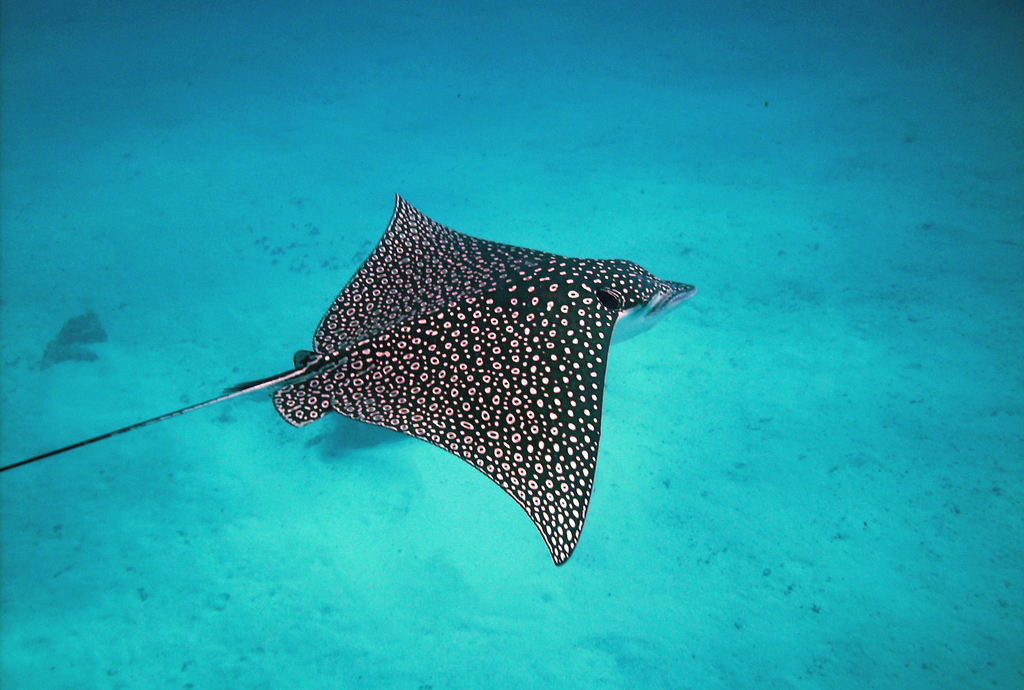
Spotted eagle ray
Aetobatus narinari
Also calledWhitespotted eagle ray · Chucho pintado (Spanish) · Raie léopard (French) · Raia-chita (Portuguese)
A graceful ray with a white-spotted dark back and a duck-billed snout, often seen 'flying' in groups over Atlantic reefs. Its jaws crack clams and conchs with plate-like teeth.
The spotted eagle ray is a cartilaginous fish of the eagle ray family, Aetobatidae. As traditionally recognized, it is found globally in tropical regions, including the Atlantic, Pacific, and Indian Oceans. Recent authorities have restricted it to the Atlantic with other populations recognized as the ocellated eagle ray and Pacific white-spotted eagle ray. Spotted eagle rays are most commonly seen alone, but occasionally swim in groups. They are ovoviviparous, the female retaining the eggs then releasing the young as miniature versions of the parent. Wikipedia
What it can do
- iCrushes hard-shelled molluscs with fused, chevron-shaped tooth plates
- iiDigs prey from sand using its shovel-like snout
- iiiLeaps clear of the water, sometimes landing in boats
- ivCarries one to several venomous barbed spines at the base of its long tail
In the field
Field marks
- aDark blue-black to grey back densely covered with white spots or rings
- bPointed, wing-like pectoral fins
- cProtruding duck-bill snout with a flat, rounded tip
- dVery long, whip-like tail, often 2–3 times disc width
- Not to be confused with
- Southern stingray lacks spots and has a rhomboid disc with no protruding head; cownose ray has a notched, two-lobed forehead and plain brown back.
- Where to see it
- Bonaire, Cozumel, Belize, Florida Keys, Bermuda
- When
- Year-round; Florida's Sarasota coast May–Oct
Life & habits
- Diet
- Clams, oysters, conchs, whelks, shrimp, crabs
- Habitat
- Shallow coastal waters, bays, reefs and lagoons to about 80 m
- Size
- Disc width up to about 3 m
- Lifespan
- Up to about 25 years
Often swims in loose groups, sometimes in schools of dozens, cruising near the surface or over sand flats.
Where it lives
Recorded sightings
—
geo-referenced records in GBIF, from museums, herbaria and field observers.
Native range
Western and central Atlantic from North Carolina to Brazil, including the Gulf of Mexico and Caribbean; Indo-Pacific populations are now split into other species
Drag the globe to turn it. Dots are where records exist, not a range map; darker means more records.
In the old herbals & bestiaries
Woodcuts and engravings matched from the Source Library’s scanned books by name. Plates marked “relative” show a close kin rather than this exact species. Click a plate to read the page it came from, with translation.


In the stacks
Searching the stacks…
Every page naming Aetobatus narinari in the Biodiversity Heritage Library →
Marginalia
The species name narinari comes from a Tupi-Guarani name recorded by Georg Marcgrave in his Historia Naturalis Brasiliae (1648).
Curiosity
In 2008 a leaping spotted eagle ray struck and killed a boater in the Florida Keys, one of very few such deaths ever recorded.
Kinship




Photographs: iNaturalist contributors under the licences shown. Records: GBIF.org. Historical plates: Source Library (CC BY-SA 4.0; originals public domain). Summary text: Nature Library editors and Wikipedia (CC BY-SA). Medicinal and edibility notes are historical and educational, not advice. iNaturalist taxon 49297.